
How to Identify the Tunisia 1 Franc
A collector's guide to identifying the French-protectorate Tunisia 1 franc by its TUNISIE wreath obverse, 'BON POUR 1 FRANC' Arabic reverse, and golden aluminum-bronze.
Read the full Tunisia 1 Franc encyclopedia entry →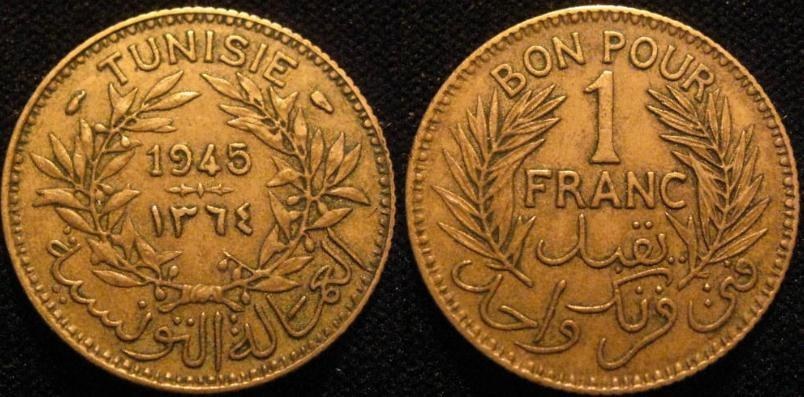
What This Coin Is
The Tunisia 1 franc is a small golden aluminum-bronze coin of the French Protectorate of Tunisia. Identification centers on a bilingual layout: a French obverse naming 'TUNISIE' with a wreath and a Gregorian year, and a reverse that states the value as 'BON POUR 1 FRANC' beside Arabic script. The example shown is dated 1945.
Reading the Obverse
The obverse carries the country name 'TUNISIE' and a four-digit year — 1945 on this coin — presented with a wreath of leaves. Read the year carefully, since the same design was used across more than one date in the protectorate series. The French country name, rather than a ruler's portrait, is the key marker; protectorate Tunisian coins of this era are typically non-figural, in keeping with local convention.
Reading the Reverse
The reverse is the strongest attribution point. It reads 'BON POUR 1 FRANC' in French — literally 'good for 1 franc' — paired with Arabic lettering that names the Tunisian state and usually carries an Islamic (AH) date matching the Christian year. Confirm the numeral reads '1 FRANC'; the same 'bon pour' formula appears on other Tunisian franc values, so the digit and word together separate the 1 franc from the 2 francs and fractional pieces.
Size, Metal, and Fabric
This is a small, light coin struck in aluminum-bronze, giving it a warm golden or brassy tone rather than the white of silver or the red-brown of copper. Weigh and measure any candidate and compare against published specifications for the Tunisian franc series; a coin markedly off in diameter or weight, or one that looks like plain silver-colored metal, warrants a second look. Genuine examples often show light spotting or darkening consistent with aged aluminum-bronze.
Look-Alikes and Authentication Cautions
The closest look-alikes are the other 'BON POUR' Tunisian franc denominations and contemporary French and French-colonial aluminum-bronze coins that share the same alloy and general style — so always read the full value and the 'TUNISIE' legend rather than judging by color and size alone. Because this is an inexpensive base-metal type, outright forgery is uncommon, but watch for corrosion, cleaning, tooling, and misread dates. For a coin whose grade might carry a premium, match it against a standard catalog of Tunisian coinage or seek a specialist opinion before paying up.
Frequently asked questions
How do I tell the 1 franc from the 2 francs or fractional pieces?
They share the 'BON POUR' formula, so read the value directly — the 1 franc states 'BON POUR 1 FRANC' — and compare size and weight, since the denominations differ in diameter.
Does the coin show a ruler's portrait?
No. Protectorate-era Tunisian franc coins of this type are non-figural, relying on the 'TUNISIE' legend, wreath, value statement, and Arabic script rather than a bust for identification.
How can I confirm the metal is aluminum-bronze?
Look for a warm golden or brassy color rather than white silver or red copper, and check the weight against published specifications; aluminum-bronze coins are light and often show light spotting with age.
What are the main things that reduce this coin's value?
Heavy wear, corrosion or verdigris, harsh cleaning, tooling, and dark or blotchy surfaces all lower value; original golden color and sharp wreath and legend detail raise it.