
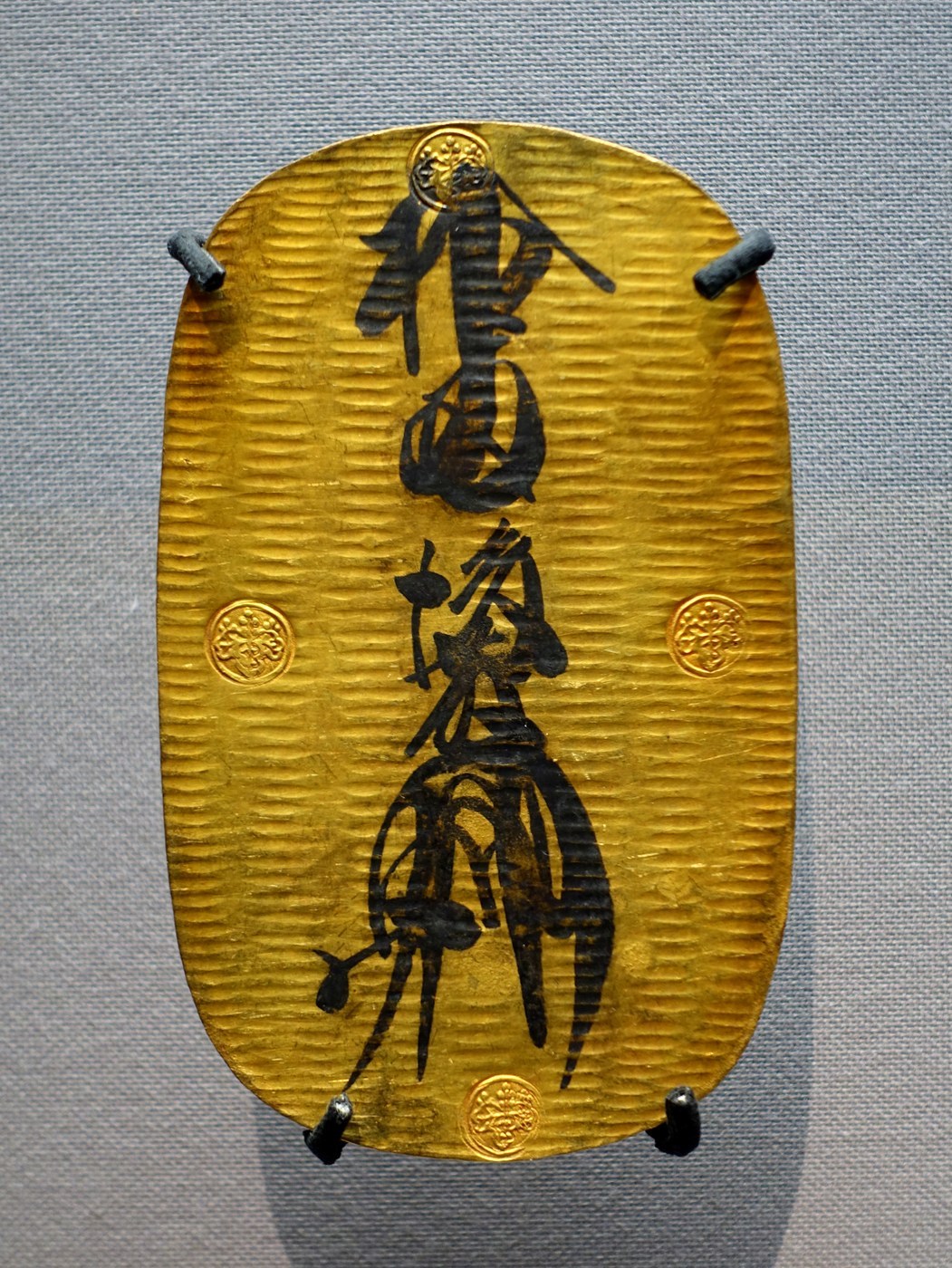
Keicho Koban
A thin oval Japanese gold coin worth one ryo, its surface covered in fine parallel striations with stamped cartouches and Goto mint marks.
- Country
- Japan
- Denomination
- Koban (one ryo)
- Metal
- Gold
Got a coin like this?
Identify any coin from a photo, free.
Overview
The coin pictured is a Keicho Koban (慶長小判), a gold oval coin issued by the early Tokugawa shogunate and valued at one ryo. It is a thin, flat, hand-worked plate of gold with rounded ends, not a round struck coin. Its most recognizable feature is a surface entirely covered in fine, closely spaced parallel striations (hammered chisel lines), across which official stamps were then punched.
On the obverse the striated field carries stamped cartouches with Japanese characters, including the denomination and fan-shaped crest stamps at the top and bottom. The reverse shows the same striated ground with circular seal stamps and the mint master's marks, which served as the guarantee of the issuing authority.
The Keicho Koban belongs to the family of Japanese "koban" gold pieces, the standard high-value gold currency of the Edo period. The Keicho issue is the first and among the purest of these koban, prized for its comparatively high gold content and its place at the very start of the Tokugawa monetary system.
History & Background
The Keicho Koban was introduced under Tokugawa Ieyasu around the start of the 17th century, in the Keicho era, as part of the new unified coinage that underpinned the Tokugawa shogunate. It replaced the patchwork of regional and warlord gold monies of the preceding Azuchi–Momoyama period with a standardized shogunal gold coin of fixed denomination.
Production of the koban was entrusted to the kinza, the official gold mint, run under the hereditary supervision of the Goto family, whose master's signature and monogram appear as guarantee marks on the coins. The koban's value of one ryo made it the workhorse of large gold transactions, while the much larger oban served ceremonial and high-value roles.
The Keicho Koban circulated until it was superseded by later koban issues, beginning with the debased Genroku koban late in the 17th century. Because subsequent koban were repeatedly reduced in gold content to stretch the government's finances, the early Keicho coins stand out historically as the high-purity benchmark of the series and a symbol of the early Edo economy.
How to Identify
Identify a Keicho Koban first by shape and material: a thin, flat gold oval with rounded ends, hand-hammered rather than struck between dies. The entire face is worked with fine parallel striations (the goza-me hammer lines), a hallmark texture of Japanese koban that a plain oval blank would lack.
Read the stamped marks. The obverse bears fan-shaped crest stamps near the top and bottom and a central inscription giving the denomination and issue, punched into the striated field. The reverse carries circular seal stamps and the signature and monogram (kao) of the Goto mint master, which functioned as the official assay guarantee. Genuine stamps are crisp punches set into, not merely printed on, the metal.
Distinguish the koban (one ryo, palm-sized oval) from the much larger oban, which is a bigger oval bearing a brush-written ink inscription across its face. Size, weight, purity, and the exact configuration of the stamps are what specialists use to place a koban within the Keicho, Genroku, and later series, since all share the same basic oval, striated form.
Value & Collectibility
Genuine Keicho Koban are scarce and valuable historic gold coins. As the earliest and among the purest koban, they are sought after by collectors of Japanese and world gold, and authentic examples typically trade in the high hundreds to several thousands of dollars and up, with exceptional pieces reaching well into the five figures at auction.
Value depends on authenticity, gold content, condition, the clarity of the stamps, and the specific sub-variety. A coin with sharp striations, legible cartouches, and clear Goto mint marks is worth far more than a worn, bent, or damaged plate. Because it is a soft, thin gold object, creasing, clipping, and test marks are common and reduce value.
Critically, the Keicho Koban is one of the most heavily reproduced coins in the world: countless brass, gilt, and modern souvenir "koban" exist, most worth little or nothing. Any coin offered as a genuine Keicho Koban should be weighed, assayed, and ideally authenticated by a specialist or grading service before purchase, as the price gap between a real piece and a replica is enormous.
Frequently asked questions
What is a Keicho Koban worth?
A genuine Keicho Koban is a scarce gold coin that generally ranges from the high hundreds to several thousand dollars, with fine examples reaching well into the five figures at auction. Value depends on authenticity, gold content, condition, and the clarity of the stamps. Most so-called koban sold cheaply are modern replicas.
How much gold is in a Keicho Koban?
The Keicho Koban is a high-purity gold coin, notably purer than the debased koban issued later in the Edo period. It was valued at one ryo. Exact fineness and weight vary by sub-type, so a genuine piece should be weighed and assayed rather than assumed.
Why is the surface covered in lines?
The fine parallel striations are hammered chisel marks (goza-me) worked into the gold as part of manufacture, and they are a hallmark of authentic Japanese koban. Official stamps and cartouches were then punched across this striated field.
What is the difference between a koban and an oban?
Both are oval Japanese gold coins. The koban is the smaller, palm-sized one-ryo piece with punched stamps, while the oban is a much larger, higher-value oval that carries a brush-written ink inscription across its face.
Is my koban real or a replica?
Replicas are extremely common and are usually brass or gilt rather than solid gold. Check the weight and metal, look for crisp punched stamps and genuine striations, and be cautious of lightweight, shiny, or suspiciously cheap pieces. Have any candidate authenticated by a specialist.
Keicho Koban guides
In-depth guides for identifying, valuing, and collecting Keicho Koban.
Other coins you may enjoy
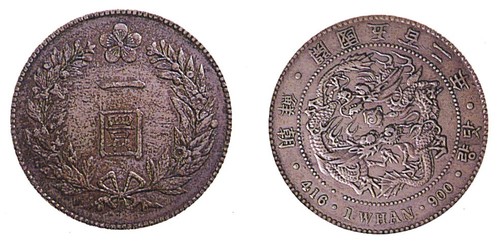
1 Hwan
Taegeuk era, late 1800s
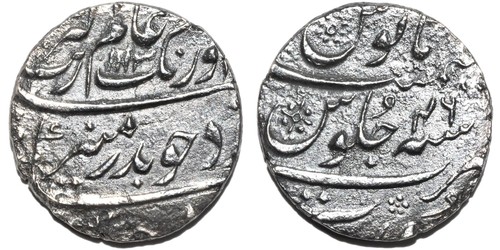
Mughal Rupee (Akbar)
AH 1003 (AD 1594)
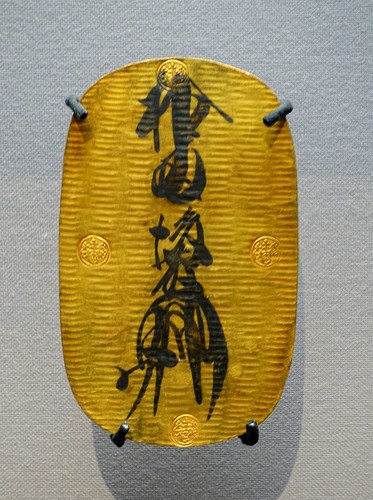
Keicho Oban
Late 1500s to early 1600s AD (Azuchi-Momoyama to early Edo period)
Mughal Quarter-Rupee
Ilahi 47 (AD 1602-1603)
Double Rupi
AH 1151 (AD 1738-1739)
Aratame Sanbu Sadame
Dated 1859 (Ansei 6); round dragon-and-sun pieces are widely encountered as later reproductions
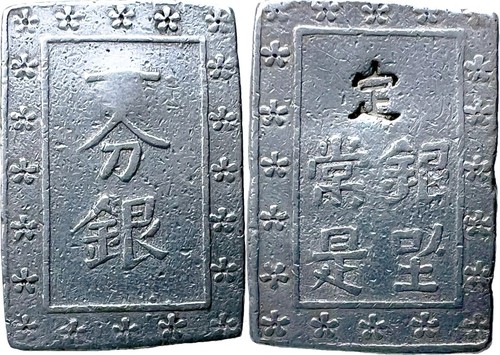
1 Bu Gin
Meiji 1 (1868-1869)
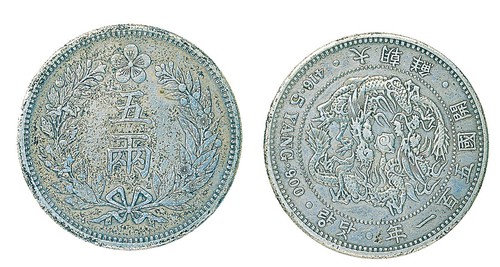
5 Yang
Late Joseon reform coinage, late 1800s (Gaeguk / Taegeuk era)