
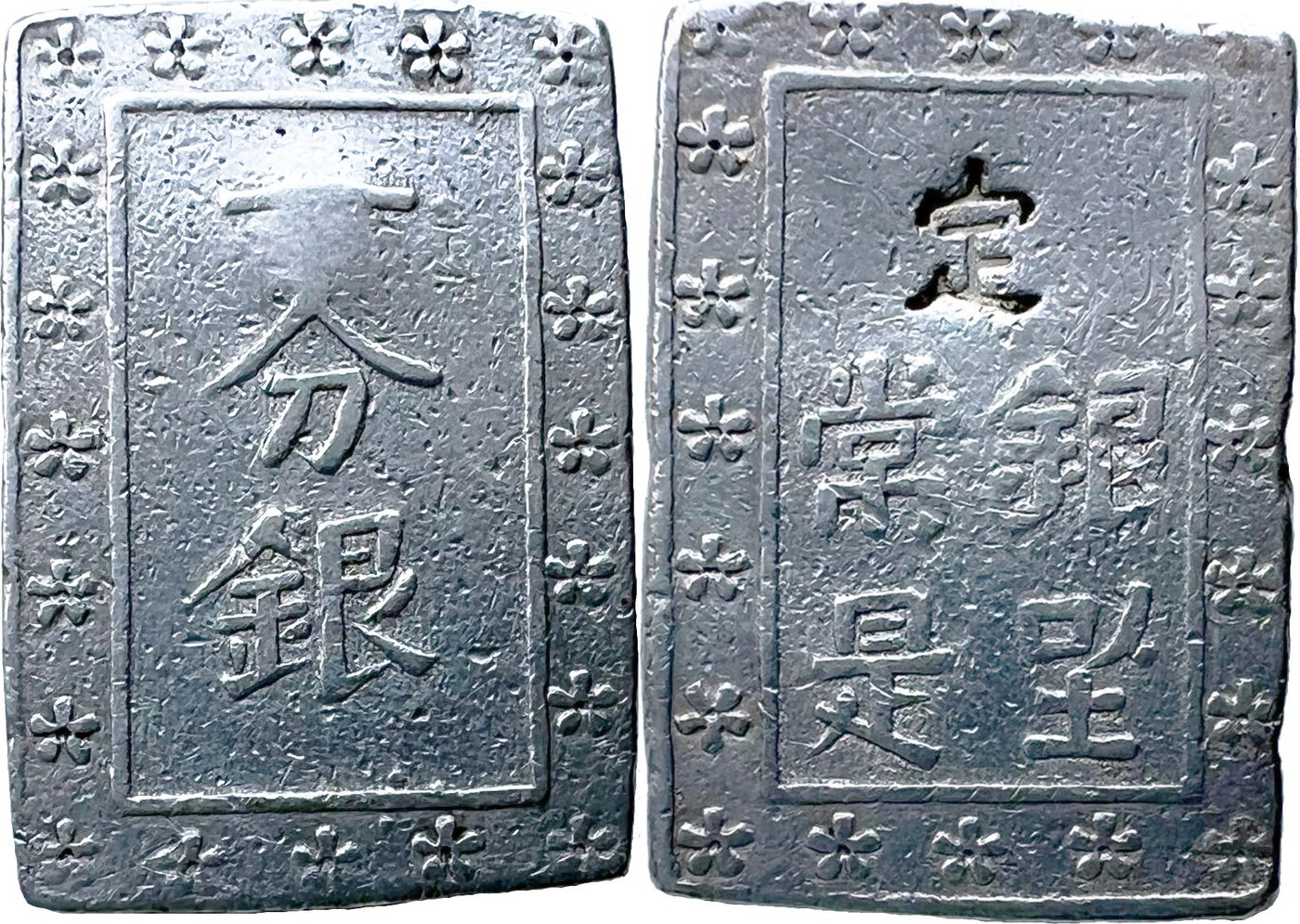
1 Bu Gin
A small rectangular Japanese silver coin, the ichibu gin, worth one bu (a quarter ryo), bearing beaded borders, paulownia crests and Ginza inscriptions.
- Country
- Japan
- Denomination
- 1 Bu
- Metal
- Silver
Got a coin like this?
Identify any coin from a photo, free.
Overview
The 1 Bu Gin (Japanese ichibu gin, 一分銀, "one-bu silver") is a small rectangular silver coin of Japan's late Edo and early Meiji period. Rather than a round disc, it is a flat oblong bar of silver, a distinctive format that sets Japanese pre-modern coinage apart from most world money.
The example pictured is dated to the Meiji 1 era (1868-1869), the very start of the Meiji Restoration, when this long-running coin type was still being struck. One face carries geometric patterns within a beaded, decorative border; the other bears Japanese characters framed by ornamental crest and floral motifs. These devices, together with the stamped inscriptions, identify it as an official Ginza silver issue.
In Japan's old monetary system the bu (分) was a unit of account: four bu made one ryo, so the ichibu gin represented a quarter of a ryo. It circulated as everyday larger-value silver money alongside gold and copper pieces, and today it is collected as a tangible relic of Japan's transition from the samurai era to a modern state.
History & Background
Rectangular silver bu coins were a fixture of the Tokugawa (Edo) monetary system, which combined gold, silver and copper money under the shogunate. The ichibu gin denomination was issued in several series from the early nineteenth century onward, struck at the official Ginza ("silver mint") that controlled silver coinage. Each piece was a guaranteed weight and fineness of silver stamped with the mint's marks.
The Meiji 1 (1868-1869) dating of this example places it at a pivotal moment: the fall of the Tokugawa shogunate and the founding of the new imperial Meiji government. Production of the older rectangular silver coins continued briefly into these first Meiji years before Japan overhauled its currency. In 1871 the Meiji government introduced the yen on a modern decimal, milled-coin standard, which retired the traditional ryo-bu-shu system and the rectangular silver pieces along with it.
Because the ichibu gin was made over an extended span with continuing designs, individual pieces are attributed by their inscriptions and mint marks rather than by a single year. The type as a whole documents the final decades of Japan's pre-modern money before Western-style coinage took hold.
How to Identify
Identify the 1 Bu Gin first by format and metal: it is a small, flat rectangular bar of silver, not a round coin, typically only a couple of centimeters on its long side and comfortably hand-held. The corners are squared and the surfaces are stamped rather than milled.
One face shows a field of fine geometric or hatched patterning enclosed by a raised, beaded (dotted) border — the ornamental ground seen in the obverse photograph. The other face carries vertical Japanese characters that state the denomination and mint, framed by decorative crest and floral devices (the paulownia-style crest and foliate motifs visible on the reverse). The denomination character group reads as ichibu gin (one-bu silver), and additional inscriptions reference the Ginza silver authority.
Use the combination of rectangular shape + silver color + beaded border + Japanese characters with crest motifs to separate the ichibu gin from its relatives. Larger rectangular silver pieces (such as the nishu or * nibu* silver) and the smaller gold bu and shu coins share the oblong format but differ in size, inscription and metal. Precise sub-type and era are read from the exact characters and stamps, best confirmed against specialized Japanese coin references.
Value & Collectibility
As a historic silver coin with genuine collector demand, the 1 Bu Gin generally trades in an affordable-to-moderate collectible range. Many circulated examples are relatively available because the type was produced in quantity over many years, so worn but honest pieces tend to sit toward the lower end, while sharply struck coins with clear inscriptions and original surfaces command higher prices.
Value is driven by condition, sharpness of the stamped design, sub-type and eye appeal rather than by silver content alone, since each piece contains only a small amount of metal. Scarcer varieties and pieces in exceptional preservation can bring a notable premium over common circulated coins.
Because the type spans several series and grading swings prices widely, treat any single figure with caution and compare against recent sales of the same variety and grade. For higher-value examples, third-party authentication and grading add confidence, as rectangular Japanese silver has been reproduced.
Frequently asked questions
Why is the 1 Bu Gin rectangular instead of round?
Traditional Japanese silver coinage of the Edo and early Meiji period used flat rectangular bars stamped with official marks, rather than round struck discs. The ichibu gin follows that format, which is one of its most recognizable features.
What does "1 bu" mean?
The bu was a unit of Japan's old money system. Four bu equaled one ryo, so a 1 bu coin was worth a quarter of a ryo. The ichibu gin is the silver coin representing that one-bu value.
Is it made of real silver?
Yes. The ichibu gin is a genuine silver coin issued by the Ginza (Japan's official silver mint), though each small piece contains only a modest amount of metal, so its value comes mainly from its collector interest.
What are the motifs on the coin?
One face has a geometric pattern inside a beaded border; the other shows Japanese characters giving the denomination and mint, framed by crest and floral devices such as the paulownia-style crest. These are official design elements, not later additions.
How old is a Meiji 1 example?
Meiji 1 corresponds to 1868-1869, the first year of the Meiji era and the start of the Meiji Restoration. A coin of this dating comes from the final period of Japan's traditional coinage, just before the yen was introduced in 1871.
1 Bu Gin guides
In-depth guides for identifying, valuing, and collecting 1 Bu Gin.
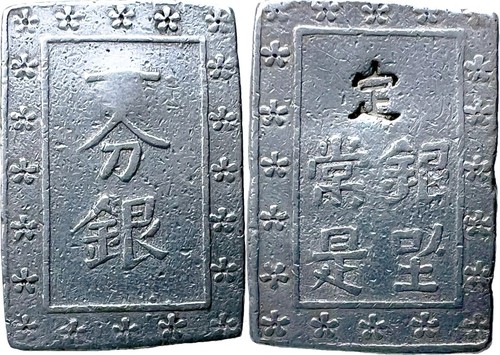
Other coins you may enjoy
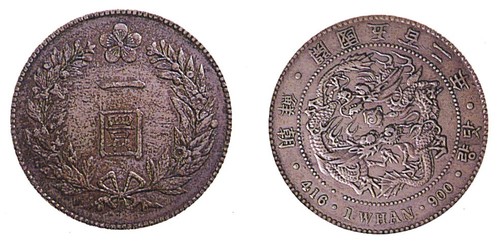
1 Hwan
Taegeuk era, late 1800s
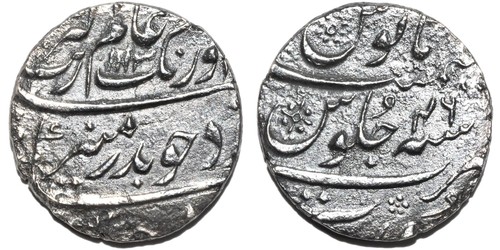
Mughal Rupee (Akbar)
AH 1003 (AD 1594)
Keicho Oban
Late 1500s to early 1600s AD (Azuchi-Momoyama to early Edo period)
Keicho Koban
Early Edo period, Keicho-era coinage (c. 1601 onward, 17th century)
Mughal Quarter-Rupee
Ilahi 47 (AD 1602-1603)
Double Rupi
AH 1151 (AD 1738-1739)
Aratame Sanbu Sadame
Dated 1859 (Ansei 6); round dragon-and-sun pieces are widely encountered as later reproductions
5 Yang
Late Joseon reform coinage, late 1800s (Gaeguk / Taegeuk era)