
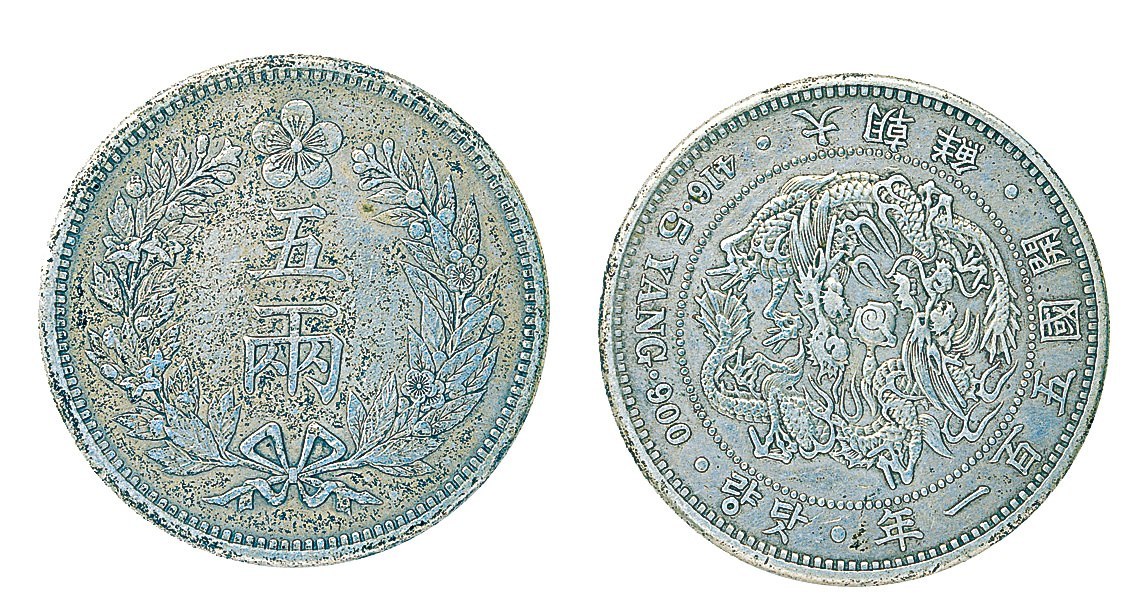
5 Yang
A late-Joseon Korean 5 Yang in bronze: a floral, chrysanthemum-and-taegeuk obverse paired with a coiled dragon and ornamental characters on the reverse.
- Country
- Korea (Joseon)
- Denomination
- 5 Yang
- Metal
- Bronze
Got a coin like this?
Identify any coin from a photo, free.
Overview
The coin pictured is a Korean 5 Yang from the late Joseon period, struck in bronze. One face carries a floral, heraldic design centered on chrysanthemums, the ornamental style typical of Korea's reform-era coinage; the opposite face shows a coiled dragon surrounded by ornamental characters stating the value and issuing authority.
The yang (兩) was the unit at the heart of the monetary reforms Korea adopted in the closing decades of the nineteenth century, when the kingdom moved from cast cash coins toward Western-style struck coinage. The 5 Yang sits among the higher denominations of that system, and its dragon motif ties it to the East Asian numismatic tradition shared with Qing China and Meiji Japan.
As a struck bronze piece of the Taegeuk/Gaeguk era, it is collected as a compact emblem of a Korea in rapid transition, its imagery blending native floral ornament, the taegeuk (yin-yang) symbol, and the imperial dragon.
History & Background
For most of the Joseon dynasty Korea used cast bronze cash coins with a central square hole, most famously the sangpyeong tongbo. In 1892 the government launched a new machine-struck coinage denominated in the yang, using modern presses and Western-influenced designs. Coins of this reform were dated by the Gaeguk (開國) era, which counts from the traditional founding of the Joseon dynasty in 1392, and many bore the taegeuk national emblem.
The reform introduced a graduated set of denominations, of which the 5 Yang was one of the larger values. These issues carried the dragon and floral ornament seen here and were produced with foreign technical assistance as Korea modernized its mint. The coinage evolved through the 1890s and into the short-lived Korean Empire (proclaimed 1897), when the won system later replaced the yang.
Because it belongs to this brief, transitional yang coinage rather than the long era of cast cash, the 5 Yang is a marker of Korea's late-nineteenth-century entry into modern struck money, before the currency reforms and the Japanese domination of the early twentieth century swept the system away.
How to Identify
Identify the piece first by its denomination and iconography. It is a struck bronze coin without the central square hole of older Korean cash, showing a chrysanthemum-and-floral obverse (often with a small taegeuk) and a coiled dragon amid ornamental characters on the reverse. The value 5 Yang is written in Chinese characters (五兩) rather than Western numerals.
Read the surrounding legends for the country name and the Gaeguk era-year, written in Chinese characters and counting from 1392; add the era-year to 1391 to approximate the Western date. The dragon and the taegeuk are the strongest diagnostics that a coin belongs to this Korean reform series rather than to a Chinese or Japanese issue of similar appearance.
Because several yang denominations share the same dragon-and-floral design family, confirm the character value and the coin's size to separate the 5 Yang from the smaller values. Diameter, the specific value characters, and the era-year together fix the attribution.
Value & Collectibility
Late-Joseon yang coins are a specialized and historically significant series, and values depend heavily on denomination, date, variety, and condition. As a higher denomination with attractive dragon imagery, a genuine 5 Yang is generally a collector coin worth well above any base-metal content, but figures vary widely across grades and varieties.
Condition is decisive: worn, corroded, or cleaned pieces sit at the lower end, while sharply struck examples with original surfaces command substantial premiums. Certain era-years and die varieties within the reform coinage are notably scarcer than others, so a single price cannot be quoted with confidence.
This series is also widely reproduced and counterfeited, which affects the market. Treat any single valuation with caution, compare recent auction results for the same denomination, era-year, and grade, and favor examples authenticated by a major grading service before relying on a high estimate.
Frequently asked questions
What is a yang?
The yang (兩) was the monetary unit Korea adopted in its late-nineteenth-century coinage reform, replacing the older cast cash system. The 5 Yang is one of the larger denominations struck under that reform.
How do I read the date?
Reform-era Korean coins are dated by the Gaeguk (開國) era, counted from the 1392 founding of the Joseon dynasty. Read the Chinese-character era-year and add it to about 1391 to approximate the Western year.
What do the two sides show?
One side carries a floral, heraldic chrysanthemum design, often with a small taegeuk (yin-yang) emblem; the other shows a coiled dragon surrounded by ornamental characters naming the value and issuer.
Is it made of silver or bronze?
The coin pictured is bronze. Korea's reform coinage was struck in several metals across its denominations, so confirm a specific coin by its metal, size, and value characters rather than assuming.
Why does a Korean coin have a dragon?
The dragon was a shared imperial and auspicious motif across East Asian coinage of the era. Its use on the 5 Yang aligns Korea's modern struck money with the design conventions of neighboring China and Japan.
5 Yang guides
In-depth guides for identifying, valuing, and collecting 5 Yang.
Other coins you may enjoy
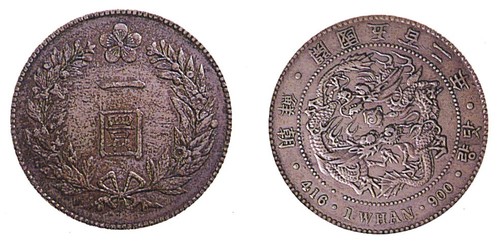
1 Hwan
Taegeuk era, late 1800s
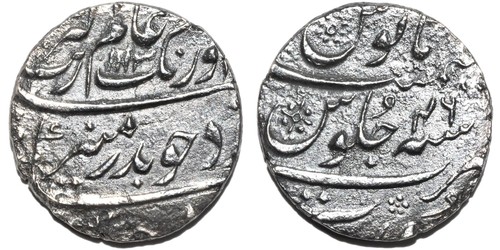
Mughal Rupee (Akbar)
AH 1003 (AD 1594)
Keicho Oban
Late 1500s to early 1600s AD (Azuchi-Momoyama to early Edo period)
Keicho Koban
Early Edo period, Keicho-era coinage (c. 1601 onward, 17th century)
Mughal Quarter-Rupee
Ilahi 47 (AD 1602-1603)
Double Rupi
AH 1151 (AD 1738-1739)
Aratame Sanbu Sadame
Dated 1859 (Ansei 6); round dragon-and-sun pieces are widely encountered as later reproductions
1 Bu Gin
Meiji 1 (1868-1869)