India One Rupee (Cupronickel)
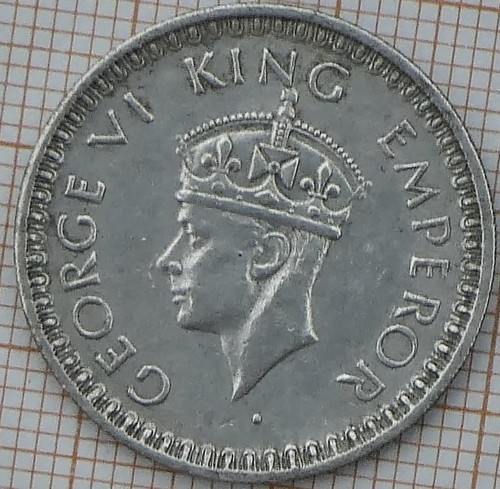
A 1947 British India one rupee in cupro-nickel, its obverse bearing King George VI's crowned bust and its reverse a striding lion above ONE RUPEE INDIA.
- Country
- India
- Denomination
- 1 Rupee
- Metal
- Cupronickel
Got a coin like this?
Identify any coin from a photo, free.
Overview
The India One Rupee shown here is the cupro-nickel type of 1947, the final one-rupee coinage struck under King George VI before India became independent in August of that year. The obverse carries a crowned bust of George VI facing left, encircled by the Latin legend GEORGIVS VI KING EMPEROR in the abbreviated form seen on the coin, GEORGIVS VI F.D. ET IMP (Fidei Defensor et Imperator, "Defender of the Faith and Emperor"). The reverse displays a striding lion in profile with the words ONE RUPEE, INDIA and the date 1947 arranged around it.
This piece belongs to the reduced-size nickel and cupro-nickel rupees that replaced the earlier large silver rupee. Rising silver prices during and after the Second World War made a base-metal rupee necessary, so the denomination was reissued at a smaller diameter in a pale silvery alloy rather than in precious metal.
As a one-year type tied to the last months of British rule, the 1947 George VI rupee is a familiar and historically resonant coin, marking the transition from imperial coinage to the coins of the new Republic and Dominion of India that followed.
History & Background
The one-rupee denomination had for generations been a large silver coin, but the demands of the Second World War drove up the price of silver and forced the government of British India to abandon precious metal for its higher denominations. The rupee was first reduced in fineness, then converted entirely to base metal, and by 1947 it was being struck in cupro-nickel at a smaller size than the old silver piece.
The 1947 issue carries the titles of George VI as King and Emperor of India, a style that would disappear almost immediately: India attained independence in August 1947, and the imperial title of Emperor was formally relinquished soon after. This makes the coin a document of the closing moment of the British Raj, struck in the same year that the empire in India came to an end.
The walking-lion reverse of these late George VI rupees replaced earlier tiger imagery and looks ahead to the animal and emblem motifs of subsequent Indian coinage. Within a few years the Republic of India would introduce its own designs bearing the Lion Capital of Ashoka, but the 1947 rupee stands at the hinge between the two eras.
How to Identify
Identify this coin from its two faces together. The obverse shows a crowned, left-facing bust of King George VI with the surrounding Latin legend GEORGIVS VI F.D. ET IMP (an abbreviation of his royal and imperial titles). The reverse shows a lion striding to the left, with ONE RUPEE and INDIA in English and the date 1947. There are no Devanagari or Persian denomination legends dominating the design as on some earlier issues; the English wording and the lion are the key markers.
Physically it is a round cupro-nickel coin, pale silvery in color and non-precious, noticeably smaller and lighter than the older silver rupee it replaced. The alloy can tone to a duller grey or take on a faint warm cast with handling. A security edge or reeding may be present depending on the sub-type. Any mint mark appears as a small dot below the date on the reverse.
Because the legends name George VI as King and Emperor and the date reads 1947, the coin can be pinned to the very end of British India. The combination of the crowned George VI portrait, the striding lion, the English ONE RUPEE INDIA legend and the 1947 date is diagnostic for this type.
Value & Collectibility
The 1947 George VI cupro-nickel rupee was a circulating coin produced in quantity, so ordinary worn examples are common and carry only a modest premium over base-metal value. Its appeal comes largely from its historical position as a coin of the last year of British rule rather than from rarity.
Condition drives most of the value. Well-worn pieces are inexpensive, while coins retaining sharp detail on the king's crown and the lion, clean fields and original surfaces command more from collectors of British India and modern India. Attractive uncirculated examples and any scarcer die or mint varieties are the most sought after.
Prices vary with grade, eye appeal and demand among specialists, so any figure should be read as general context rather than a fixed quote. Because it is a base-metal coin, there is no precious-metal floor to its worth; a clean, problem-free example is collectible but affordable, and heavily circulated coins trade close to token value.
Frequently asked questions
Who is on this coin?
It is King George VI, who reigned as King of the United Kingdom and Emperor of India. The Latin legend GEORGIVS VI F.D. ET IMP abbreviates his titles as Defender of the Faith and Emperor.
Is the 1947 one rupee made of silver?
No. By 1947 the rupee was struck in cupro-nickel, a base-metal alloy, because wartime silver prices had made a silver rupee impractical. Its pale color comes from the nickel content, not from precious metal.
Why does it say INDIA but carry a British king?
In 1947 India was still under British rule for part of the year, and George VI was King and Emperor. The coin was struck just as India moved toward independence, which is why it bears both the English title and the name INDIA.
What animal is on the reverse?
A striding lion shown in profile, placed above the words ONE RUPEE and INDIA with the date. It replaced the tiger used on some earlier issues.
Is this rupee valuable?
Most circulated examples carry only a small premium because they were made in quantity. Value rises with condition, so sharp, uncirculated coins are worth more than worn ones.
India One Rupee (Cupronickel) guides
In-depth guides for identifying, valuing, and collecting India One Rupee (Cupronickel).