
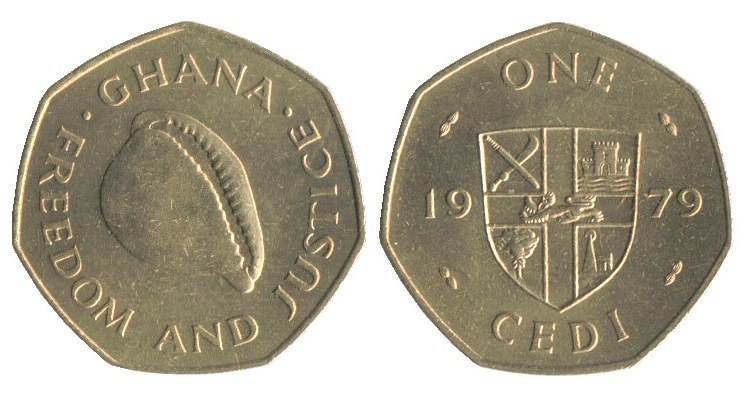
Ghana 1 Cedi
A golden-brass Ghanaian coin dated 1979, showing a cocoa pod with FREEDOM AND JUSTICE on one face and the national coat of arms on the other.
- Country
- Ghana
- Denomination
- 1 Cedi
- Metal
- Brass
Got a coin like this?
Identify any coin from a photo, free.
Overview
The Ghana 1 cedi is a mid-size circulation coin struck in a warm, golden-colored brass alloy. As pictured, one face carries a cocoa pod motif with the national motto FREEDOM AND JUSTICE, while the other shows the Ghanaian coat of arms with its central shield above the date 1979 and the value marked as 1 cedi.
The cedi is Ghana's principal unit of currency, subdivided into pesewas, and the 1 cedi was the higher end of the coin range in this series. The design pairs a distinctly Ghanaian economic symbol, the cocoa pod, with the country's official emblem, tying the coin's imagery to both national identity and the cocoa trade that has long anchored Ghana's economy.
The piece is a base-metal circulation coin rather than a precious-metal issue, so its appeal today is historical and thematic rather than as bullion. The bold cocoa pod and coat-of-arms pairing make it an easily recognized African coin type.
History & Background
The cedi was introduced in Ghana in the 1960s as the country moved away from the older shilling-and-pound colonial system, and it was reformed and redenominated across later decades as inflation eroded the value of the smaller coins. The 1 cedi coin dated 1979 belongs to a series struck in brass for everyday circulation during that period.
By the late 1970s Ghana was experiencing significant economic strain and high inflation, and the 1 cedi's shift from earlier smaller-denomination coinage to a brass 1 cedi piece reflects that pressure on the currency. Coins of this era were produced for practical circulation rather than as commemoratives, and the motto FREEDOM AND JUSTICE that appears on the cocoa pod face is the same phrase carried on Ghana's coat of arms and national symbols.
Because it was a workaday circulation coin, the 1979 1 cedi was made for use and handling, and surviving examples are frequently well worn. It stands as a small artifact of Ghana's post-independence coinage and of the country's central reliance on cocoa.
How to Identify
Start with the two main devices. One face shows a cocoa pod, an oval, ribbed fruit, encircled by the inscription FREEDOM AND JUSTICE; this motto is Ghana's national slogan. The opposite face carries the Ghanaian coat of arms built around a central shield, together with the date 1979 and the denomination reading as 1 cedi. On worn coins the denomination lettering can be indistinct and may look like a garbled rendering of the word cedi.
The coin is round and struck in brass, giving it a yellow to golden tone rather than the silvery-gray of nickel or cupronickel coins. It is a base-metal piece with no precious-metal content, moderate in size and weight for a circulation coin of its era. The single date 1979 is the key year for this particular type.
To confirm the identification, match all three elements together: the cocoa pod with FREEDOM AND JUSTICE, the coat of arms with its shield, and the 1979 date. The combination of a Ghanaian national emblem with the distinctive cocoa pod is the clearest signature of this coin and separates it from other African brass coins of similar color and size.
Value & Collectibility
As a base-metal circulation coin, the Ghana 1979 1 cedi carries modest collector value and no bullion value. Well-circulated examples are common and inexpensive, typically trading as low-cost world-coin material at a fraction of a dollar to a few dollars depending on the market.
Condition is the main driver of any premium. Coins that survive with sharp detail, clean brass surfaces, and little wear are far scarcer than the heavily handled pieces that dominate the market, and high-grade or uncirculated examples can bring a stronger premium from collectors of African or single-year type coins.
Because values are driven entirely by collector demand and preservation rather than metal content, treat any figure as a rough guide. Check recent world-coin listings for the specific date and grade, and be aware that cleaned or corroded brass examples generally sell for less than problem-free coins.
Frequently asked questions
What is the cocoa pod on the Ghana 1 cedi?
It is a cocoa pod, the fruit of the cacao tree, chosen because cocoa has long been central to Ghana's economy. It is encircled by the national motto FREEDOM AND JUSTICE.
Is the Ghana 1 cedi made of silver or gold?
No. Despite its warm golden color it is struck in brass, a base-metal alloy with no precious-metal content. Its appeal is historical and thematic rather than as bullion.
What does FREEDOM AND JUSTICE mean on the coin?
It is Ghana's national motto, the same phrase carried on the country's coat of arms. On this coin it surrounds the cocoa pod on one face.
What year is this Ghana 1 cedi?
The pictured type is dated 1979, which appears near the coat of arms on the reverse. That date is the key identifier for this particular brass 1 cedi coin.
Is my 1979 Ghana 1 cedi valuable?
Usually only modestly. Most are common, well-circulated brass coins worth little beyond a small collector value, though clean, high-grade examples can bring a stronger premium.
Ghana 1 Cedi guides
In-depth guides for identifying, valuing, and collecting Ghana 1 Cedi.
Other coins you may enjoy
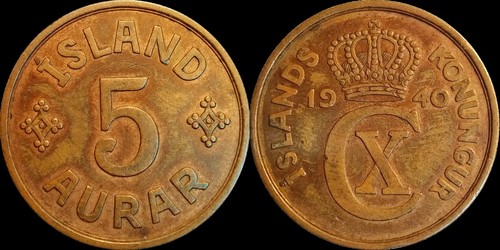
5 Aurar
1926-1942
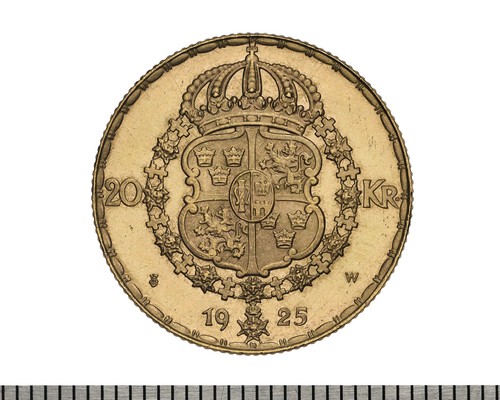
20 Kronor
1925 (denomination struck 1873-1925)
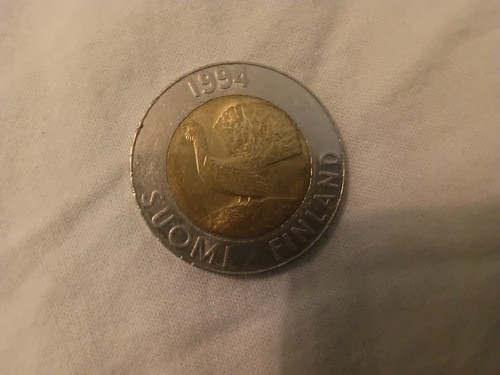
10 Markka
1993–2001
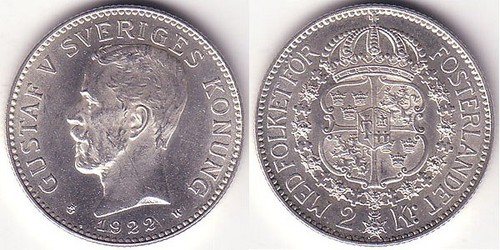
2 Kronor
1910-1940 (this example dated 1922)
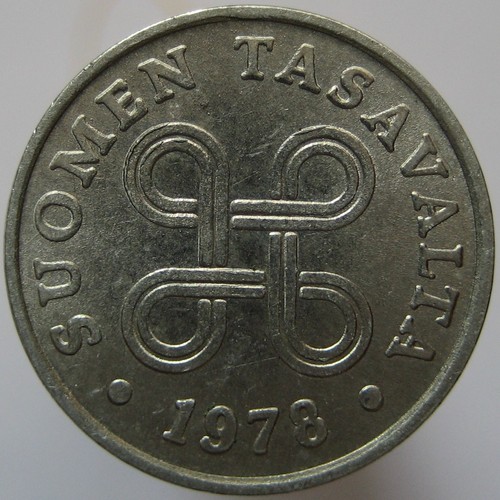
1 Penni
1969–1979
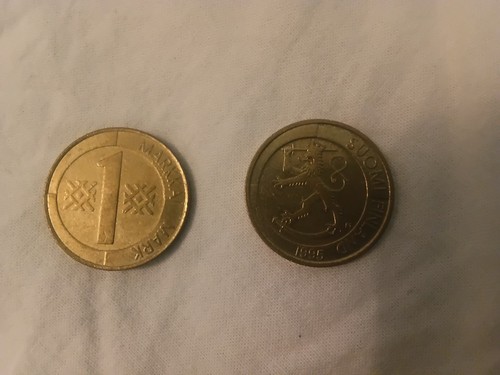
1 Markka
1993–2001
Kenya 5 Shillings
Bimetallic issues (2005–2010)
Kenya 20 Shillings
Modern issue (late 1990s–2000s)
South Africa Farthing
1923-1960
Kenya 10 Shillings
Republic of Kenya, bimetallic issues (mid-1990s to c. 2010)
Gold Sovereign
1817–present
Henri V Five Francs
1831