
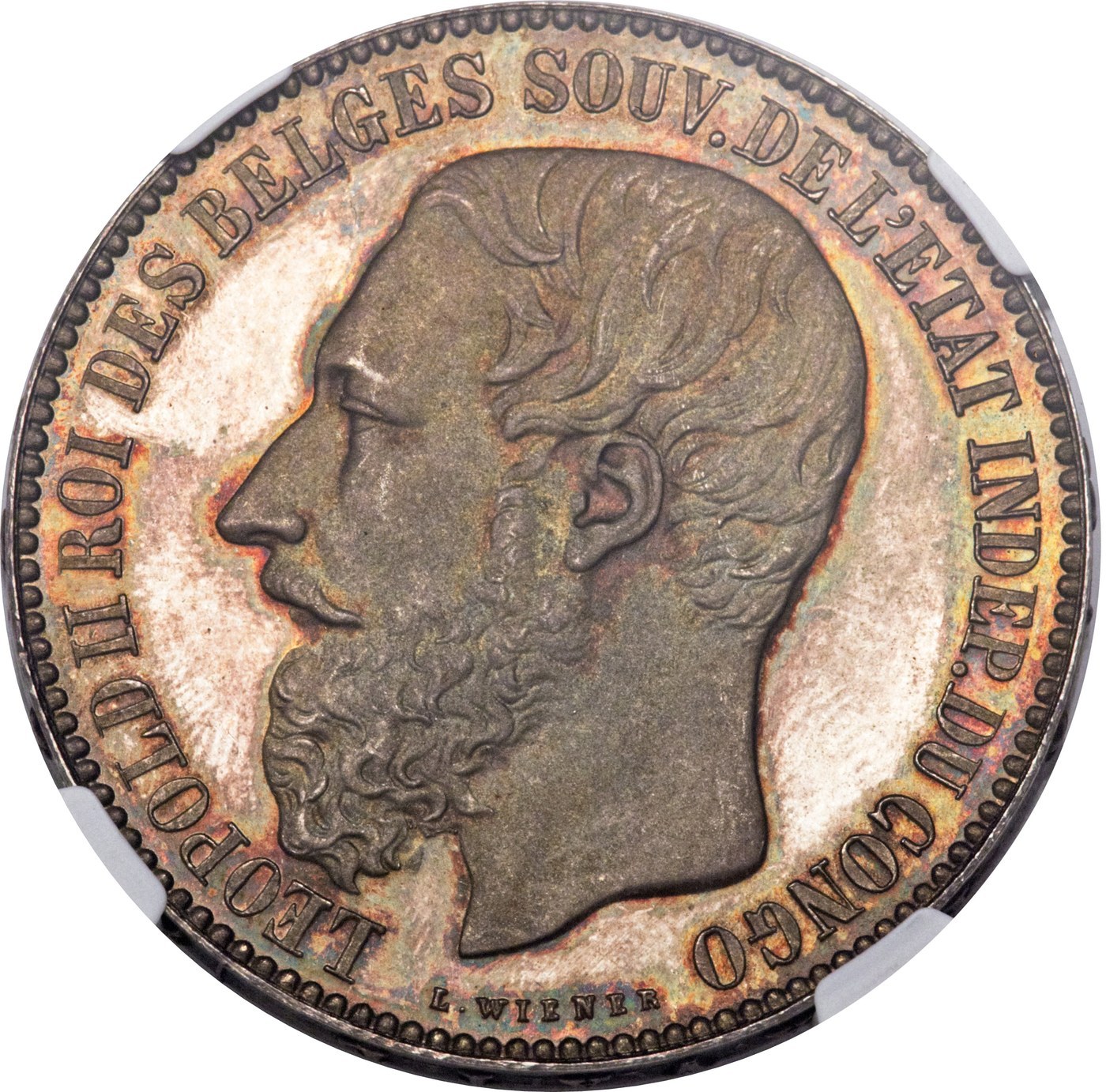
Belgian Congo 5 Francs (Copper)
A copper 5 Francs piece dated 1887 with a radiant star obverse and a crowned heraldic reverse reading CONGO BELGE, widely regarded as a fantasy or novelty type.
- Country
- Belgian Congo
- Denomination
- 5 Francs
- Metal
- Copper
Got a coin like this?
Identify any coin from a photo, free.
Overview
This is a copper 5 Francs piece bearing the date 1887 and the inscription CONGO BELGE. As seen on the coin, one face carries a sunburst or radiant star made of long radiating lines set with small crosses, while the other shows a crown above heraldic devices and the country legend. The star motif echoes the golden star on a blue field that served as the flag of the Congo region under Leopold II.
The piece is struck in copper rather than precious metal, giving it a reddish-brown tone and a solid but not heavy feel for its size. The design is emblematic rather than a ruler's portrait: no monarch's bust appears, and the imagery relies on the star, crown, and shield-like heraldry.
Collectors should note that the name CONGO BELGE (Belgian Congo) did not come into use until 1908, so a coin combining that legend with an 1887 date is historically inconsistent. Pieces of this description are generally treated as decorative, novelty, or fantasy issues rather than coins that ever circulated as official 5 Francs money.
History & Background
In 1887 the vast Congo territory was not the Belgian Congo but the Congo Free State (État Indépendant du Congo), a domain ruled personally by King Leopold II of Belgium. The official 5 Francs coin of that era was a large silver piece carrying Leopold II's portrait and Free State legends, not a copper star design. The Congo did not formally become the Belgian Congo, a colony of the Belgian state, until 1908.
Because of this, a copper 5 Francs dated 1887 yet inscribed CONGO BELGE cannot match any official issue: the anachronism between the date and the country name is the key historical clue. Pieces of this type belong to the broad family of fantasy and novelty coins that borrow real place names, dates, and symbols to create attractive but unofficial objects.
The star and crown imagery draws on genuine Congo symbolism, the single golden star of the Free State flag and European-style heraldic crowns, which is what gives these pieces a plausible period look. Their exact origin and production are not documented in standard national coinage records, and they are collected as curiosities rather than as struck legal tender.
How to Identify
Start with the two designs. The obverse shows a bold radiant star or sunburst formed by many straight rays, with small crosses worked into the field, an emblematic device rather than a human portrait. The reverse presents a crown above heraldic elements together with the legend CONGO BELGE and the date 1887.
Confirm the metal. This is a copper piece: look for a reddish-brown or chocolate surface tone rather than the bright grey of silver. Genuine Congo Free State 5 Francs of the 1880s were struck in silver and carried Leopold II's bust, so a copper, portrait-free coin of this style is clearly a different object.
The decisive tell is the mismatch between the 1887 date and the CONGO BELGE legend, since the Belgian Congo name dates only from 1908. Treat that inconsistency, combined with the star-and-crown emblematic design and copper composition, as identifying this as a novelty or fantasy 5 Francs rather than an official circulating coin.
Value & Collectibility
Because pieces of this description are regarded as novelty or fantasy issues rather than official coinage, they are valued as curiosities, not as regular-issue Congo coins. Values are typically modest, generally in the low single-digit to low double-digit dollar range depending on condition, eye appeal, and how the piece is marketed.
Copper examples with sharp star detail, clean fields, and pleasing color tend to bring a little more than worn, corroded, or heavily handled pieces. They should not be confused with the scarce and far more valuable genuine silver Congo Free State 5 Francs of Leopold II, which trade at much higher levels.
Treat any price as approximate. Since these are not catalogued as standard national issues, comparable recent sales of similar star-design copper Congo pieces are the best guide, and buyers should price them as decorative or collectible novelties rather than as investment-grade coins.
Frequently asked questions
Is this a genuine official Belgian Congo coin?
Almost certainly not. The name Belgian Congo (CONGO BELGE) dates from 1908, so an 1887-dated copper piece using that legend cannot be an official issue. It is best understood as a novelty or fantasy type.
What was the real 5 Francs of 1887 Congo?
In 1887 the territory was the Congo Free State under Leopold II, and its 5 Francs was a large silver coin bearing the king's portrait, not a copper piece with a star and crown.
What does the star on the obverse represent?
The radiant star echoes the single golden star on a blue field used as the flag of the Congo under Leopold II. On this piece it appears as a sunburst of rays set with small crosses.
Is my copper 5 Francs made of any precious metal?
No. It is copper, with a reddish-brown tone. The genuine period 5 Francs was silver, so a copper example of this design is a base-metal novelty rather than a precious-metal coin.
How much is it worth?
As a novelty or fantasy piece it usually carries only modest value, often a few dollars up to low double digits depending on condition and appeal, not the higher prices of authentic silver Congo Free State coins.
Belgian Congo 5 Francs (Copper) guides
In-depth guides for identifying, valuing, and collecting Belgian Congo 5 Francs (Copper).
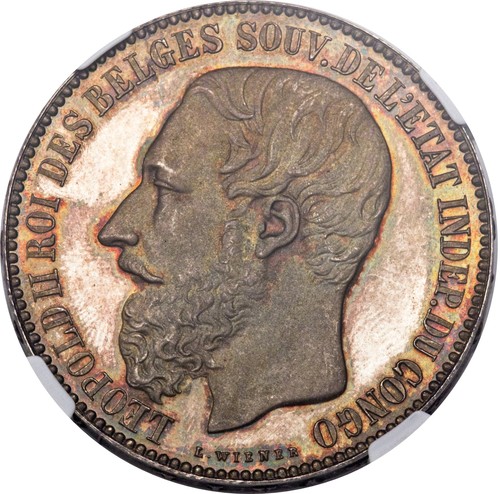
Other coins you may enjoy
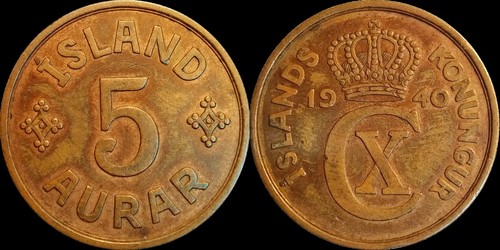
5 Aurar
1926-1942
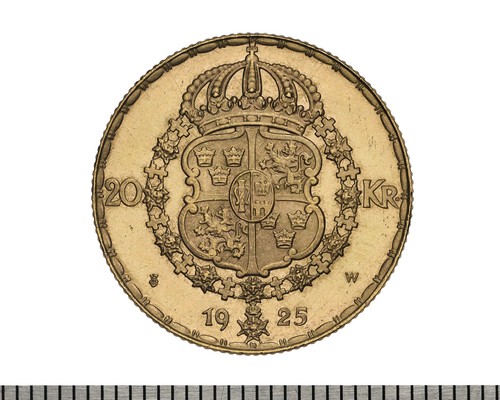
20 Kronor
1925 (denomination struck 1873-1925)
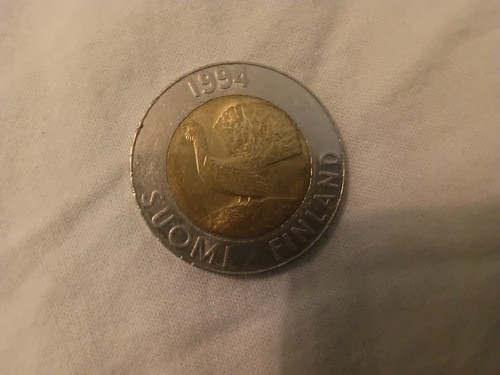
10 Markka
1993–2001
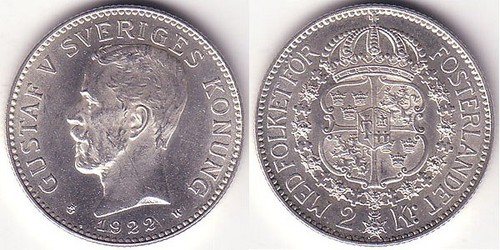
2 Kronor
1910-1940 (this example dated 1922)
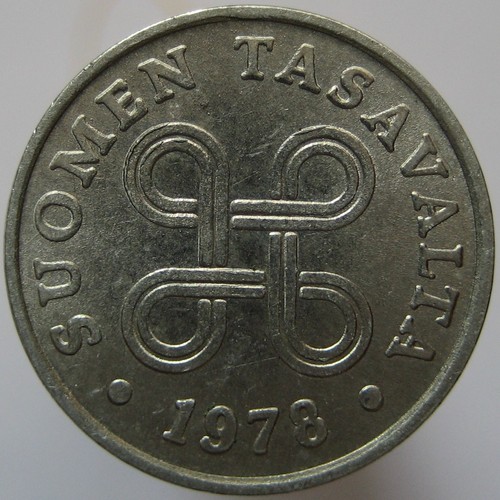
1 Penni
1969–1979
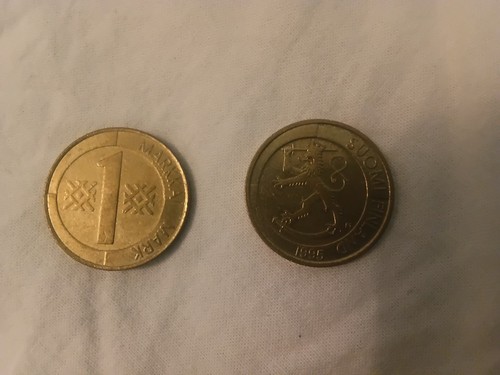
1 Markka
1993–2001
Kenya 5 Shillings
Bimetallic issues (2005–2010)
Kenya 20 Shillings
Modern issue (late 1990s–2000s)
South Africa Farthing
1923-1960
Kenya 10 Shillings
Republic of Kenya, bimetallic issues (mid-1990s to c. 2010)
Gold Sovereign
1817–present
Henri V Five Francs
1831