
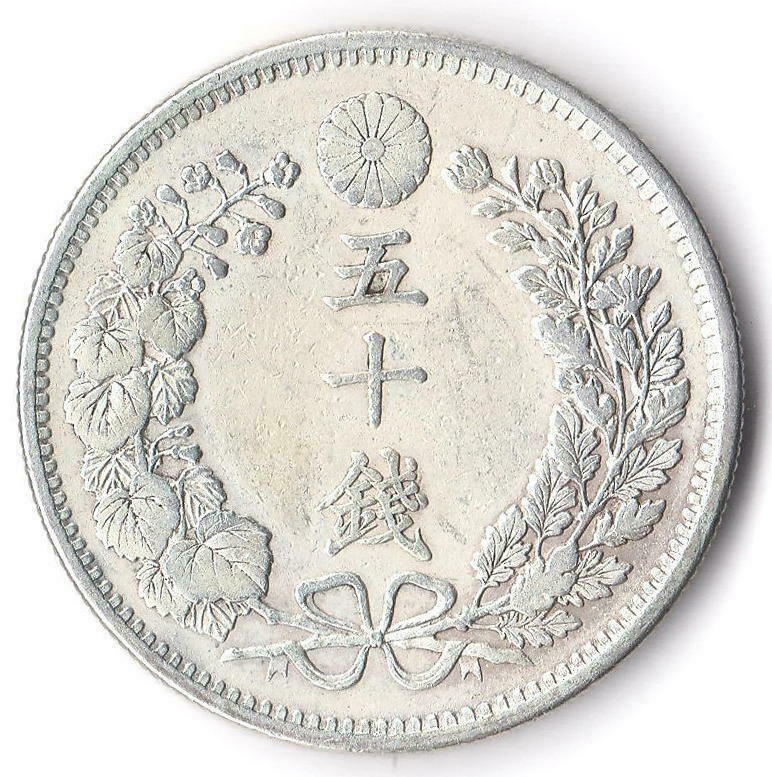
50 Sen (Dragon Type)
A Meiji-era Japanese silver 50 sen: a coiled dragon on one face, a sunburst-and-wreath value design on the other, dated Meiji 4 (1871).
- Country
- Japan
- Denomination
- 50 Sen
- Metal
- Silver
Got a coin like this?
Identify any coin from a photo, free.
Overview
The coin pictured is a Japanese 50 Sen silver piece of the "Dragon" type, dated Meiji 4 (1871) — the first year of Japan's modern decimal coinage. Under the new yen-based system, 100 sen made one yen, and the 50 sen was a substantial silver half-yen denomination used in everyday commerce.
One face carries a coiled Japanese dragon in high relief, ringed by kanji legends and the denomination, while the other shows a central sunburst of radiating lines carrying the value, framed by paulownia sprays and floral wreaths with the imperial chrysanthemum crest above. This dragon-and-sunburst formula was shared across Japan's silver yen and sen denominations of the era, scaled to size.
Struck in .800-fine silver at the newly modernized Imperial Mint in Osaka, the dragon 50 sen replaced older Tokugawa-era coinage as Japan industrialized. It is a widely collected representative of early Meiji silver, common enough to be affordable yet historically significant as a first-year issue of a brand-new monetary system.
History & Background
In Meiji 4 (1871) Japan passed the New Currency Act, abandoning the old feudal money for a Western-style decimal system based on the yen, divided into 100 sen (and the sen into 10 rin). The reform was part of the sweeping modernization that followed the Meiji Restoration of 1868, and the new coins were struck on modern machinery at the Imperial Mint at Osaka, established with foreign technical help.
The 50 sen was introduced in this first year as a silver half-yen coin. The pictured Meiji 4 (1871) issue is a debut year of the dragon design; early strikes of this first year are known in more than one variety, differing in details of the dragon and the sunburst rays. The type carried the value in both Japanese kanji and English lettering, reflecting Japan's outward-looking currency reform and the growing role of foreign trade.
The dragon 50 sen continued as a circulating silver coin through much of the Meiji era before the design and silver content were later revised. As a class, these coins survive in large numbers, but the Meiji 4 first-year pieces hold particular interest as the opening chapter of Japan's modern coinage.
How to Identify
Confirm the coin as a round, machine-struck silver piece with a coiled dragon filling one face. Around the dragon run kanji legends: 大日本 ("Great Japan") and the date 明治四年 ("Meiji 4th year"), read right-to-left, together with the denomination — on this type expressed in English as "50 SEN". The dragon's scaled, serpentine body and clawed limbs are the signature diagnostic.
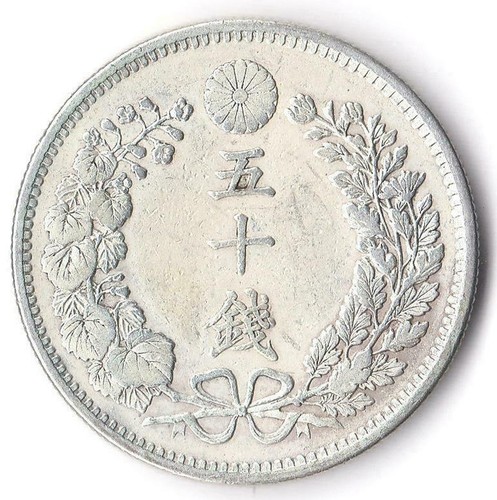
The opposite face shows a starburst of straight rays radiating from the center — the "rising sun" element noted on the photo — carrying the value 五十錢 (fifty sen). This is enclosed by curved paulownia branches and floral wreaths, with the imperial chrysanthemum crest at the top. The pairing of a central sunburst, wreaths, and a chrysanthemum is standard for Meiji dragon silver.
Date the coin by reading the era-name kanji: 明治 (Meiji) followed by the year numeral and 年 ("year"). Here the numeral is 四 (four), giving Meiji 4 = 1871. Size and weight help confirm the denomination against its larger (1 yen) and smaller (20 sen, 10 sen) dragon relatives, since all share the same basic design language.
Value & Collectibility
As a class, Meiji dragon 50 sen coins are relatively common silver pieces, and worn circulated examples typically trade in an affordable range not far above their silver-bullion content. Condition drives value: coins with sharp dragon scales, clean fields, and original surfaces command clear premiums over rubbed, cleaned, or damaged ones.
The Meiji 4 (1871) first-year date carries added collector interest, and early varieties can be more sought-after than later, more plentiful dates. Because first-year issues exist in more than one die variety, careful attribution can matter — a scarcer variety in high grade is worth considerably more than a common one in low grade.
Exact values swing widely with grade, variety, and market, so treat any single figure with caution. For a meaningful estimate, pin down the precise variety and condition, then compare recent sales of matching examples; professional grading is worthwhile for coins that appear choice or unusually well struck.
Frequently asked questions
What do the characters on the dragon side mean?
They read 大日本 ('Great Japan') and 明治四年 ('Meiji 4th year'), plus the denomination. The date uses the Meiji era name followed by the year numeral, so this coin was struck in 1871, the first year of Japan's decimal currency.
Is the dragon side the front or the back?
Collectors usually treat the dragon side as the obverse. Conventions vary, but the important point is that the dragon face carries the country name and date, while the sunburst-and-wreath face carries the value in kanji.
What is this coin made of?
It is a silver coin, struck in .800-fine silver at Japan's Imperial Mint. Much of its base value comes from that silver content, with collector demand adding a premium for date, variety, and condition.
Is a Meiji 4 (1871) 50 sen valuable?
Most circulated dragon 50 sen are common and modestly priced near their silver value, but the Meiji 4 first-year issue draws extra interest. Sharp, original examples and scarcer varieties are worth notably more than worn ones.
How do I read the date on Japanese coins like this?
Find the era name 明治 (Meiji), then the year numeral before 年 ('year'). Here the numeral is 四 (four), giving Meiji 4, which corresponds to 1871. The legend reads right to left.
50 Sen (Dragon Type) guides
In-depth guides for identifying, valuing, and collecting 50 Sen (Dragon Type).
50 Sen (Dragon Type) identified by the community
Real coins identified with Coin Identifier.
Other coins you may enjoy
5 Francs (First Republic)
L'an 9 (1800–1801)
Trinidad and Tobago Dollar
2015
German 5 Reichsmark (Hindenburg)
1935–1936 (Hindenburg type with swastika)
5 Francs Semeuse
1960–1969
French Cérès 1 Franc
1849–1895
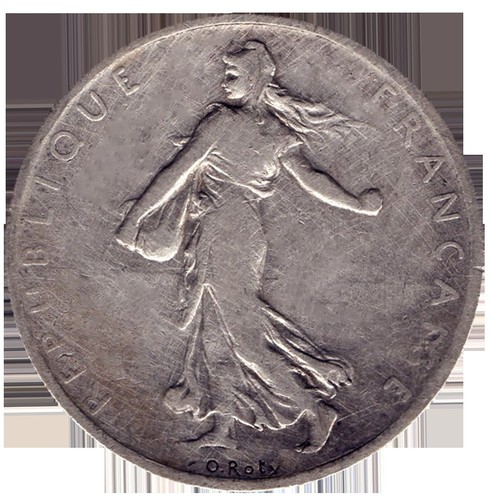
French Semeuse 2 Francs
1898–1920 (silver issues; pictured example dated 1899)
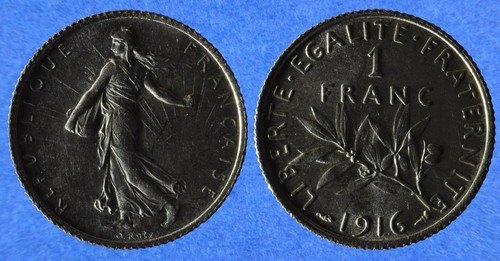
French Semeuse 1 Franc
1898–1920 (silver Semeuse 1 franc type)
France 50 Cent Euro
1999–present
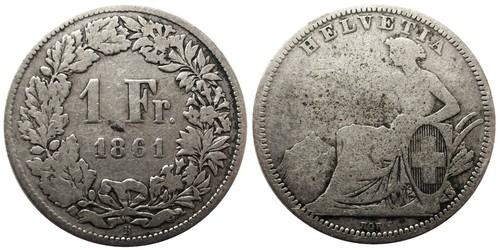
Swiss 1 Franc
1861
France 20 Centimes
1962–2001 (Fifth Republic, Marianne / Lagriffoul type)
Swiss 2 Francs
1860
Austria-Hungary 15 Kreuzer
1807