
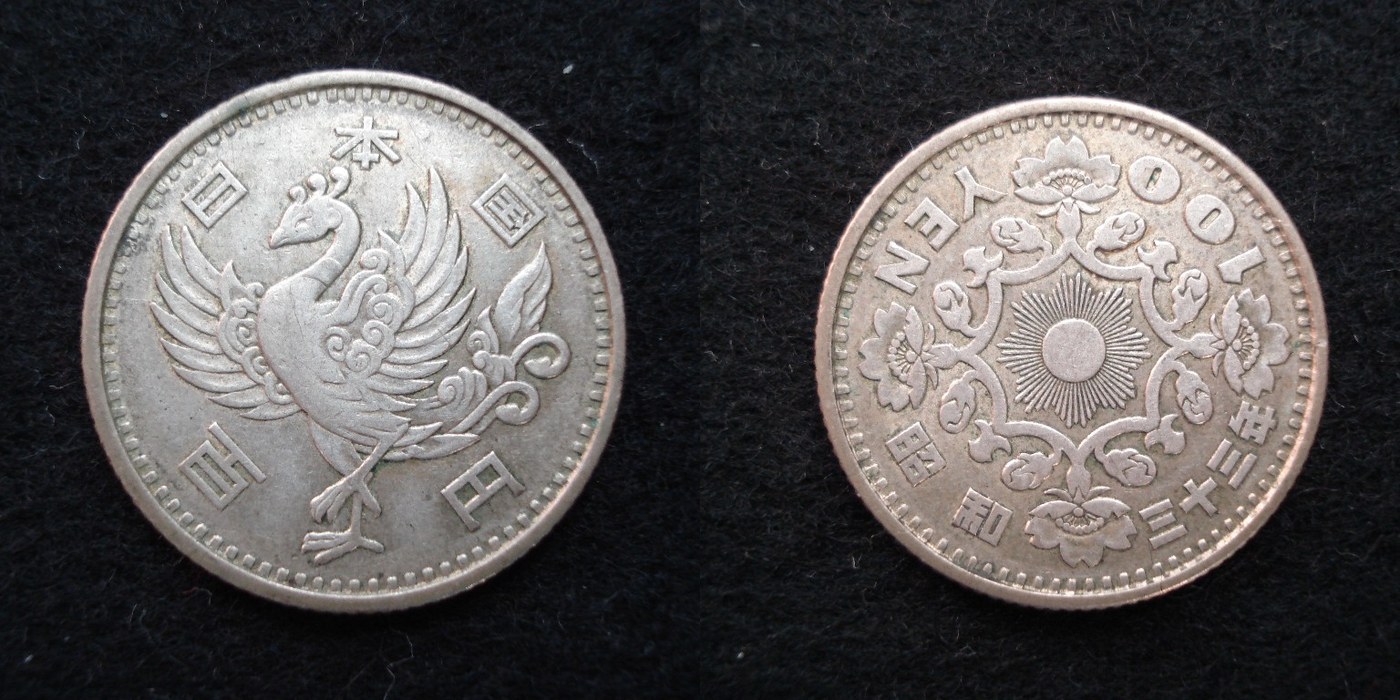
100 Yen (Showa Silver)
Japan's first 100 Yen coin, in silver: a phoenix in flight on the obverse and a bold radiating 100 on the reverse. Dated Showa 33 (1958).
- Country
- Japan
- Denomination
- 100 Yen
- Metal
- Silver
Got a coin like this?
Identify any coin from a photo, free.
Overview
The coin pictured is a Japanese 100 Yen struck in silver during the Showa era. The obverse shows a phoenix (hō-ō) in flight, wings spread, set within an ornamental border with Japanese inscriptions naming the country, the value, and the era-year. The reverse is dominated by a large "100" at center over a field of radiating lines, with a small floral device and the denomination spelled out.
This example is dated Showa 33 (1958), part of the short-lived Phoenix type, which was Japan's very first 100 Yen coin. It was struck only for the years Showa 32 (1957) and Showa 33 (1958) before the design was changed.
As a mid-century .600 fine silver circulation piece, it is collected as a one-of-a-kind design (the phoenix never returned to the 100 Yen), as a compact silver type coin, and as an accessible entry point into modern Japanese numismatics.
History & Background
Before 1957 the 100 Yen existed only as a paper note. Japan introduced its first 100 Yen coin in Showa 32 (1957), and it was struck in silver, reflecting both the value of the denomination and the prevailing use of silver for higher-value coinage in the era. The chosen motif was the phoenix, a traditional emblem of rebirth and good fortune long associated with Japanese and East Asian art.
The Phoenix type ran for just two dates, Showa 32 (1957) and Showa 33 (1958). From Showa 34 (1959) the 100 Yen was redesigned with a cherry-blossom obverse, still in .600 silver, and that design continued through Showa 41 (1966).
In 1967 rising silver prices ended the silver 100 Yen altogether: the coin was reissued in cupro-nickel with a rice-ear (sheaf) design, the basic type Japan still uses today. The phoenix coin dated Showa 33 therefore belongs to the very beginning of the 100 Yen coin's history, in the two-year window when it was both new and silver.
How to Identify
Confirm the design pair first. The Phoenix 100 Yen shows a phoenix in flight on the obverse and a large "100" over radiating lines on the reverse. If the obverse instead shows cherry blossoms or rice ears/sheaves, you have a later 100 Yen (silver cherry-blossom, 1959-1966, or cupro-nickel sheaf, 1967 onward), not the phoenix.
Check metal and size. This is a .600 fine silver coin, roughly 22.6 mm in diameter and about 4.8 grams, with a reeded edge. A later cupro-nickel 100 Yen of similar diameter will show no silver tone on the edge and rings differently. Read the date from the kanji: 昭和 (Showa) followed by the year numerals and 年 ("year"). Showa 33 corresponds to 1958 (add 1925 to the Showa year).
Because Japanese dates are written in era-year form and can read right to left, verify the numerals carefully. The value 100 appears in Western numerals on the reverse, but the country name and era-year are in kanji around the designs.
Value & Collectibility
The Phoenix 100 Yen contains only a small amount of silver (about 4.8 g of .600 fine metal, under a tenth of a troy ounce), so its bullion value is modest but still sets a floor well above face value. Because both dates were struck in large numbers for circulation, the type is common and affordable in worn to average grades.
As with most modern coins, condition drives the premium. Circulated examples trade for a small multiple of their silver value, while sharply struck, lustrous uncirculated coins command a stronger collector premium. The two dates, Showa 32 and Showa 33, are both readily available, so grade and eye appeal matter more than the specific year for this type.
Because silver prices and grade both move values, treat any single figure with caution and check recent sales for the specific date and condition. This is a widely collected but low-liability coin; certified high-grade examples bring the strongest prices.
Frequently asked questions
What year is this coin?
It is dated Showa 33, which corresponds to 1958. Japanese coins use the reign-era system: the characters read 昭和 (Showa) followed by the year 33 and 年 ("year"). Add 1925 to the Showa year to get the Western year.
Is it really silver?
Yes. The Phoenix 100 Yen is struck in .600 fine silver, about 4.8 grams, with a reeded edge. Later 100 Yen coins from 1967 onward are cupro-nickel and contain no silver.
What is the bird on the front?
It is a phoenix (hō-ō), a traditional emblem of good fortune and rebirth. This was Japan's first 100 Yen coin design, used only in 1957 and 1958.
How long was this design made?
Only two years: Showa 32 (1957) and Showa 33 (1958). It was replaced by a cherry-blossom silver 100 Yen in 1959, and by a cupro-nickel rice-sheaf design in 1967.
Is it valuable?
Both dates were made in quantity, so circulated coins are common and worth a small multiple of their silver content. Uncirculated, well-struck examples carry a stronger collector premium; check recent sales for the exact grade.
100 Yen (Showa Silver) guides
In-depth guides for identifying, valuing, and collecting 100 Yen (Showa Silver).
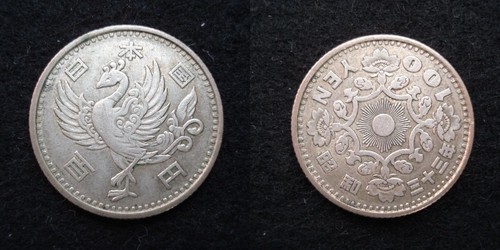
100 Yen (Showa Silver) identified by the community
Real coins identified with Coin Identifier.
Other coins you may enjoy
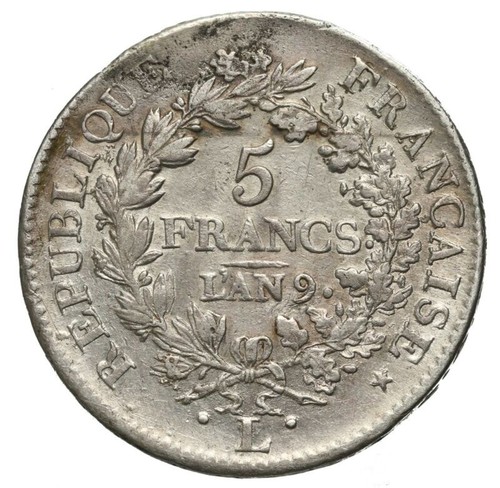
5 Francs (First Republic)
L'an 9 (1800–1801)
Trinidad and Tobago Dollar
2015
German 5 Reichsmark (Hindenburg)
1935–1936 (Hindenburg type with swastika)
5 Francs Semeuse
1960–1969
French Cérès 1 Franc
1849–1895
French Semeuse 2 Francs
1898–1920 (silver issues; pictured example dated 1899)
French Semeuse 1 Franc
1898–1920 (silver Semeuse 1 franc type)
France 50 Cent Euro
1999–present
Swiss 1 Franc
1861
France 20 Centimes
1962–2001 (Fifth Republic, Marianne / Lagriffoul type)
Swiss 2 Francs
1860
Austria-Hungary 15 Kreuzer
1807