
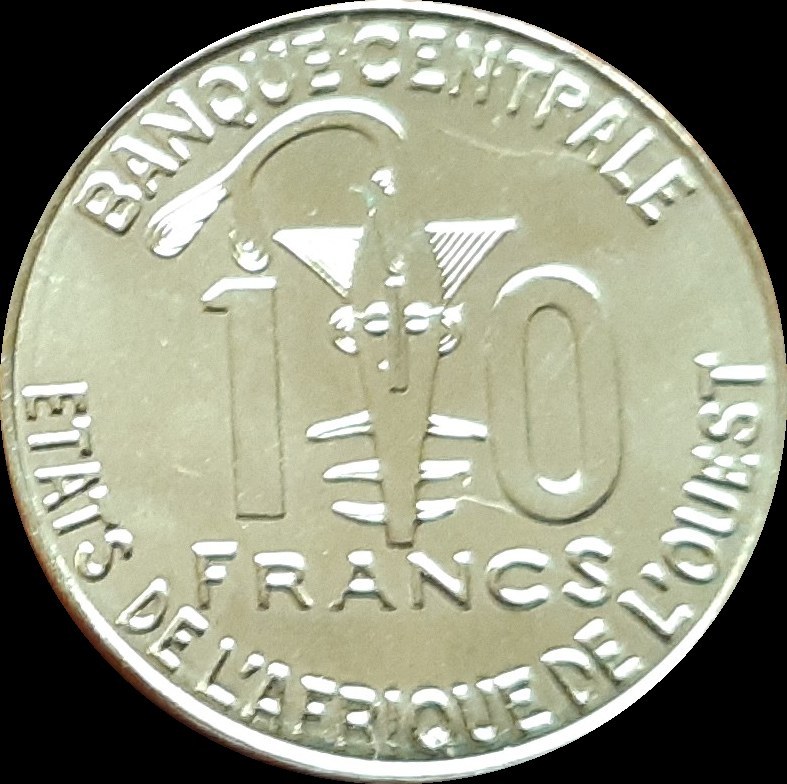
10 CFA Francs
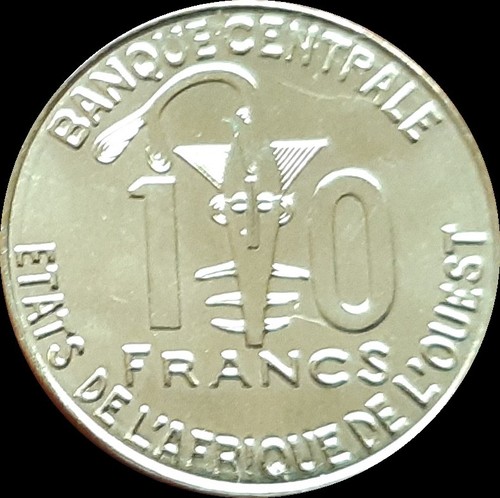
A small modern circulation coin of the West African CFA franc zone, showing a stylized traditional emblem and the bold value 10.
- Country
- West Africa (CFA)
- Denomination
- 10 Francs
- Metal
- Nickel-silver
Got a coin like this?
Identify any coin from a photo, free.
Overview
The 10 CFA francs is a low-value modern circulation coin used across the West African CFA franc zone, a group of eight West African nations that share a common currency issued through the Banque Centrale des États de l'Afrique de l'Ouest (BCEAO). It is a small, pale silver-colored piece struck in a base-metal alloy, not precious metal.
As seen on the coin, one face carries the large numeral 10 with the denomination and inscriptions, while the other bears a stylized decorative emblem drawn from traditional West African symbolism. The design is compact and utilitarian, intended for everyday small change rather than commemoration.
Because the same currency circulates in several countries, an individual 10 franc coin usually names the shared central bank and the union rather than a single nation, making it a familiar sight throughout the region.
History & Background
The CFA franc was introduced in France's West African territories in the mid-20th century and continued after those countries became independent around 1960. In West Africa the currency is managed by the BCEAO on behalf of a monetary union whose members have included Benin, Burkina Faso, Côte d'Ivoire, Guinea-Bissau, Mali, Niger, Senegal, and Togo.
Small denominations such as the 10 francs have been struck in successive series over the decades to serve day-to-day commerce. The coinage is deliberately standardized across the union so that a coin minted for one member circulates freely in all of them.
The West African CFA franc has long been tied to a fixed exchange rate against the French franc and later the euro, which has kept the value of small coins like the 10 francs low and stable. As a result these pieces are common, heavily circulated, and produced in large numbers rather than as scarce collector items.
How to Identify
Look first at the numeral. The 10 franc coin displays a large 10 together with the word FRANCS and legends identifying the issuing central bank and the West African union. This bold denomination is the quickest way to separate it from the 5, 25, 50, 100, or higher franc coins of the same series.
The opposite face carries a stylized decorative emblem rather than a portrait, presenting a geometric, ornamental device inspired by traditional West African symbolism. The coin is small, thin, and struck in a pale, silvery-looking base-metal alloy; it is light in the hand and non-magnetic to weakly magnetic depending on the exact alloy used.
Because the West African (BCEAO) and Central African (BEAC) CFA francs look broadly similar, check the inscriptions: a West African piece references the West African states and their central bank. The year of striking usually appears near the design and identifies the specific issue within the long-running series.
Value & Collectibility
The 10 CFA francs is a common, low-face-value circulation coin, and most examples are worth little beyond their small monetary value. Well-worn pieces are typically sold in bulk or as inexpensive world-coin filler, often for a fraction of a dollar.
Condition drives what modest premium exists. Uncirculated or lustrous examples, scarcer dates within the series, and coins from less-common issuing years can bring somewhat more from collectors of West African or Francophone coinage, but values generally remain in the low single-dollar range.
Because these coins are so widely produced and still in use, treat any figure as a rough guide. Verify a specific date and variety against recent world-coin listings, since a handful of dates or minor varieties can be worth more than ordinary circulation strikes.
Frequently asked questions
Which countries use the 10 CFA franc coin?
It circulates across the West African CFA franc union, whose members have included Benin, Burkina Faso, Côte d'Ivoire, Guinea-Bissau, Mali, Niger, Senegal, and Togo. The same coin is legal tender in all of them.
Is the 10 CFA francs made of silver?
No. Despite its pale, silvery appearance it is struck in a base-metal alloy, not precious metal. It is a modern low-value circulation coin rather than a bullion or silver piece.
How is West African CFA different from Central African CFA?
They are two separate currencies of similar value and appearance. The West African version is issued by the BCEAO; the Central African version is issued by the BEAC. Check the inscriptions to tell them apart.
Is my 10 CFA franc coin valuable?
Usually only modestly. Most are common circulation coins worth little beyond face value, though uncirculated examples or scarcer dates can bring a small premium from collectors.
What does the emblem on the coin represent?
The non-numeral face shows a stylized, ornamental emblem drawn from traditional West African symbolism rather than a ruler's portrait, reflecting the shared identity of the currency union.
10 CFA Francs guides
In-depth guides for identifying, valuing, and collecting 10 CFA Francs.
Other coins you may enjoy
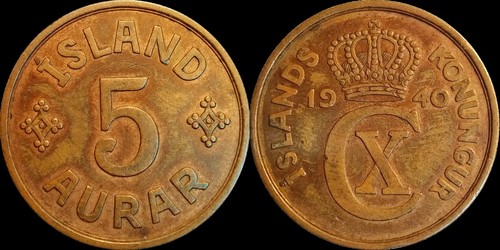
5 Aurar
1926-1942
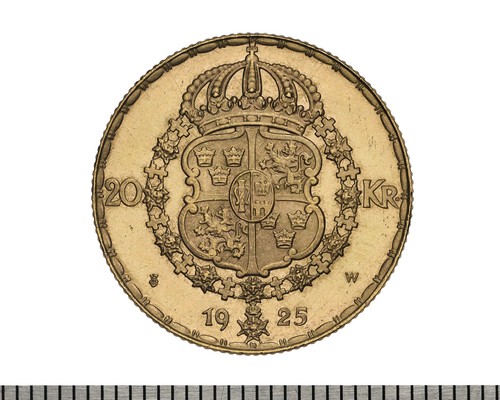
20 Kronor
1925 (denomination struck 1873-1925)
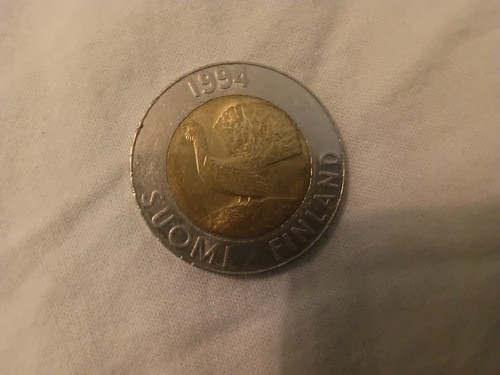
10 Markka
1993–2001
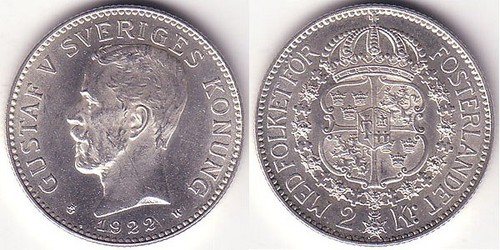
2 Kronor
1910-1940 (this example dated 1922)
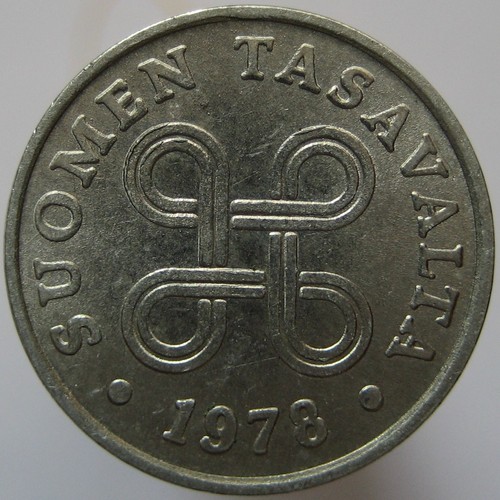
1 Penni
1969–1979
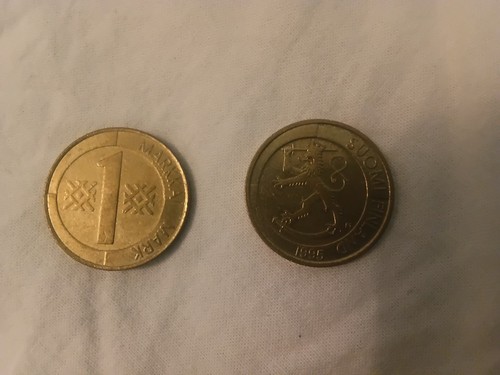
1 Markka
1993–2001
Kenya 5 Shillings
Bimetallic issues (2005–2010)
Kenya 20 Shillings
Modern issue (late 1990s–2000s)
South Africa Farthing
1923-1960
Kenya 10 Shillings
Republic of Kenya, bimetallic issues (mid-1990s to c. 2010)
Gold Sovereign
1817–present
Henri V Five Francs
1831