
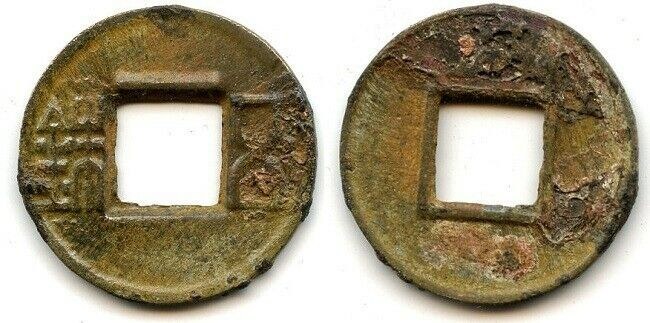
Wu Zhu Cash
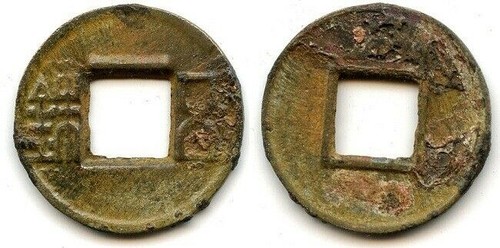
A round Han-dynasty bronze cash coin with a central square hole and two seal-script characters, Wu Zhu, naming its weight of five zhu.
- Country
- China
- Denomination
- 1 Cash
- Metal
- Bronze
Got a coin like this?
Identify any coin from a photo, free.
Overview
The Wu Zhu is a small round bronze cash coin of ancient China, cast with a square central hole and bearing two characters in seal script that read Wu Zhu, meaning "five zhu" after an old unit of weight. First introduced under the Han dynasty, it became one of the most enduring coin types in Chinese history, and the example described here is attributed to the Western Han period during the reign of Emperor Xuandi (74-49 BC).
Unlike coins struck between dies in the Western tradition, the Wu Zhu was cast in molds, which gives it the smooth, slightly rounded relief typical of Chinese cash. The obverse carries the two-character legend flanking the square hole, while the reverse is typically plain or shows only minimal features such as raised rims. The square hole allowed strings of coins to be threaded together for counting and carrying.
As a modest bronze piece rather than a precious-metal issue, the Wu Zhu is prized more for its historical depth than its intrinsic value. It represents a coinage standard that outlasted many dynasties and circulated, in one form or another, for centuries.
History & Background
The Wu Zhu coinage was introduced in the Western Han period, traditionally dated to 118 BC under Emperor Wudi, as part of reforms meant to stabilize the money supply after earlier experiments with lighter and heavier coins. The denomination took its name from its nominal weight of five zhu, a small ancient Chinese unit, and the coin's specified weight helped standardize value across the empire.
Production continued under successive Han emperors, and the example here is placed in the reign of Emperor Xuandi (Liu Bingyi), who ruled from 74 to 49 BC and presided over a period often remembered for administrative consolidation and relative prosperity. Because the same basic Wu Zhu design was cast over long stretches of time and at many foundries, coins of this type from different reigns closely resemble one another, and specialists distinguish them mainly by subtle differences in calligraphy, casting, and rim treatment.
The Wu Zhu proved remarkably durable as a monetary standard. Versions of it were cast well beyond the Han, continuing intermittently for several centuries until later dynasties introduced new inscriptions. This longevity makes the Wu Zhu one of the longest-lived coin concepts in world history.
How to Identify
Look for a round bronze coin with a square hole in the center and exactly two characters on one face, arranged on either side of the hole. Those characters, read in seal script, are Wu (five) and Zhu (the weight unit). The reverse is normally blank or shows only plain raised rims around the hole and edge, without additional legends.
The coin is cast bronze, so surfaces tend to be smooth with soft, rounded relief rather than the crisp, pressed detail of a struck coin. Genuine ancient examples usually carry an earthy or greenish patina from long burial. Diameter and weight are modest, consistent with a small everyday cash piece, and the square hole is a defining structural feature used historically to string coins together.
Because the Wu Zhu was cast for centuries with only gradual changes, precise dating from appearance alone is difficult. Attribution to a particular Han reign relies on the style of the seal-script characters, the shape and finishing of the rims, and casting characteristics, features that specialists compare against reference examples.
Value & Collectibility
The Wu Zhu is one of the more commonly encountered ancient Chinese cash coins, having been produced in enormous quantities over a very long period. As a result, ordinary worn examples are generally affordable and accessible to collectors, and the type is often an entry point into ancient Chinese numismatics.
Value depends chiefly on condition, clarity of the seal-script characters, the quality and stability of the patina, and any features that allow attribution to a specific period or variety. Coins with sharp, well-cast legends, even surfaces, and attractive patina command higher premiums than corroded or damaged pieces, while scarce varieties can be worth considerably more.
Because these are base-metal cast coins, appeal rests on history and preservation rather than bullion content. Given how many look-alike Wu Zhu were cast across the centuries, buyers seeking a specific reign attribution or a premium example should confirm prices and authenticity against recent sales of comparable coins.
Frequently asked questions
What does Wu Zhu mean?
Wu Zhu means "five zhu." The zhu was a small ancient Chinese unit of weight, and the two seal-script characters on the coin state its nominal weight of five zhu, which also served as its name.
Why does the coin have a square hole?
The square central hole is a standard feature of Chinese cash coins. It let people thread many coins onto a string for easier counting, storage, and transport, and it also aided in finishing the cast blanks.
Is the Wu Zhu made of silver or gold?
Neither. The Wu Zhu is a bronze cash coin, a base-metal piece for everyday use. Its interest to collectors is historical rather than tied to precious-metal content.
How old is this Wu Zhu coin?
This example is attributed to the Han dynasty during the reign of Emperor Xuandi, who ruled from 74 to 49 BC, making it roughly two thousand years old. The Wu Zhu type as a whole was cast over many centuries.
Why do so many Wu Zhu coins look alike?
The Wu Zhu design was cast almost unchanged for centuries at many foundries and under many rulers. That consistency means coins from different reigns closely resemble one another and are told apart mainly by subtle details of script and casting.
Wu Zhu Cash guides
In-depth guides for identifying, valuing, and collecting Wu Zhu Cash.
Other coins you may enjoy
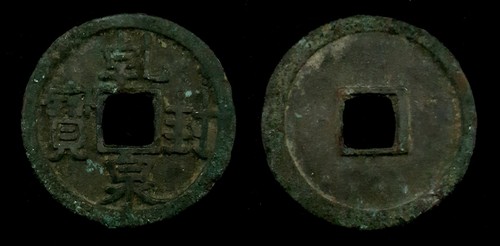
Qian Feng Quan Bao
Tang Dynasty, Qianfeng era (666-667 CE)

Qianlong Tongbao (An Nam)
18th century (Qianlong period, mid-to-late 1700s)
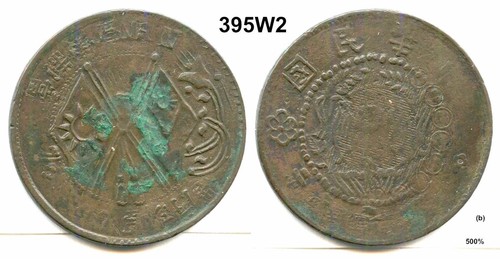
Ho-Nan 100 Cash
Republic of China era (circa 1920s–1930s)
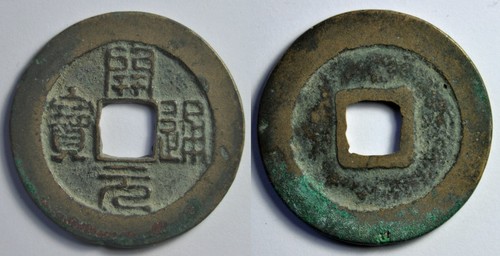
Kai Yuan Tong Bao
Tang Dynasty (7th-10th century AD)
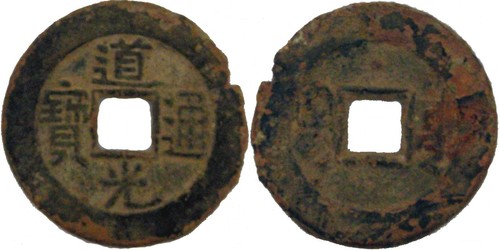
Daoguang Tongbao
1821–1850
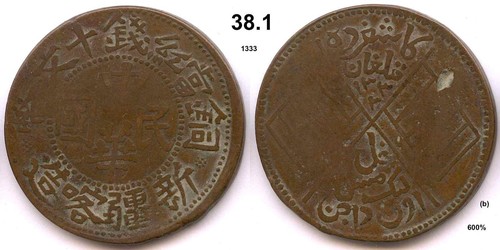
Aksu Mint 10 Cash
Republic of China period (early 20th century)
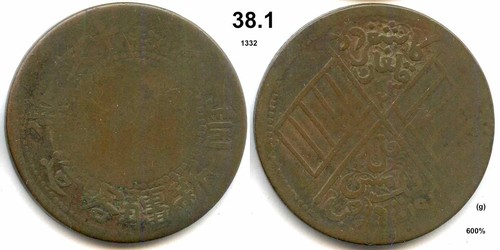
10 Cash (Republic)
Republic of China era (from 1912; many issues struck through the 1910s-1920s)