
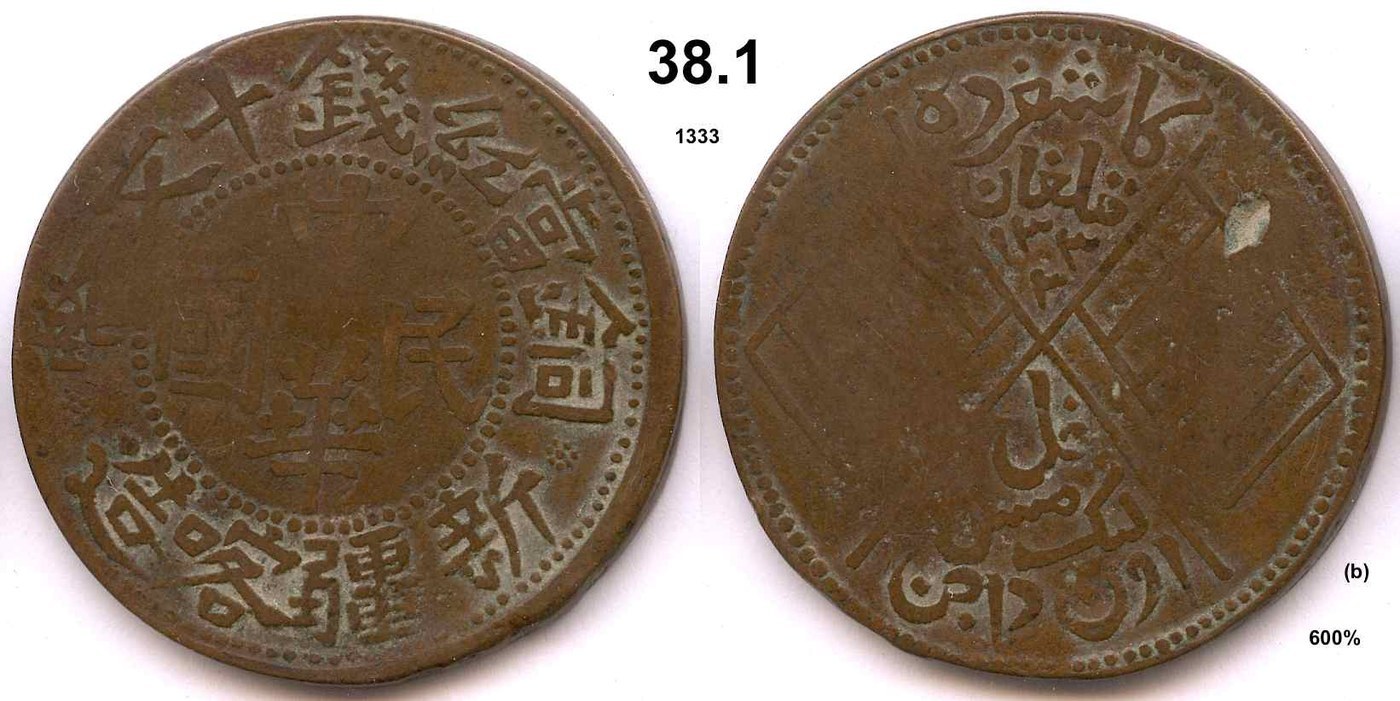
Aksu Mint 10 Cash
A struck copper 10 cash coin from the Aksu mint in Xinjiang, with Chinese characters and a denomination mark in a circular layout, without a central hole.
- Country
- China
- Denomination
- 10 Cash
- Metal
- Copper
Got a coin like this?
Identify any coin from a photo, free.
Overview
The coin pictured is an Aksu Mint 10 Cash, a struck copper coin issued in Xinjiang (Sinkiang), the far-western province of China, during the Republic of China period of the early 20th century. It represents a value of ten cash (wen), a multiple of the old base cash unit.
Unlike the older cast cash of China, this piece has no central square hole. Instead it is a solid round disc struck with dies, carrying a circular arrangement of Chinese characters around a central denomination mark on the obverse, and further characters combined with geometric or floral ornament in a circular layout on the reverse.
The coin belongs to the distinctive provincial coinage of Xinjiang, which the Aksu mint in the south of the province helped produce. These issues sit at the transition between the traditional cash tradition and modern machine-struck coinage, and their layout, script, and ornament set them apart from coins of China's eastern provinces.
History & Background
Xinjiang was administered as a frontier province with its own mints and monetary customs, long accustomed to producing local "red cash" copper coins rather than the pieces circulating in China proper. The Aksu mint, located in southern Xinjiang, was one of the provincial facilities that struck copper coinage for regional use.
After the fall of the Qing dynasty and the founding of the Republic of China in 1912, Xinjiang continued to issue its own copper coins, including 10 cash denominations, under provincial authority. Because the province was remote and politically semi-autonomous, its Republic-era coinage retained a strongly local character in design, script, and manufacture rather than closely following national patterns.
Production spanned an unsettled period marked by changing provincial administrations, so Xinjiang copper coins of this era vary in style, quality of strike, and detail. Exact mintages and issue dates for individual Aksu types are not well documented, and specimens are generally attributed by their inscriptions, denomination, and design features rather than by precise records.
How to Identify
Identify this coin first by its format: a round, struck copper piece with no central hole, distinguishing it immediately from the older cast cash of round-with-square-hole form. The obverse shows a ring of Chinese characters encircling a central denomination mark that expresses the value of ten cash.
The reverse carries additional Chinese characters set in a circular arrangement, combined with geometric and floral ornament. This decorative treatment, together with the provincial script style, is characteristic of Xinjiang copper coinage and helps separate Aksu and other Xinjiang issues from the copper coins of eastern Chinese provinces.
Because many Xinjiang mints used similar layouts, attribution to Aksu specifically rests on reading the mint and province references in the legends and matching the coin against catalogued Xinjiang types. Diameter, weight, color of the copper, and the exact wording and ornament are the practical tools for placing a given specimen; worn or weakly struck coins can be difficult to attribute precisely.
Value & Collectibility
The Aksu Mint 10 Cash is a collector coin valued for its provincial Xinjiang origin rather than for precious-metal content, since it is struck in copper. Values depend heavily on the specific type, the sharpness of the strike, the legibility of the inscriptions, and overall condition.
Well-struck, clearly legible examples with even wear are more desirable than weakly struck, corroded, or heavily worn pieces, which are common for frontier copper coinage produced under difficult conditions. Because documented issue data is limited and types vary, prices are best judged by comparison with recent sales of the same Xinjiang type and grade rather than by any single figure.
As with other collectible Chinese provincial coins, condition and clear attribution drive value. For any specimen bought as a scarce or higher-grade Xinjiang type, it is prudent to compare it against catalogued examples and seek specialist opinion, since regional coppers can be misattributed.
Frequently asked questions
What is an Aksu Mint 10 Cash coin?
It is a struck copper coin worth ten cash, produced in connection with the Aksu mint in Xinjiang (Sinkiang) province, China, during the Republic of China period of the early 20th century. It has Chinese characters and a denomination mark arranged in a circle and no central hole.
Why doesn't it have a square hole like other Chinese cash?
This is a machine-struck copper coin, not a traditional cast cash. By the Republic period, provincial mints including those in Xinjiang were producing solid struck coins without the old central square hole, though the value was still expressed in the traditional cash unit.
Where is Aksu?
Aksu is a city in southern Xinjiang, the far-western province of China. Xinjiang operated its own mints and had a long tradition of local copper coinage, which continued into the Republic of China period.
Is this coin made of gold or silver?
No. The Aksu Mint 10 Cash is a copper coin. Its value to collectors comes from its type, condition, and provincial origin, not from precious-metal content.
How much is an Aksu Mint 10 Cash worth?
Value varies with the specific type, strike quality, legibility, and condition. Because documented mintage data is limited, it is best to compare a coin against recent sales of the same Xinjiang type and grade rather than rely on a single price.
Aksu Mint 10 Cash guides
In-depth guides for identifying, valuing, and collecting Aksu Mint 10 Cash.
Other coins you may enjoy
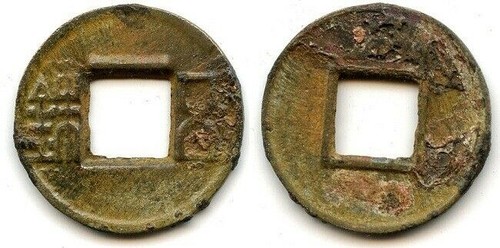
Wu Zhu Cash
Han Dynasty (issue attributed to the reign of Emperor Xuandi, 74-49 BC)
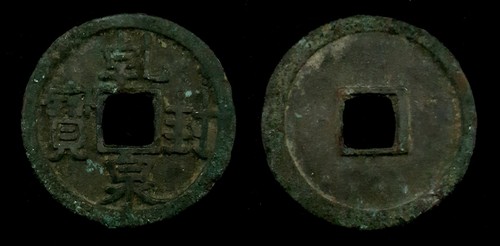
Qian Feng Quan Bao
Tang Dynasty, Qianfeng era (666-667 CE)

Qianlong Tongbao (An Nam)
18th century (Qianlong period, mid-to-late 1700s)
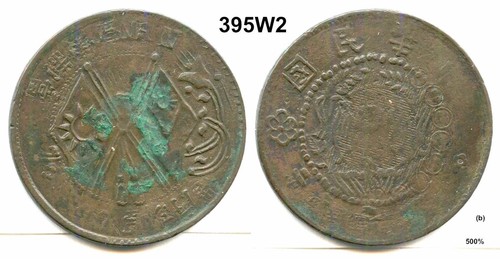
Ho-Nan 100 Cash
Republic of China era (circa 1920s–1930s)
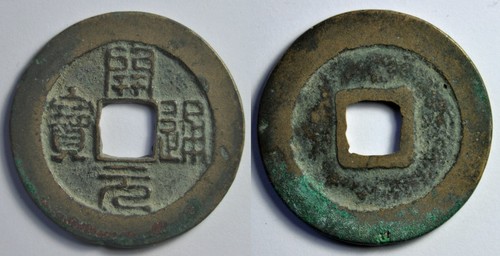
Kai Yuan Tong Bao
Tang Dynasty (7th-10th century AD)
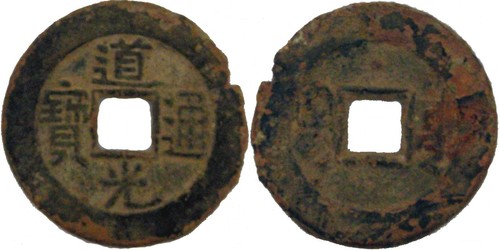
Daoguang Tongbao
1821–1850
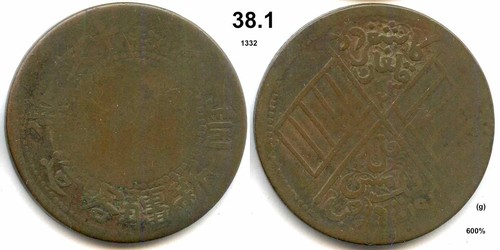
10 Cash (Republic)
Republic of China era (from 1912; many issues struck through the 1910s-1920s)