
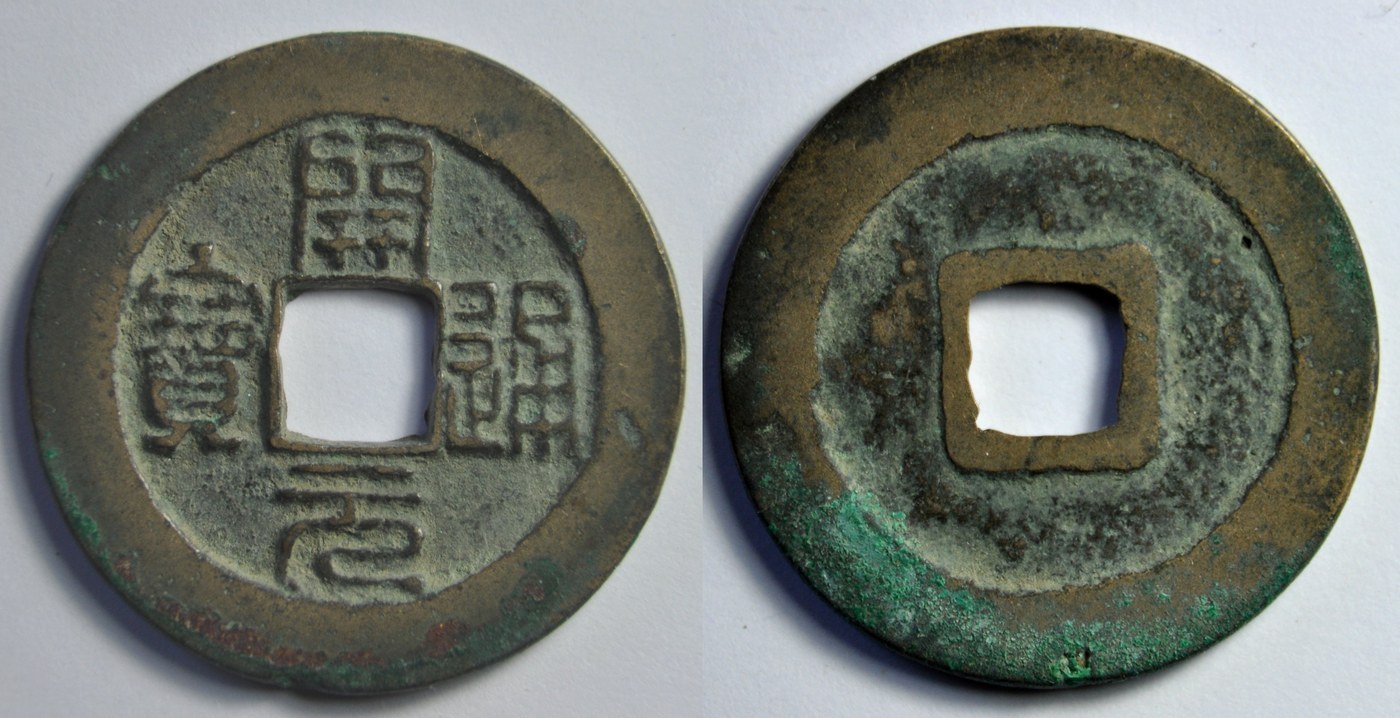
Kai Yuan Tong Bao
A Tang-dynasty Chinese bronze cash coin with the four seal-script characters Kai Yuan Tong Bao around a central square hole.
- Country
- China
- Denomination
- 1 Cash
- Metal
- Bronze
Got a coin like this?
Identify any coin from a photo, free.
Overview
The coin pictured is a Kai Yuan Tong Bao, the standard bronze cash coin of China's Tang dynasty and one of the most influential coin types in East Asian history. It is a round coin with a central square hole, the classic form of Chinese cast coinage that endured for two thousand years. The four characters around the hole read Kai Yuan Tong Bao (開元通寶), rendered here in the crisp seal-influenced regular script attributed to the calligrapher Ouyang Xun.
The name is usually understood as "inaugural currency" or "circulating treasure of the new beginning," marking a break from earlier coins that were named for their weight. On this example the obverse carries the four-character legend and the reverse is blank apart from the square hole, which is typical of the earliest Tang issues; later castings sometimes added crescents, dots, or mint characters on the back.
Because the type was cast in enormous quantities across nearly three centuries and imitated long afterward, individual pieces like this one are common and are collected as accessible, historically rich examples of medieval Chinese money rather than for any precious-metal content.
History & Background
The Kai Yuan Tong Bao was introduced in 621 AD, early in the reign of Emperor Gaozu, the founder of the Tang dynasty. It replaced the older wu zhu coinage that had circulated in various forms since the Han dynasty, and it deliberately abandoned weight-based coin names in favor of an auspicious reign-style legend. The reform set the standard weight and module for the Chinese cash coin, and the tong bao ("circulating treasure") formula it established was copied by Chinese dynasties for the next thousand years.
Minted continuously through most of the Tang period, the type was produced at numerous imperial mints and in vast numbers, which is why so many survive today. Its influence spread well beyond China: cash coins of the same round-with-square-hole form and comparable legends were later cast in Japan, Korea, and Vietnam, making the Kai Yuan a foundational design for the wider East Asian monetary world.
Because the coin was cast rather than struck, and because it was produced over such a long span, there is considerable variety in calligraphy, size, and reverse markings. Later imitations and continued casting after the Tang mean that the type is often encountered outside a strictly datable context, and precise attribution of a given specimen usually rests on style and reverse details.
How to Identify
Identify the coin first by its form: a round bronze disc with a central square hole, cast rather than struck. The obverse bears exactly four Chinese characters arranged around the hole, read top-bottom-right-left as Kai Yuan Tong Bao (開元通寶). The lettering is in a distinctive early-Tang script with strong, even strokes; recognizing this four-character legend is the single most reliable identifier.
On the example shown the reverse is blank except for the square hole and a plain raised rim, which is consistent with the earlier Tang issues. Many later Kai Yuan castings show reverse features such as a crescent ("fingernail") mark, a dot, or a single mint character; the presence or absence of these helps place a specimen within the long production history but does not change the basic identification.
Typical pieces are modest in size and made of a bronze (copper-alloy) casting with a brown or greenish patina from age. Note that because the type was cast for centuries and widely imitated, reading the exact characters and comparing the calligraphy and reverse against reference charts is more dependable than judging by size or wear alone.
Value & Collectibility
The Kai Yuan Tong Bao was produced in enormous quantities and is one of the most common of all ancient Chinese coins, so ordinary circulated examples sit at the affordable end of the market. Well-worn pieces with a plain blank reverse are typically inexpensive and are often sold in groups, making the type a popular entry point for collectors of Chinese cash.
Value rises with condition, sharpness of the calligraphy, attractive patina, and scarcer reverse varieties. Coins with distinctive reverse crescents, dots, or mint marks, unusually large or fine castings, and clearly early strikes can command more, while damaged, corroded, or heavily cleaned pieces are worth less.
Because casting spanned centuries and imitations abound, treat any single price as a broad guide rather than a fixed figure. For better examples, compare against recent sales of the same variety and, where value warrants, seek specialist attribution to distinguish early Tang issues from later castings and copies.
Frequently asked questions
What do the four characters mean?
They read Kai Yuan Tong Bao (開元通寶), usually translated as "inaugural currency" or "circulating treasure of the new beginning." It marks the Tang reform that replaced weight-based coin names with an auspicious legend.
How old is this coin?
The type was first cast in 621 AD under the Tang dynasty and continued to be produced for much of the following centuries. A given piece dates broadly to the Tang era (7th-10th century AD), with the exact period judged from style and reverse details.
Why is there a square hole in the middle?
The central square hole is the standard form of Chinese cash coins. It let coins be strung together in bundles and held on a square rod so many could be filed or finished at once during casting.
Is my Kai Yuan Tong Bao rare or valuable?
Most are common and inexpensive because the type was cast in huge numbers over a long period. Value depends on condition, calligraphy, patina, and scarcer reverse varieties, with special mint marks or fine early examples worth more.
Why is the back of the coin blank?
A plain blank reverse is typical of the earlier Tang issues. Later castings sometimes added a crescent, a dot, or a mint character on the reverse, but a blank back is normal and does not indicate a problem.
Kai Yuan Tong Bao guides
In-depth guides for identifying, valuing, and collecting Kai Yuan Tong Bao.
Other coins you may enjoy
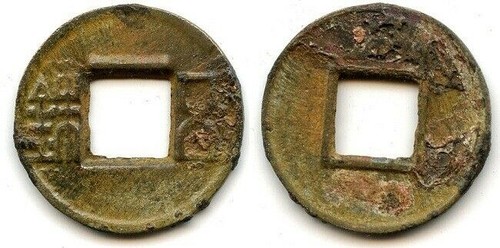
Wu Zhu Cash
Han Dynasty (issue attributed to the reign of Emperor Xuandi, 74-49 BC)
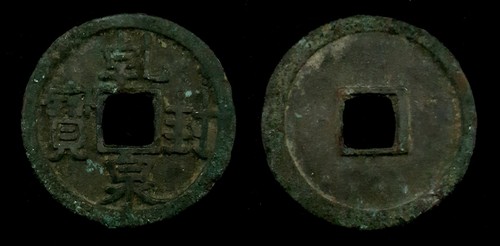
Qian Feng Quan Bao
Tang Dynasty, Qianfeng era (666-667 CE)

Qianlong Tongbao (An Nam)
18th century (Qianlong period, mid-to-late 1700s)
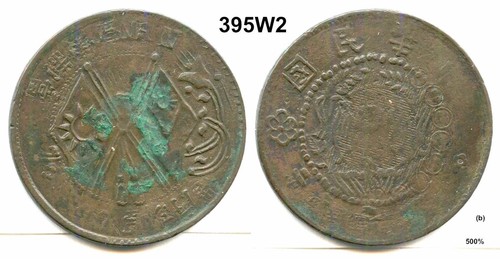
Ho-Nan 100 Cash
Republic of China era (circa 1920s–1930s)
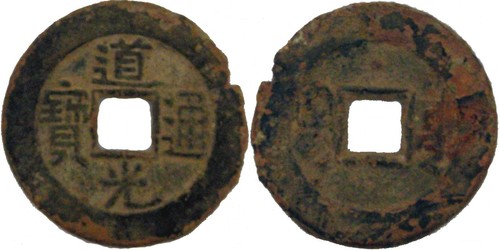
Daoguang Tongbao
1821–1850
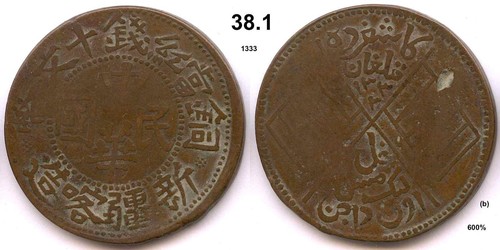
Aksu Mint 10 Cash
Republic of China period (early 20th century)
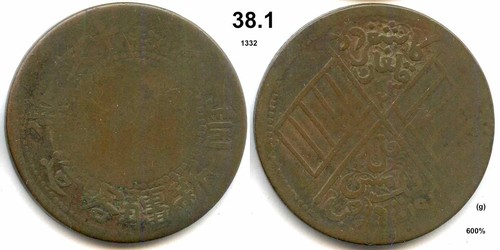
10 Cash (Republic)
Republic of China era (from 1912; many issues struck through the 1910s-1920s)