
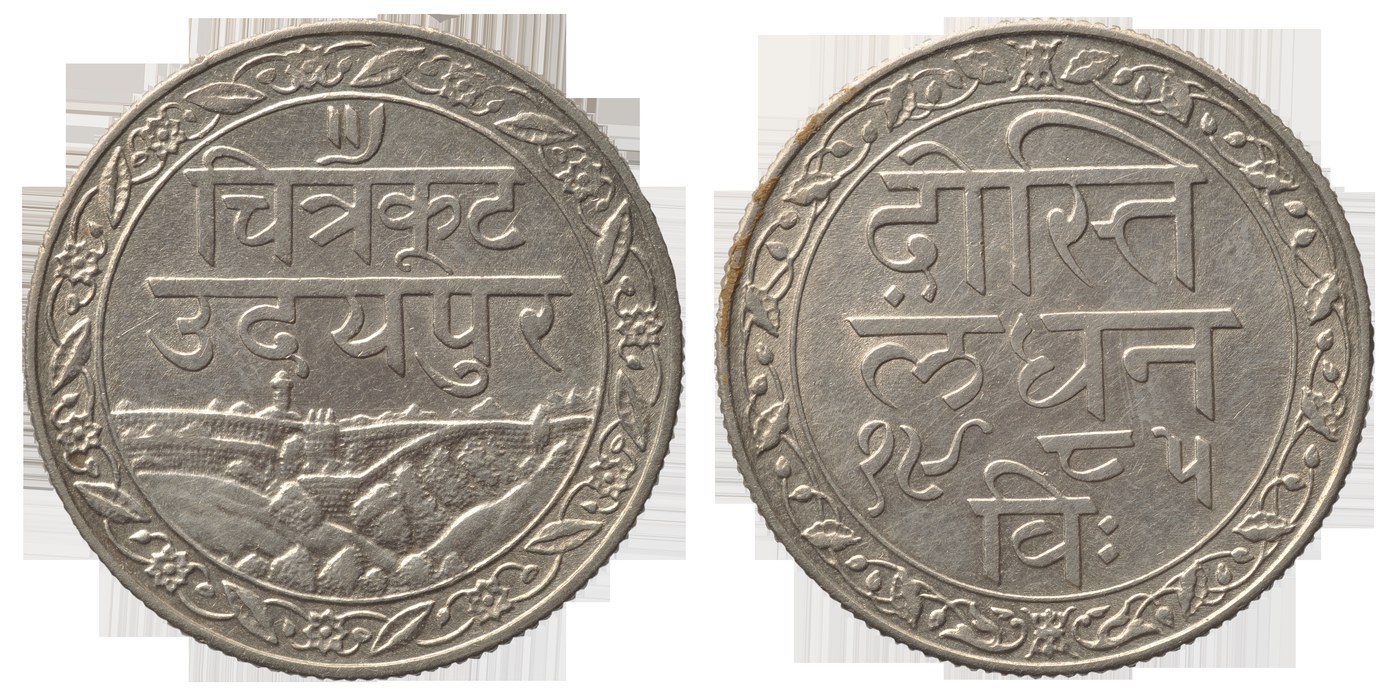
Mewar Chitrakut Half Rupee
A silver half rupee of the princely state of Mewar (Udaipur), dated VS 1985 (c. 1928), with Devanagari legends including the denomination अर्धरुपये.
- Country
- India
- Denomination
- 1/2 Rupee
- Metal
- Silver
Got a coin like this?
Identify any coin from a photo, free.
Overview
The Mewar Chitrakut Half Rupee is a silver coin of the princely state of Mewar in Rajputana (modern Rajasthan), whose ruling house governed from Udaipur. The example shown is dated Vikram Samvat 1985, which corresponds to roughly AD 1928. Its obverse carries the Devanagari denomination अर्धरुपये ("ardha rupaye," meaning half rupee) within an ornamental border, while the reverse bears further Devanagari inscriptions set within a decorative pattern.
Unlike the earlier hand-struck Mewar coinage, this half rupee belongs to the state's later, more regular machine-made issues, on which the value, place and date are spelled out in the Devanagari script rather than left to abbreviated symbols. The "Chitrakut" element in its name refers to Chittor (Chittorgarh), the ancient fortress capital of Mewar, whose name the dynasty continued to honour on its coins long after the seat of government moved to Udaipur.
As a state issue rather than a British India coin, it circulated primarily within Mewar and its neighbouring markets, functioning as a half unit of the local silver rupee.
History & Background
Mewar was one of the senior Rajput states of Rajputana, ruled by the Sisodia dynasty who traced their line to Chittor before establishing Udaipur as their capital in the sixteenth century. The state entered into a treaty relationship with the British East India Company in 1818, after which it retained internal autonomy — including the right to strike its own coinage — under overall British paramountcy. That arrangement continued through the period this coin was made.
A date of Vikram Samvat 1985 places the piece around AD 1928, during the reign of Maharana Fateh Singh, who ruled Mewar from 1884 until 1930. By this era many princely mints were modernising, moving from irregular hand-struck flans toward more uniform, milled coins produced with mechanical presses. Coins bearing the state's own Devanagari legends and Vikram Samvat dates are characteristic of this later phase of Mewar coinage.
The coinage of Mewar continued into the reign of the last ruling Maharana before the Indian states were integrated into the Republic of India after 1947, at which point the separate rupee systems of the princely states were withdrawn in favour of a unified national currency.
How to Identify
This is a silver coin of half-rupee size, smaller and lighter than a full state rupee and correspondingly larger than the quarter-rupee and smaller fractions of the same series. It is broadly circular, and on later machine-struck examples the flan and strike are noticeably more regular than on the older hand-struck Mewar coins.
The surest identifier is the Devanagari legend. The obverse states the denomination directly as अर्धरुपये (half rupee) within an ornamental border, which immediately separates this coin from the full rupee and from lower fractions of the same design family. The reverse carries additional Devanagari inscriptions — the state and mint identity together with the Vikram Samvat date — framed by a decorative pattern. Reading the date as VS 1985 confirms an issue of about AD 1928.
Because the entire coin is inscribed in Devanagari and dated in the Vikram Samvat era, it should not be confused with British India half rupees of the same period, which carry English lettering, a royal portrait or the crowned effigy, and a Christian-era date. The absence of any English text or ruler portrait, and the presence of the spelled-out Devanagari denomination and VS date, mark it as a Mewar state issue.
Value & Collectibility
As a silver princely-state fraction, the Mewar Chitrakut Half Rupee draws interest from collectors of Indian States coinage as well as from those who value it for its silver content. Values are shaped mainly by condition, the sharpness and completeness of the Devanagari legends, the specific Vikram Samvat date, and eye appeal. Well-struck, fully legible examples with clear dates are more desirable than worn or weakly struck pieces.
Half rupees are generally less common in the market than the full state rupee of the same series, which can add modest collector appeal, though half rupees also tend to be smaller and less showy. Because these coins were issued in varying quantities across different dates, some year-and-denomination combinations are scarcer than others; an accurate reading of the date is therefore the biggest single factor in placing a given coin within the series.
Exact prices vary widely with grade and demand, so figures here are context rather than fixed quotations. As with all silver state coinage, condition and clear attribution — confirming both the denomination and the Vikram Samvat date — matter most in determining where a particular example sits.
Frequently asked questions
What does the Devanagari अर्धरुपये on the coin mean?
It reads "ardha rupaye," meaning half rupee. It is the denomination spelled out in the Devanagari script, telling you directly that the coin is a half unit of the Mewar silver rupee.
What year is VS 1985 in the common era?
VS stands for Vikram Samvat, a calendar era used in the coin's dating. Vikram Samvat 1985 corresponds to approximately AD 1928, during the reign of Maharana Fateh Singh of Mewar.
Why is it called a Chitrakut half rupee?
Chitrakut refers to Chittor (Chittorgarh), the historic fortress capital of Mewar. The dynasty continued to honour that name on its coinage even after the capital moved to Udaipur.
Is this a British India coin?
No. It is a coin of the princely state of Mewar, which struck its own money under British paramountcy. It carries only Devanagari legends and a Vikram Samvat date, with no English lettering or royal portrait.
Is the coin made of silver?
Yes, it is a silver half rupee of the Mewar state series, struck as a half unit of the local rupee. As with other state silver, exact fineness can vary by issue.
Mewar Chitrakut Half Rupee guides
In-depth guides for identifying, valuing, and collecting Mewar Chitrakut Half Rupee.
Other coins you may enjoy
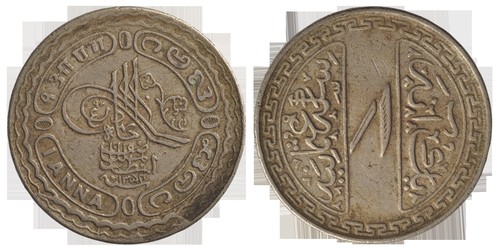
Hyderabad One Anna
AH 1354 (c. 1935 CE); type of the 1930s–1940s
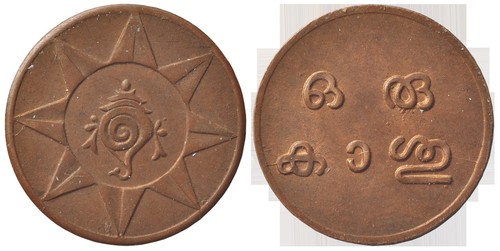
Travancore One Cash
Early 20th century
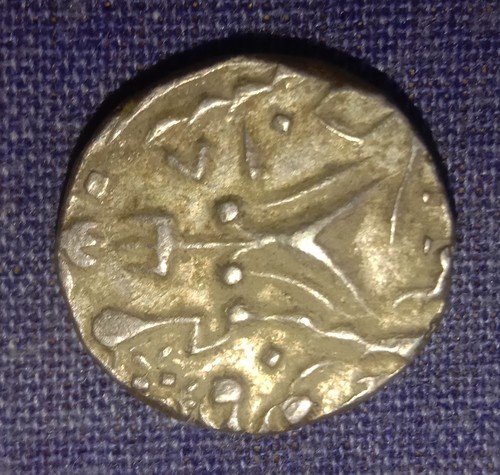
Silver Rupee of Bhopal State
c. 1806-1837 (name of Muhammad Akbar II)
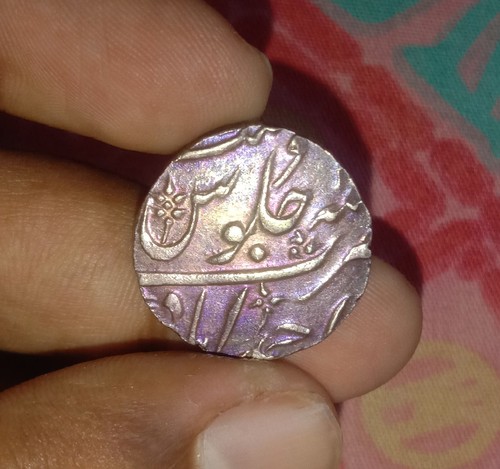
Silver Rupee of Bombay Presidency
c. 1806-1837 (Akbar II era)
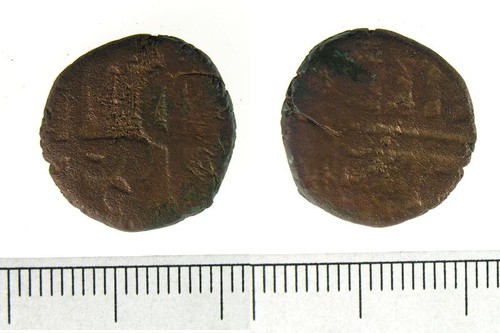
Indian Paisa
c. 1820–1830
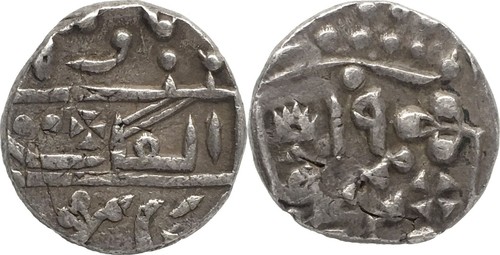
Kotah State Rupee
1858-1901
Travancore Eight Cash
Early 20th century
Travancore One Chuckram
Early 20th century