
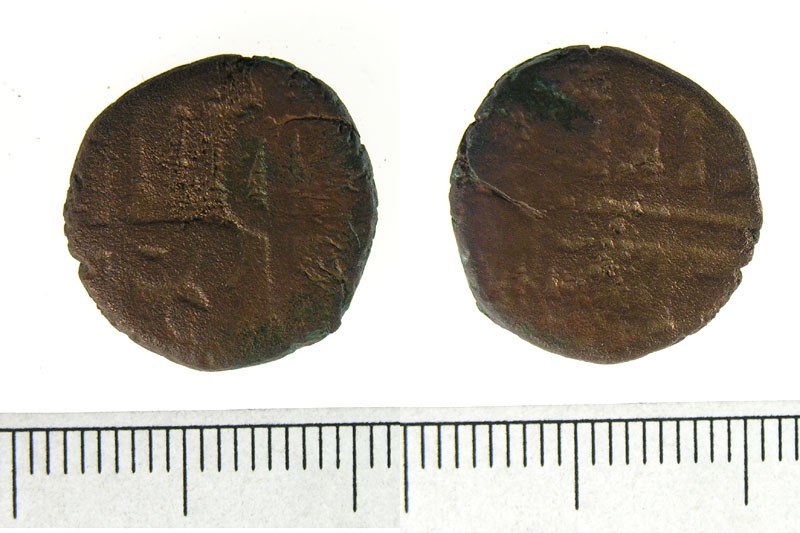
Indian Paisa
A hand-struck copper paisa from early 19th-century India, its legends worn smooth by age and circulation. A humble base-metal coin of everyday commerce.
- Country
- India
- Denomination
- 1 Paisa
- Metal
- Copper
Got a coin like this?
Identify any coin from a photo, free.
Overview
The Indian paisa shown here is a small, hand-struck copper coin of the type used for everyday small transactions across India in the early 19th century. It is dated to roughly 1820–1830 on the basis of style and fabric. Both the obverse and reverse legends are so worn from age and circulation that they are effectively illegible, which is very common for base-metal coins of this era.
The paisa (also written pice) was the workhorse copper denomination of the Indian monetary system, sitting well below the silver rupee in value. Coins of this kind were issued in large numbers by numerous princely states and the European trading presidencies, and they passed from hand to hand for decades, which is exactly why so many survive in heavily worn condition.
Because the inscriptions on this particular example can no longer be read, it is best described by what can be observed directly: a copper flan of paisa size and weight, aniconic in the Indian tradition, with the surface detail largely smoothed away.
History & Background
In the early 19th century India had no single unified coinage. Alongside the coins of the British East India Company presidencies (Bengal, Madras and Bombay), hundreds of princely states struck their own money, and copper paisas were the most widely produced small change of all. The paisa's ancestry lies in the copper falus and paisa of the Mughal system, and many post-Mughal issuers simply continued that tradition after central Mughal authority declined.
A copper paisa of about 1820–1830 belongs to this fragmented, transitional period. Silver rupees held most of the store of value, while copper paisas handled the small daily purchases of ordinary people. Because they were low in value and struck by hand, individual pieces received little care in manufacture and heavy use in circulation.
The decades that followed saw the gradual consolidation of Indian coinage, culminating after 1835 in more standardized East India Company issues and, later, uniform British Indian coinage. Worn anonymous paisas like this one are relics of the earlier, decentralized world that preceded that standardization.
How to Identify
This is a copper coin of paisa size — typically a thick, roughly circular to slightly irregular flan on the order of about 15–25 mm across, though exact dimensions vary widely between issuers. Copper of this age normally shows a brown, reddish or dark patina and, on well-used pieces like this one, a smooth surface where the design has been worn flat.
On the coin shown, the legends on both faces are illegible due to wear, so the specific ruler, state and mint cannot be read. Genuine paisas of the period are aniconic, carrying inscriptions and ornamental devices rather than portraits; what remains here is largely the shape and metal rather than readable text. The hand-struck manufacture often leaves the design off-center, with parts of any original legend running off the edge even before wear is taken into account.
Attribution of a coin in this state relies on fabric, size and weight rather than on reading the inscription. A magnet test helps confirm it is copper and not a later magnetic imitation, and the overall thickness and diameter place it within the paisa range rather than among the larger double-paisa or smaller fractional coppers.
Value & Collectibility
Heavily worn, unattributed copper paisas are among the most common and least expensive Indian coins on the market. Because they were struck in vast numbers and circulated for decades, ordinary well-worn examples typically trade for very modest sums, often as inexpensive bulk or study pieces rather than as premium collectibles.
Value rises sharply when a coin can be attributed — that is, when the legend is clear enough to identify the issuing state, ruler, mint and date. Sharp, well-centered strikes, scarce mints, and pieces tied to a specific historical issuer command more than an anonymous worn coin can. Unfortunately, when the inscriptions are illegible, as on the example here, that attribution premium is largely lost.
As always with hand-struck base-metal coins, condition, readability and specialist demand set the price, so any figures are general context rather than fixed values. A worn paisa is valued chiefly as an affordable, tangible piece of early 19th-century Indian everyday commerce.
Frequently asked questions
What is an Indian paisa?
The paisa (or pice) was the main copper small-change coin of India. It sat below the silver rupee in value and was used for everyday minor purchases. This example is a copper paisa of roughly 1820–1830.
Why can't the writing on my coin be read?
Copper paisas circulated heavily for years and were struck by hand, so the inscriptions often wear smooth. On this coin the legends on both sides are worn away and can no longer be read, which is common for base-metal coins of this age.
Who issued paisas like this?
In the early 19th century, copper paisas were struck by many princely states and by the European trading presidencies in India. Because this coin's legend is illegible, the exact issuer and mint cannot be determined from the piece itself.
Is it made of real copper?
Yes. Paisas of this period are copper, typically showing a brown or reddish patina with age. Copper is not magnetic, so a coin that is attracted to a magnet would be a later imitation rather than a genuine copper paisa.
Is a worn paisa worth much?
Usually not a great deal. Worn, unattributed copper paisas are common and inexpensive. Value depends heavily on being able to read the legend to identify the state, ruler and mint, which is not possible on a piece this worn.
Indian Paisa guides
In-depth guides for identifying, valuing, and collecting Indian Paisa.
Other coins you may enjoy
Hyderabad One Anna
AH 1354 (c. 1935 CE); type of the 1930s–1940s
Travancore One Cash
Early 20th century
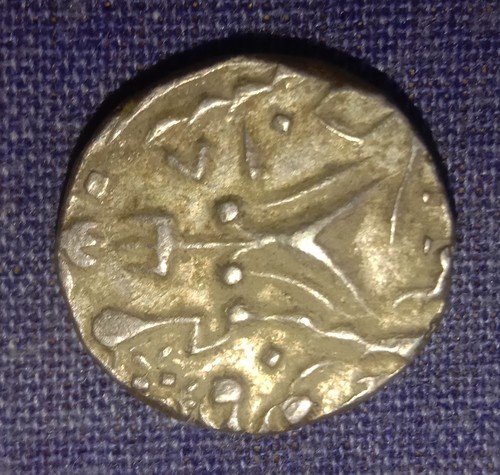
Silver Rupee of Bhopal State
c. 1806-1837 (name of Muhammad Akbar II)
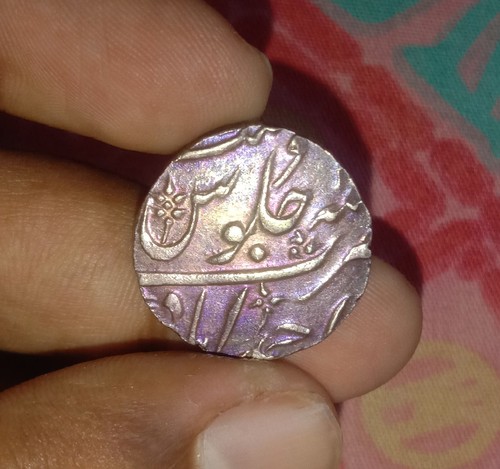
Silver Rupee of Bombay Presidency
c. 1806-1837 (Akbar II era)
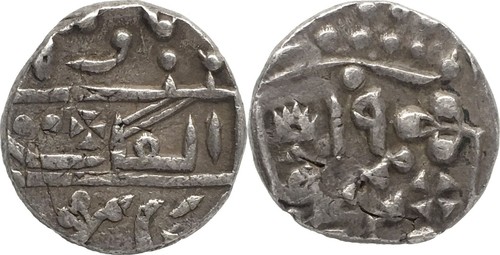
Kotah State Rupee
1858-1901
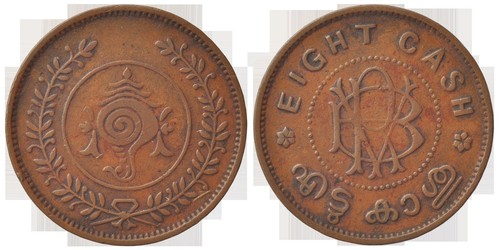
Travancore Eight Cash
Early 20th century
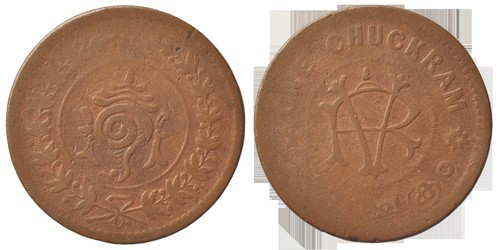
Travancore One Chuckram
Early 20th century
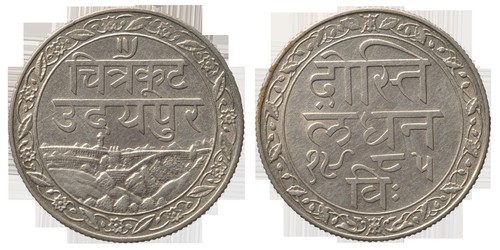
Mewar Chitrakut Half Rupee
circa VS 1985 (AD 1928)