
How to Identify the Mewar Chitrakut Half Rupee
A collector's guide to attributing a Mewar (Udaipur) silver half rupee: reading the Devanagari denomination, the Vikram Samvat date and telling it from British India coins.
Read the full Mewar Chitrakut Half Rupee encyclopedia entry →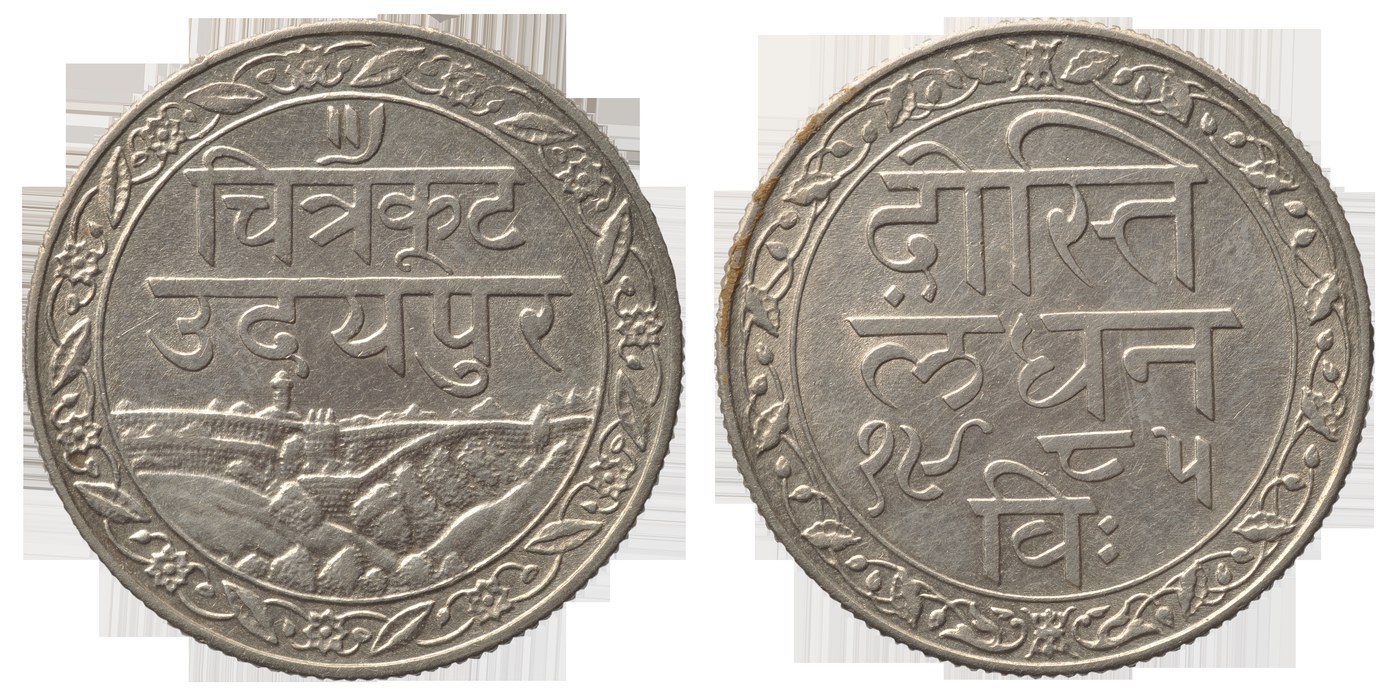
Begin with size and metal. This is a silver coin at the half-rupee level, so it should sit between the full state rupee and the quarter rupee in both diameter and weight. Later Mewar issues like this one are machine-struck, so a fairly round flan and an even, regular strike are expected; a badly misshapen or crudely cut blank points instead to an older hand-struck coin or to a fake. The metal should be silver in colour and non-magnetic.
The decisive test is the script. Confirm the obverse shows the Devanagari denomination अर्धरुपये (half rupee) inside its ornamental border — this single legend fixes the value and separates the coin from the full rupee and from the smaller quarter and eighth fractions of the same design family. Do not rely on diameter alone, since worn coins of adjacent denominations can look similar; the spelled-out denomination is the reliable anchor.
Next, read the reverse. It carries Devanagari inscriptions naming the state and mint together with the date, set within a decorative pattern. The date is given in the Vikram Samvat era, so a reading of VS 1985 corresponds to about AD 1928. Because scarcity within the series depends heavily on the exact year, taking the time to read the Vikram Samvat date correctly is the most valuable step in a serious attribution.
Rule out the main look-alike: British India half rupees of the same decade. Those carry English lettering, a monarch's portrait or crowned effigy, and a Christian-era date. If your coin has any English text or a ruler's bust, it is not a Mewar state issue. A coin that is entirely Devanagari, with the denomination written out and a VS date, is consistent with the Mewar series shown here. Be aware that other Rajputana and princely states also struck Devanagari-legend silver, so read the actual legends rather than assuming from the script alone.
Finally, apply standard authentication caution. Genuine machine-struck coins have crisp, well-defined lettering and no casting seams; a soft, grainy or bubbled surface, a mould line around the rim, or an off weight are warning signs of a cast copy. When unsure, weigh and measure the coin, photograph both faces clearly, and have the Devanagari legends and the Vikram Samvat date checked against standard references on Indian States coinage.
Frequently asked questions
How do I tell this from a British India half rupee of the same period?
Look for script and imagery. British India coins carry English lettering, a royal portrait or crowned effigy, and a Christian-era date. The Mewar coin is entirely Devanagari, states its denomination as अर्धरुपये, and is dated in the Vikram Samvat era.
Where do I find the date, and how do I convert it?
The date appears in the Devanagari reverse inscription in the Vikram Samvat (VS) era. Subtract roughly 57 years to reach the common era, so VS 1985 is about AD 1928.
How can I confirm it is the half rupee and not another fraction?
Read the obverse denomination legend अर्धरुपये, meaning half rupee. Because worn coins of nearby denominations can be similar in size, the written denomination is more reliable than diameter alone.
What are the signs of a fake?
Machine-struck originals show sharp lettering and no casting marks. Watch for casting seams, a mould line at the rim, a soft or bubbled surface, incorrect weight, or magnetic metal, and verify the legends against reference material when in doubt.