
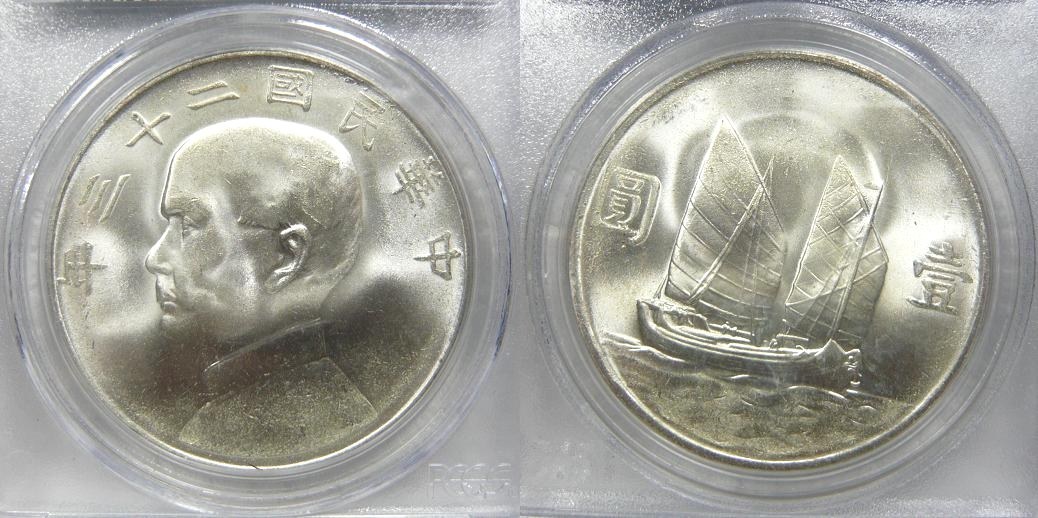
Junk Dollar
China's Republic-era silver dollar with Sun Yat-sen facing left and a Chinese junk under sail on the reverse; the pictured coin is Year 23 (1934).
- Country
- China
- Denomination
- 1 Yuan
- Metal
- Silver
Got a coin like this?
Identify any coin from a photo, free.
Overview
The coin pictured is a Chinese 1 Yuan (silver dollar) of the Republic of China, universally nicknamed the "Junk Dollar" for the sailing junk on its reverse. The obverse carries a left-facing bust of Sun Yat-sen (Sun Zhongshan), founding father of the Republic, above a date in Chinese characters reading 中華民國二十三年 -- the 23rd year of the Republic, corresponding to 1934.
The reverse shows a traditional Chinese junk sailing to the left across water, with the denomination 壹圓 ("one yuan/dollar") flanking the ship. It is a large crown-size silver coin, struck in roughly 0.880-fine silver at about 26.7 grams and 39 mm in diameter, matching the international trade-dollar standard of its day.
The Junk Dollar was the principal circulating silver dollar of Nationalist China in the early 1930s and is among the most widely collected of all modern Chinese coins. The Year 23 (1934) issue seen here is the most abundant date of the type.
History & Background
After years of competing provincial and warlord dollars, the Nationalist government sought a single unified national silver dollar. The junk design was introduced in Year 21 (1932) pairing Sun Yat-sen's portrait with a Chinese junk. That first 1932 issue famously included a rising sun and flying birds above the ship; the motifs were dropped in the following years, a change traditionally explained by their unwanted resemblance to Japanese imperial imagery amid rising tensions with Japan.
The cleaner design without the sun and birds was struck for Year 22 (1933) and Year 23 (1934), the latter being produced in very large numbers and serving as the workhorse silver dollar of the period. The coins were struck at Republic mints, with the Shanghai Central Mint a principal producer.
The type's circulation was cut short by the mid-1930s. Global silver-price swings and the U.S. Silver Purchase Act drained silver from China, prompting the government's 1935 currency reform that abolished the silver standard in favor of paper fabi. Silver dollars like the Junk were withdrawn, ending the series and making it a closing chapter of China's silver-dollar era.
How to Identify
Identify the Junk Dollar first by its two signature devices: a bust of Sun Yat-sen facing left on the obverse and a Chinese junk under sail on the reverse. The obverse date is written in Chinese characters as 中華民國 (Republic of China) followed by the year -- here 二十三年, Year 23 = 1934. The reverse denomination reads 壹圓 (one yuan).
Confirm the physical profile: a crown-size silver coin near 26.7 g and 39 mm, with a reeded edge, in roughly 0.880-fine silver. The pictured 1934 coin shows the ship alone above the water; distinguish it from the scarcer Year 21 (1932) variety, which adds a sun and three flying birds above the junk.
Read the year characters carefully to separate the common Year 23 (1934) from Year 22 (1933) and the earlier 1932 issue, as date drives both variety and value. Any English wording is absent -- all legends are in Chinese characters.
Value & Collectibility
As a large 0.880-fine silver coin of about 26.7 g, every genuine Junk Dollar carries a silver-bullion floor that moves with the metal price, so worn or damaged examples trade close to melt plus a modest collector premium. The common Year 23 (1934) date is affordable in circulated grades and is one of the most frequently traded modern Chinese coins.
Value rises sharply with grade and eye appeal: lightly circulated to Mint State 1934 dollars command solid premiums, while the scarcer Year 21 (1932) sun-and-birds variety and high-grade certified examples of any date are worth substantially more. Prices span a wide range from bullion-level up into strong collector territory.
Because the Junk Dollar is heavily counterfeited, condition alone should not drive a purchase. Treat any single price as a guide only and rely on recent sales for the matching date and grade, ideally with third-party certification for higher-value pieces.
Frequently asked questions
Who is on the front of the Junk Dollar?
The obverse shows Sun Yat-sen (Sun Zhongshan), the founding father of the Republic of China, in a left-facing bust. Above him is a Chinese date reading 'Republic of China, Year 23,' which corresponds to 1934.
What does the ship on the back mean?
It is a traditional Chinese junk sailing under full sail, the design element that gives the coin its 'Junk Dollar' nickname. It flanks the denomination 壹圓 (one yuan) and symbolizes the nation moving forward.
How much silver does it contain?
The Junk Dollar is a crown-size silver coin of roughly 0.880 fineness, about 26.7 grams total and near 39 mm across. Its silver content gives every genuine example a bullion value that tracks the silver price.
What is the difference between the 1932 and 1934 issues?
The first Year 21 (1932) issue placed a rising sun and three flying birds above the junk. Those motifs were removed for Year 22 (1933) and Year 23 (1934), so the pictured 1934 coin shows the ship alone. The 1932 variety is scarcer.
Why did the Junk Dollar stop being made?
Rising world silver prices and the U.S. Silver Purchase Act drained silver from China, leading to the 1935 currency reform that ended the silver standard and replaced silver dollars with paper fabi, closing the series.
Junk Dollar guides
In-depth guides for identifying, valuing, and collecting Junk Dollar.
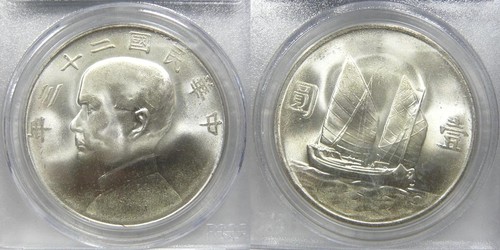
Junk Dollar identified by the community
Real coins identified with Coin Identifier.
Other coins you may enjoy
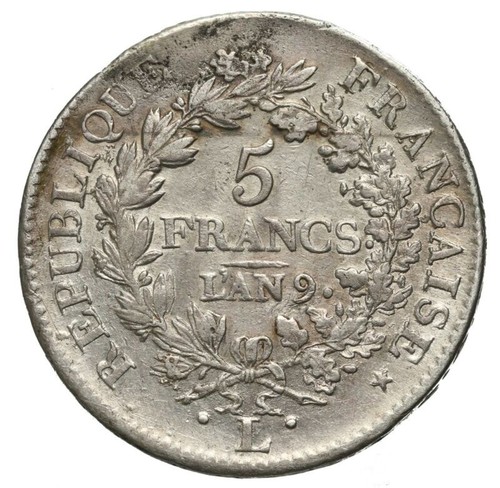
5 Francs (First Republic)
L'an 9 (1800–1801)
Trinidad and Tobago Dollar
2015
German 5 Reichsmark (Hindenburg)
1935–1936 (Hindenburg type with swastika)
5 Francs Semeuse
1960–1969
French Cérès 1 Franc
1849–1895
French Semeuse 2 Francs
1898–1920 (silver issues; pictured example dated 1899)
French Semeuse 1 Franc
1898–1920 (silver Semeuse 1 franc type)
France 50 Cent Euro
1999–present
Swiss 1 Franc
1861
France 20 Centimes
1962–2001 (Fifth Republic, Marianne / Lagriffoul type)
Swiss 2 Francs
1860
Austria-Hungary 15 Kreuzer
1807