
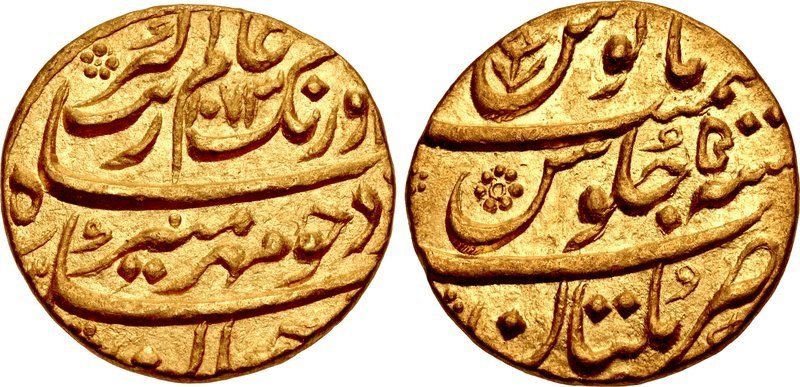
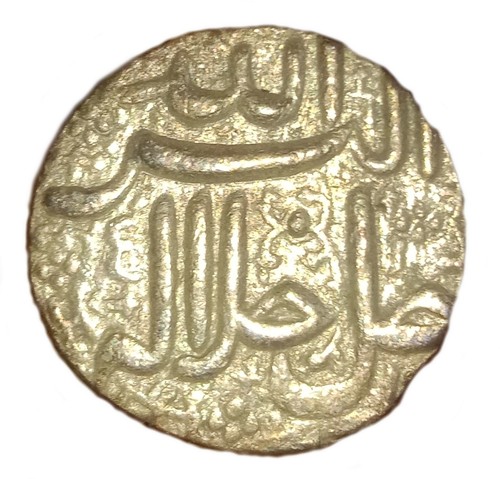
Gold Mohur of Aurangzeb
A hand-struck gold mohur of Mughal emperor Aurangzeb Alamgir, bearing Persian couplets and a mint name such as Multan.
- Country
- India
- Denomination
- Mohur
- Metal
- Gold
Got a coin like this?
Identify any coin from a photo, free.
Overview
The gold mohur was the principal high-value gold coin of the Mughal Empire, and issues of Aurangzeb Alamgir (reigned 1658-1707) are among the most frequently encountered. The example shown carries Persian inscriptions across both faces, with the emperor's titles on the obverse and the mint and regnal information on the reverse, including the mint name Multan.
Each mohur was struck by hand from a gold blank, so no two pieces are perfectly identical in centering or strike. The coins are inscriptional rather than pictorial: Mughal issues of this period avoid portraits and figural imagery, relying entirely on elegant Persian calligraphy arranged within circular or square borders.
History & Background
Aurangzeb, who took the reign-title Alamgir ("World-Seizer"), was the sixth Mughal emperor and ruled one of the empire's largest territorial extents. His long reign produced coinage from dozens of active mints spread across the subcontinent, from Multan and Lahore in the northwest to the Deccan in the south.
Early in his reign Aurangzeb replaced the older kalima (Islamic declaration of faith) coin legends with couplets naming the emperor and his sovereignty, a change often linked to his religious policy of not placing sacred text on money that could be handled in unclean conditions. As a result his gold and silver typically bear a rhyming Persian verse plus the mint, regnal year, and the julus (accession) formula. Coins were dated by both Hijri year and the emperor's regnal year.
How to Identify
Look for a round gold coin covered edge to edge in Persian (Arabic-script) legend, with no portrait or figural design. The obverse gives Aurangzeb's name and titles, frequently including the word "Alamgir," while the reverse names the mint and the year of reign, here reading Multan among the mint data.
A full mohur weighs roughly 10.9-11 grams of high-purity gold and is typically about 20-22 mm across, though hand-striking causes variation. Because the dies were larger than some flans, part of the legend may run off the edge, so the mint name and date are not always fully visible on a given specimen.
Value & Collectibility
Value depends heavily on mint, regnal year, calligraphic quality, weight, and state of preservation. Common mints in ordinary grade trade as bullion-plus-premium gold, while scarce mints, unusual dates, or exceptionally well-struck and centered pieces command significant collector premiums.
Because the coin is high-purity gold weighing near 11 grams, its melt value sets a firm floor that moves with the gold price. Well-documented, clearly attributed examples with a legible mint such as Multan generally sell above melt to collectors. For any specific piece, compare recent auction results for the same mint and reign rather than relying on a single figure.
Frequently asked questions
How much gold is in an Aurangzeb mohur?
A full mohur is high-purity gold weighing roughly 10.9 to 11 grams, which is why its metal content alone sets a meaningful minimum value.
Why are there no pictures on the coin?
Mughal coinage of this era is purely inscriptional. Aurangzeb's mohurs carry Persian couplets, titles, mint, and regnal year rather than any portrait or figural image.
What does the mint name Multan tell me?
It identifies where the coin was struck. Aurangzeb operated many mints; the mint name plus regnal year are key to attributing and valuing a specific piece.
Is this the same as a rupee?
No. The rupee was the standard silver coin. The mohur was the gold denomination, worth a multiple of the silver rupee and struck to a similar inscriptional design.
Gold Mohur of Aurangzeb guides
In-depth guides for identifying, valuing, and collecting Gold Mohur of Aurangzeb.
Other coins you may enjoy
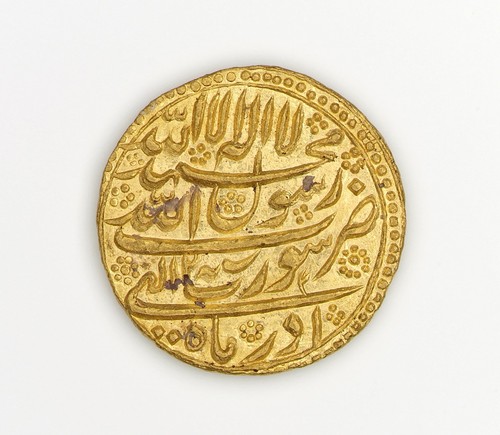
Gold Mohur of Shah Jahan
1628-1658
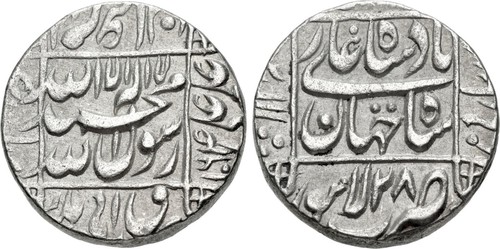
Shah Jahan Rupee
AH 1064 (AD 1653-1654)
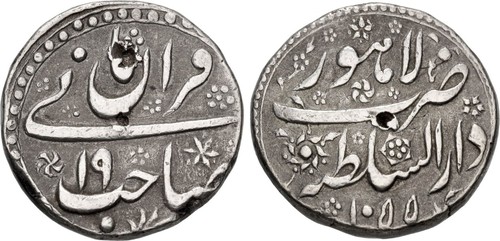
Shah Jahan Half Rupee
AH 1055 (AD 1647)
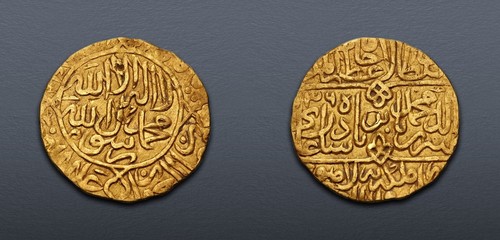
Mithqal (Tilla) of Babur
AH 932–937 (AD 1526–1530)
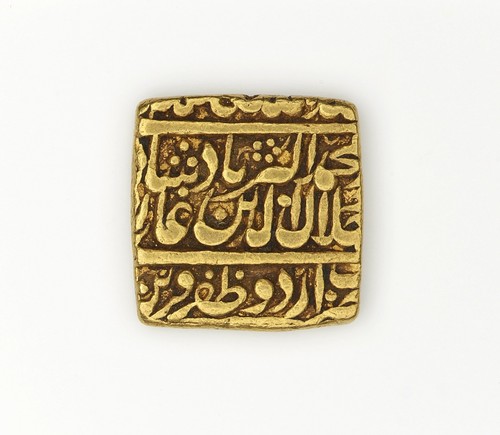
Gold Mohur of Akbar
1556-1605
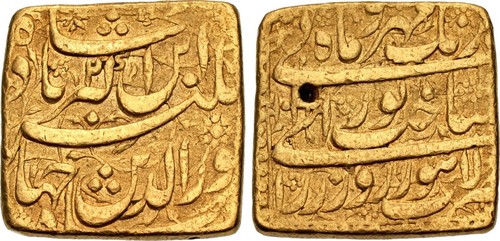
Gold Square Mohur of Jahangir
1605-1627
Silver Rupee of Ahmadabad
Reign of Akbar, 1556-1605 CE (this coin dated Regnal/Ilahi Year 47, c. 1602-03 CE)