
How to Identify the Gold Mohur of Aurangzeb
Diagnostics for attributing a hand-struck Mughal gold mohur of Aurangzeb: legends, mint names, weight, and authentication cautions.
Read the full Gold Mohur of Aurangzeb encyclopedia entry →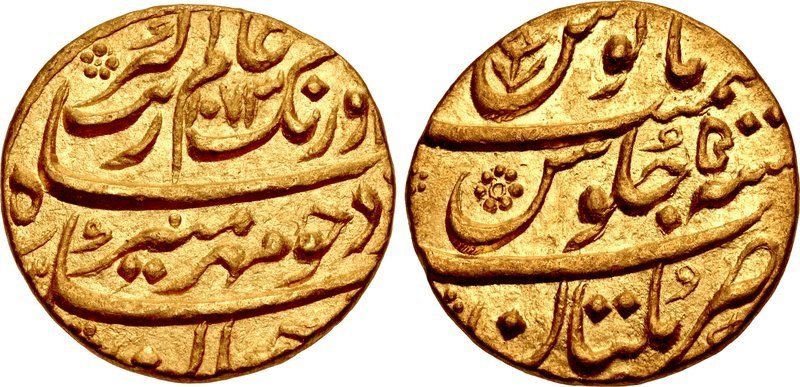
Start with metal and format. Confirm you are holding a yellow, high-purity gold coin roughly 20-22 mm across and near 11 grams. It should be entirely covered in flowing Persian (Arabic-script) legend with no portrait, animal, or figure. A pictorial design or a much lighter, paler piece points away from a genuine imperial mohur.
Read the two faces. The obverse carries Aurangzeb's name and titles, often including "Alamgir" and a sovereignty couplet; the reverse gives the mint name and the regnal/Hijri year plus the julus formula. On the pictured coin the reverse mint reads Multan. Because Mughal dies were often larger than the flan, expect part of the legend to run off the edge, so the mint or date may be only partly present.
Use mint and date to attribute. The combination of mint name and regnal year is what distinguishes one issue from another and drives scarcity. Cross-check the couplet and mint against a standard Mughal reference (such as catalogs of Aurangzeb's coinage) rather than relying on the name alone, since successors continued similar inscriptional styles.
Watch for look-alikes and fakes. Later Mughal emperors and some princely states issued visually similar inscriptional gold, and cast copies, gilt forgeries, and modern restrikes exist. Genuine hand-struck pieces show sharp, slightly uneven relief and a weight at or just under the ~11 g standard; casts look soft or grainy and often weigh wrong. Verify weight and specific gravity, and when in doubt seek attribution by a specialist in Mughal numismatics before assigning value.
Frequently asked questions
How can I tell a mohur from a Mughal silver rupee?
Metal and color: the mohur is gold, the rupee is silver. Both share the inscriptional style, so check the metal, weight (~11 g gold vs. ~11.5 g silver), and color rather than the design alone.
The mint name is cut off at the edge. Can I still identify it?
Sometimes. Partial mint names and dates are common because the die exceeded the flan. Match the visible letters and the couplet against reference plates for Aurangzeb's mints to narrow it down.
What are the biggest red flags for a fake?
A soft or grainy surface (casting), incorrect weight, wrong diameter, low specific gravity, or a color suggesting gilt base metal. Sharp uneven hand-struck relief and correct weight support authenticity.