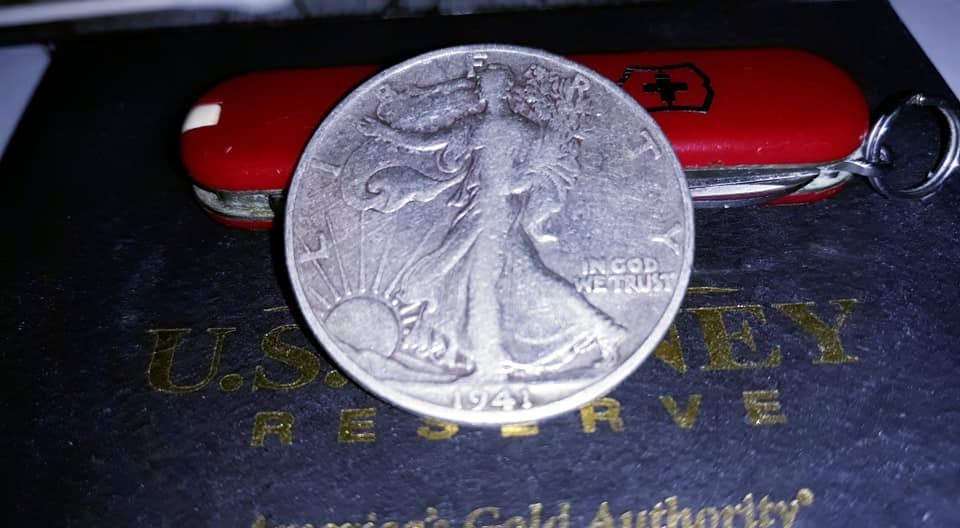
Walking Liberty Half Dollar
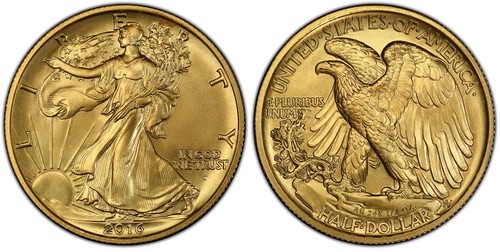
A classic U.S. silver half dollar struck 1916–1947, showing Liberty striding toward the sunrise on the obverse and a perched eagle on the reverse.
- Country
- United States
- Denomination
- 50 cents
- Metal
- Silver
Got a coin like this?
Identify any coin from a photo, free.
Overview
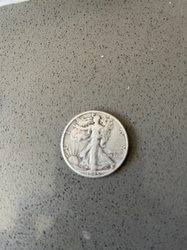
The Walking Liberty Half Dollar is a fifty-cent silver coin produced by the United States Mint from 1916 through 1947. It is widely regarded as one of the most admired designs in American coinage and was the standard half dollar for more than three decades. The example shown here is dated 1943-S, a wartime issue struck at the San Francisco Mint.
The coin is struck in a silver alloy of about 90% silver and 10% copper, measures roughly 30.6 mm in diameter, and weighs about 12.5 grams. The obverse depicts Liberty walking to the left toward a rising sun, draped in the American flag and carrying branches of laurel and oak; the reverse shows an eagle perched on a rocky crag with a mountain-pine sapling. Because it was minted in large quantities across many years, the type is common overall, but individual dates, mint marks, and high grades vary greatly in scarcity.
History & Background
The Walking Liberty Half Dollar was designed by sculptor Adolph A. Weinman and introduced in 1916 as part of a broad renaissance in U.S. coin design that also produced the Mercury dime and other celebrated types of the era. It replaced the Barber half dollar and remained in production until 1947, when it gave way to the Franklin Half Dollar in 1948.
The series spans coins struck at the Philadelphia, Denver, and San Francisco mints, with production interrupted during parts of the 1920s and early 1930s and then resumed heavily through the late 1930s and 1940s. The 1943-S seen here is a World War II–era issue from San Francisco, part of the large wartime output. The design proved so enduring that Weinman's striding Liberty was later revived for the obverse of the American Silver Eagle bullion coin introduced in 1986.
How to Identify
The obverse shows a full-length figure of Liberty striding to the left toward a rising sun at the lower right, wrapped in the Stars and Stripes with laurel and oak branches cradled in her left arm and her right hand extended. LIBERTY arcs across the top, IN GOD WE TRUST appears at the right field, and the date sits at the lower right. The reverse shows an eagle perched on a rocky crag, wings unfolding, with a sapling of mountain pine growing from the rock, surrounded by UNITED STATES OF AMERICA, E PLURIBUS UNUM, and HALF DOLLAR.
The coin is silver, about 30.6 mm across and roughly 12.5 g, with a reeded edge. On the 1943-S and other issues from 1918 onward, the mint mark is on the reverse, at the lower left near the base of the design; on 1916 and part of 1917 it instead appears on the obverse below the motto. A coin with an 'S' at the reverse lower left, like this one, was struck at San Francisco; 'D' indicates Denver, and no mint mark indicates Philadelphia.
Strike quality varies across the series, and Liberty's left hand and the skirt lines are common points where detail is weak or missing. Fully struck examples with complete central detail are prized. These traits help distinguish original coins and grades but are separate from questions of authenticity.
Value & Collectibility
Most circulated Walking Liberty half dollars, including common wartime dates, trade close to their silver bullion value, with modest collector premiums depending on date and condition. As 90% silver coins, they carry intrinsic metal worth that sets a practical floor for worn pieces. The 1943-S is one of the more available dates, so ordinary circulated examples are generally valued for their silver content plus a small premium.
Uncirculated and well-struck 'gem' examples command higher premiums, and certain early dates and low-mintage issues in the series are genuinely scarce and valuable. Value is driven by date, mint mark, grade, strike, and eye appeal. Treat any figures as broad context only; for a specific coin, consult current price guides and, for higher-value pieces, third-party grading by a reputable service such as PCGS or NGC.
Frequently asked questions
What years was the Walking Liberty Half Dollar made?
It was struck from 1916 through 1947 at the Philadelphia, Denver, and San Francisco mints, then replaced by the Franklin Half Dollar in 1948.
Is the Walking Liberty Half Dollar real silver?
Yes. It was struck in an alloy of about 90% silver and 10% copper, weighing roughly 12.5 grams, so it carries real bullion value.
Where is the mint mark on a 1943-S?
On issues from 1918 onward, including the 1943-S, the mint mark is on the reverse at the lower left of the design. An 'S' there means San Francisco.
Is my 1943-S half dollar valuable?
The 1943-S is a common wartime date. Circulated examples are generally worth their silver content plus a small premium, while fully struck uncirculated coins can bring more.
Why is Liberty's hand or skirt sometimes blurry?
Weak central detail is common on the series because of striking characteristics. Fully struck coins with complete hand and skirt lines are more desirable, but soft detail does not mean a coin is fake.
Walking Liberty Half Dollar guides
In-depth guides for identifying, valuing, and collecting Walking Liberty Half Dollar.
Walking Liberty Half Dollar identified by the community
Real coins identified with Coin Identifier.