How to Identify the Walking Liberty Half Dollar
A collector's walkthrough for confirming a Walking Liberty half dollar: the striding Liberty obverse, perched-eagle reverse, size, silver metal, and mint-mark placement.
Read the full Walking Liberty Half Dollar encyclopedia entry →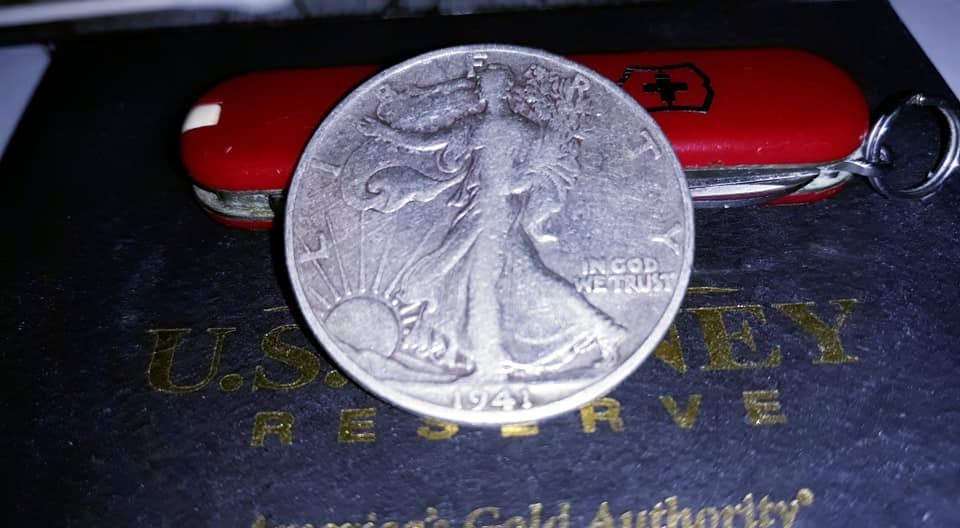
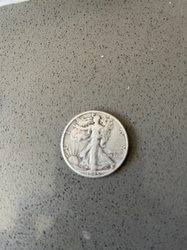
Start with the obverse. A Walking Liberty half dollar shows a full-length Liberty striding to the left toward a rising sun, wrapped in the American flag and carrying laurel and oak branches, with LIBERTY arcing across the top and IN GOD WE TRUST in the right field. This full-figure walking design is distinctive; if the coin shows only a bust or profile head, it is a different half dollar type such as the Barber or Franklin.
Check the reverse. The genuine type shows an eagle perched on a rocky crag with wings beginning to unfold and a small mountain-pine sapling rising from the rock, ringed by UNITED STATES OF AMERICA and HALF DOLLAR. A standing or perched eagle in this rugged, naturalistic pose is a strong confirmation of the type.
Confirm size, metal, and edge. This is a silver coin about 30.6 mm across and roughly 12.5 g, with a reeded edge — larger and heavier than a quarter. As a 90% silver piece it has a bright ring and clear bullion value. Then locate the mint mark: for 1918 and later issues, including the 1943-S shown here, it sits on the reverse at the lower left; on 1916 and part of 1917 it is on the obverse below the motto. No mint mark means Philadelphia.
Use the date and mint mark together to place your coin in the series and gauge scarcity, since some early and low-mintage issues are far rarer than common wartime dates like 1943-S. Because the design was revived for the modern American Silver Eagle bullion coin, make sure a 'Walking Liberty' piece is actually a half dollar and not a one-ounce Silver Eagle, which carries a different reverse and 'ONE DOLLAR' denomination. For any higher-value or questioned coin, have it authenticated and graded by a reputable service such as PCGS or NGC.
Frequently asked questions
How do I tell a Walking Liberty half dollar from a Silver Eagle?
They share the striding Liberty obverse, but the half dollar's reverse shows a perched eagle on a crag and reads HALF DOLLAR, while the American Silver Eagle bullion coin has a heraldic eagle reverse and reads ONE DOLLAR / 1 OZ FINE SILVER.
Where should I look for the mint mark?
On 1918 and later coins, including the 1943-S, check the reverse lower left near the base of the design. On 1916 and early 1917 issues, look on the obverse below IN GOD WE TRUST.
My coin has no mint mark — is something wrong?
No. Coins struck at Philadelphia carry no mint mark. The absence of a letter simply indicates a Philadelphia issue and is correct for the type.
The center detail is soft — is my coin counterfeit?
Not necessarily. Weak detail on Liberty's hand and skirt is a common striking trait on the series. It affects grade and desirability, not authenticity; have any doubtful coin checked by a professional grading service.
Walking Liberty Half Dollar identified by the community
Recent Walking Liberty Half Dollar coins identified with Coin Identifier.