Kennedy Half Dollar Bicentennial
U.S. fifty-cent piece issued for the 1976 Bicentennial, pairing the Kennedy portrait with a Liberty Bell reverse and the dual date 1776-1976.
- Country
- United States
- Denomination
- 50 cents
- Metal
- Copper-nickel clad
Got a coin like this?
Identify any coin from a photo, free.
Overview
The Kennedy Half Dollar Bicentennial is a United States fifty-cent coin issued to mark the 200th anniversary of American independence. It keeps the familiar profile of President John F. Kennedy on the obverse but replaces the usual Presidential Seal reverse with a special one-year design showing the Liberty Bell superimposed over the Moon. In place of a single year it carries the dual date 1776-1976.
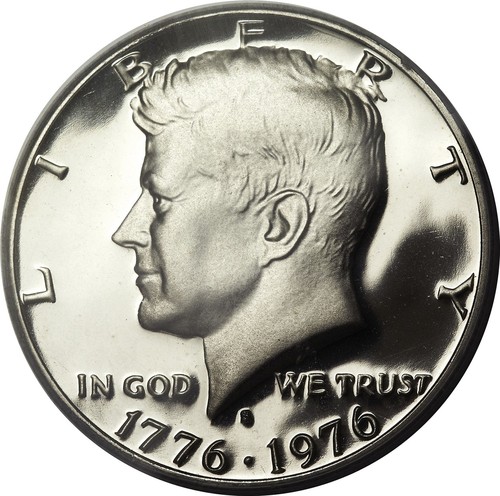
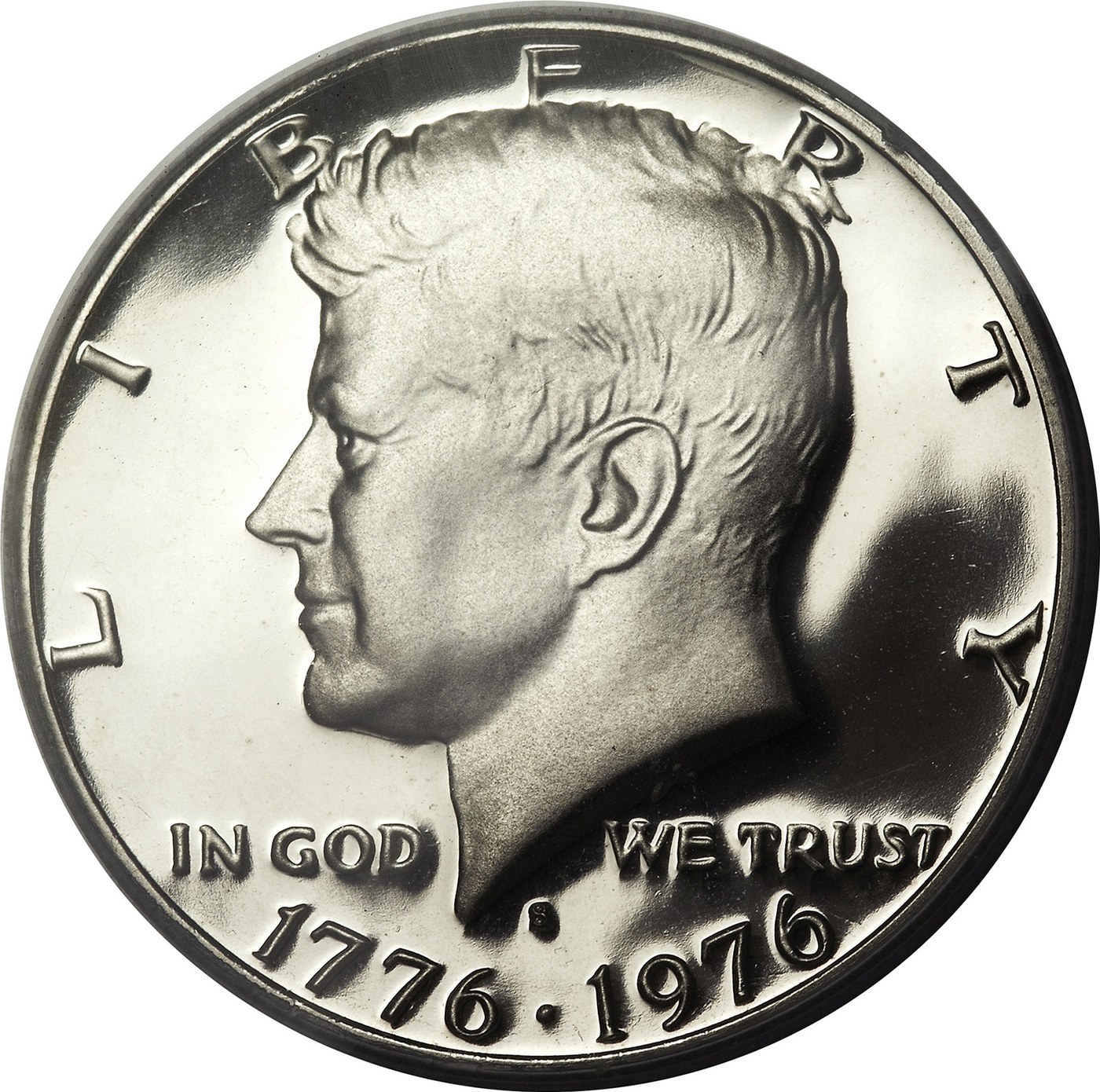
Circulating examples are copper-nickel clad — an outer layer of 75% copper and 25% nickel bonded to a pure copper core — roughly 30.6 mm across and about 11.3 g in weight, with a reeded edge. The coin shown here bears an S mint mark on the obverse below Kennedy's neck, marking it as a San Francisco strike.
History & Background
As the United States approached its Bicentennial in 1976, Congress authorized special reverse designs for the quarter, half dollar, and dollar. For the half dollar, the Mint held a design competition won by Seth G. Huntington, whose rendering of the Liberty Bell against the Moon appeared on every 1976 half dollar. No half dollars were dated 1975; pieces struck in that year already carried the 1776-1976 dual date, and the design reverted to the standard eagle reverse in 1977.
Hundreds of millions of clad Bicentennial halves were struck at Philadelphia (no mint mark) and Denver (D) for circulation, so the coin is extremely common. San Francisco (S) struck proof and uncirculated versions for collectors, including a special three-piece set of 40% silver-clad Bicentennial coins sold directly by the Mint. Because the standard obverse still shows Kennedy — first introduced in 1964 shortly after his assassination — the Bicentennial issue reads as a familiar coin with a commemorative twist rather than a wholly new type.
How to Identify
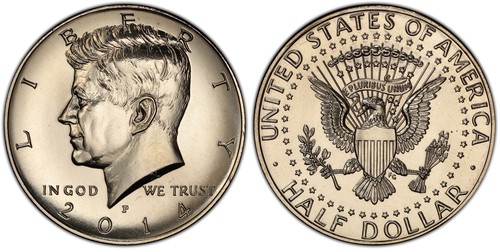
The obverse is the standard Kennedy portrait, a profile bust of President John F. Kennedy, with LIBERTY arcing above, IN GOD WE TRUST across the field near the neck, and, on San Francisco and Denver pieces, a small mint mark below the truncation of the neck. The example here carries an S mint mark. The date does not appear on the obverse of this issue.
The reverse is the giveaway: a Liberty Bell overlapping a depiction of the Moon, with UNITED STATES OF AMERICA and HALF DOLLAR around the rim and E PLURIBUS UNUM to the left. The dual date 1776-1976 appears on this side. Any Kennedy half showing this Liberty Bell reverse and the 1776-1976 date is a Bicentennial issue.
Most coins are copper-nickel clad and show a coppery stripe along the reeded edge. The scarcer 40% silver collector versions, struck only at San Francisco, look brighter, weigh slightly more (about 11.5 g), and lack the copper edge stripe.
Value & Collectibility
Because they were made by the hundreds of millions, circulated copper-nickel Bicentennial halves are worth their face value of fifty cents and are still occasionally found in change. There is no silver in the ordinary clad pieces, so they carry no bullion premium.
Collector value attaches to specific formats: San Francisco proof strikes, uncirculated coins in original Mint packaging, and especially the 40% silver-clad versions from the special Bicentennial sets, which carry a modest premium tied partly to their silver content. High-grade certified examples and pieces with dramatic mint errors can bring more. Treat any figures as general context — actual prices depend on grade, format, and market conditions, and a well-worn clad coin remains a common fifty-cent piece.
Frequently asked questions
Why does my Kennedy half dollar say 1776-1976?
That dual date marks the United States Bicentennial. Every Kennedy half struck in 1975 and 1976 carries the 1776-1976 date and the special Liberty Bell reverse; no 1975-dated halves exist.
Is a 1776-1976 Kennedy half dollar made of silver?
Most are not. Circulating coins are copper-nickel clad with no silver. Only the special 40% silver-clad versions sold by the Mint, struck at San Francisco, contain silver.
What does the S mint mark mean on this coin?
S stands for the San Francisco Mint, which struck proof and collector versions. A D means Denver, and no mint mark means Philadelphia. The mark sits below Kennedy's neck on the obverse.
Is my Bicentennial half dollar valuable?
Ordinary clad examples are worth face value — fifty cents. Premiums generally apply only to proofs, uncirculated coins in original packaging, the 40% silver sets, and high-grade or error pieces.
Who designed the Liberty Bell reverse?
Seth G. Huntington won the Mint's design competition. His reverse shows the Liberty Bell superimposed over the Moon, used only on 1776-1976 half dollars.
Kennedy Half Dollar Bicentennial guides
In-depth guides for identifying, valuing, and collecting Kennedy Half Dollar Bicentennial.