
How to Identify the Kennedy Half Dollar Bicentennial
A collector's walkthrough for confirming a 1776-1976 Kennedy half: the Liberty Bell reverse, dual date, mint marks, and how to spot the silver versions.
Read the full Kennedy Half Dollar Bicentennial encyclopedia entry →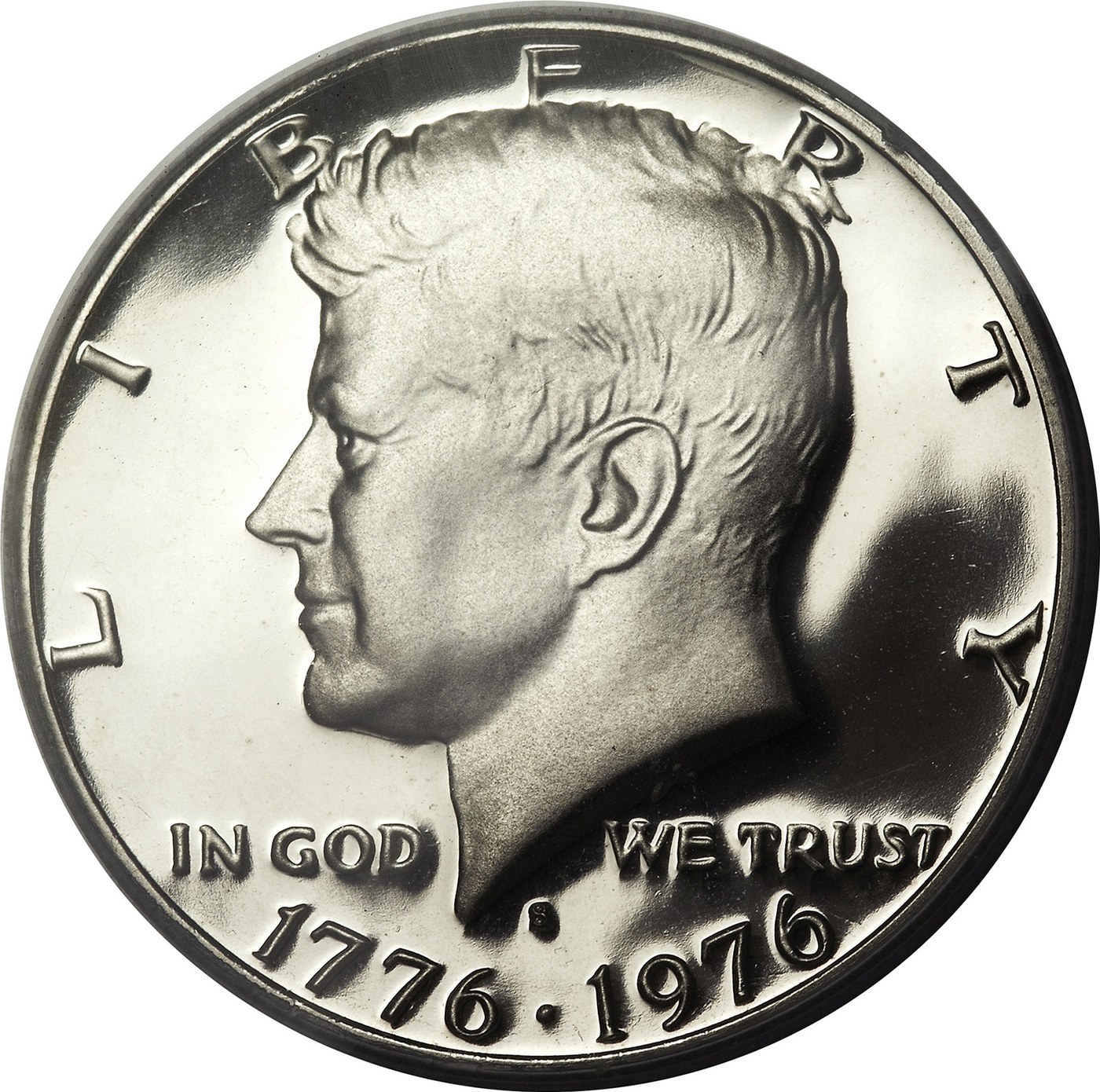
Begin with the reverse, because that is where this coin declares itself. A Bicentennial half dollar shows the Liberty Bell overlapping the Moon, with UNITED STATES OF AMERICA and HALF DOLLAR around the rim. If you see this Liberty Bell design instead of the usual Presidential Seal eagle, you have a 1976 Bicentennial issue. Confirm it with the dual date 1776-1976 struck on the same side.
Now check the obverse. It carries the standard Kennedy portrait with LIBERTY above and IN GOD WE TRUST beside the neck. Note that the date is absent here — it lives on the reverse. Just below the neck you may find a small mint mark: S for San Francisco (as on the coin shown), D for Denver, or nothing at all for Philadelphia. Use magnification, as the mark is small.
Verify size and metal. A genuine half dollar is large — about 30.6 mm across and roughly 11.3 g — with a reeded edge. On ordinary copper-nickel clad coins you will see a distinct copper-colored stripe along that edge. This edge check is the fastest way to separate a common clad coin from the scarcer silver versions.
To spot a 40% silver collector piece, look at the edge and the color. Silver-clad Bicentennial halves lack the copper stripe, appear brighter and whiter overall, and weigh slightly more (about 11.5 g). These came only from San Francisco in special sets, so a silver-looking edge combined with an S mint mark is a good sign — though weight confirmation on a small scale is more reliable than eye alone.
Few authentication worries apply here, since the coin is common and rarely counterfeited. The main cautions are honest mistakes: assuming any 1976 half is silver (most are not), or confusing a cleaned or toned clad coin for silver. When a piece is claimed to be a rare error or a high-grade silver strike worth a real premium, a reputable grading service such as PCGS or NGC can settle both the metal and the grade.
Frequently asked questions
How do I know if my Bicentennial half is silver or clad?
Look at the edge. A copper-colored stripe means copper-nickel clad with no silver. A solid bright edge with no copper stripe, usually on an S-mint coin from a special set, indicates a 40% silver version.
Where is the date on this coin?
On the reverse, shown as the dual date 1776-1976, not on the obverse. The Kennedy portrait side carries LIBERTY and IN GOD WE TRUST but no year.
My coin has no mint mark — is it fake?
No. Coins with no mint mark were struck at Philadelphia. Mint marks appear below Kennedy's neck: S for San Francisco or D for Denver.
Could my 1976 half be a valuable rarity?
Most are common face-value coins. Genuine premiums attach mainly to proofs, original-packaged uncirculated pieces, silver sets, and certified high grades or errors — have those authenticated before assuming value.