
Franklin Half Dollar
U.S. 90% silver fifty-cent piece struck 1948–1963, with Benjamin Franklin's profile and a Liberty Bell reverse flanked by a small eagle.
- Country
- United States
- Denomination
- 50 cents
- Metal
- Silver
Got a coin like this?
Identify any coin from a photo, free.
Overview
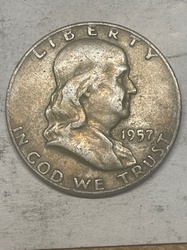
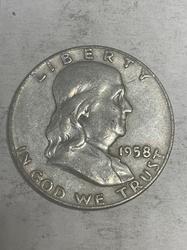
The Franklin Half Dollar is a United States fifty-cent coin struck from 1948 through 1963. Its obverse carries a right-facing profile portrait of Benjamin Franklin, while the reverse is dominated by the Liberty Bell, with a small eagle set to the right of the bell. It is the only regular-issue U.S. coin to depict Franklin, and one of the few U.S. coins to feature the Liberty Bell.
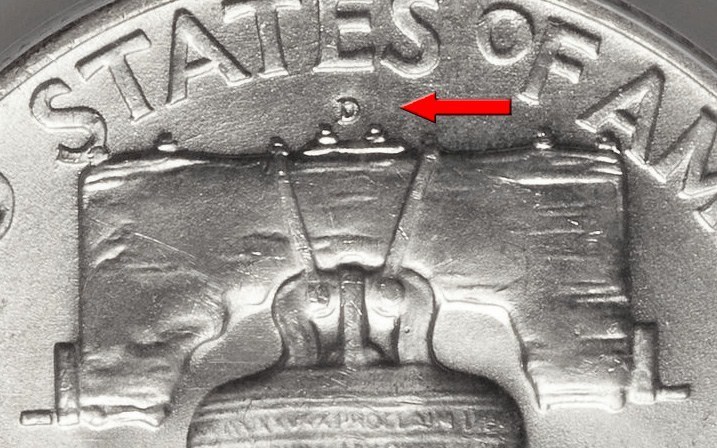
The coin is 90% silver and 10% copper, about 30.6 mm in diameter and weighing roughly 12.5 grams, with a reeded edge. The photographed example shows the reverse: the eagle with raised wings beside the Liberty Bell, and the mint-mark position visible above the bell's wooden yoke.
History & Background
The Franklin Half Dollar was introduced in 1948 at the urging of Mint Director Nellie Tayloe Ross, a longtime admirer of Benjamin Franklin who wanted him honored on a circulating coin. The design was executed by Chief Engraver John R. Sinnock, whose initials JRS appear beneath the shoulder truncation on the obverse. The small eagle beside the Liberty Bell was added to satisfy a legal requirement that the half dollar bear an eagle.
The series ran for only sixteen years. It was cut short in 1964, when the assassination of President John F. Kennedy in November 1963 led Congress to place his portrait on the half dollar. As a result, the last Franklin halves are dated 1963, and the Kennedy Half Dollar took over in 1964.
Franklin halves were struck at Philadelphia (no mint mark), Denver (D), and San Francisco (S). Mintages varied widely by year and mint, and some issues are far scarcer than others in high grade.
How to Identify
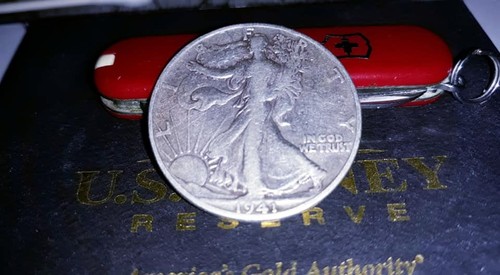
Look first at the design. The obverse shows Benjamin Franklin's bust facing right, with LIBERTY above and the date below; the reverse shows the Liberty Bell with a small eagle to its right, the motto E PLURIBUS UNUM to the left of the bell, and HALF DOLLAR below. This bell-and-eagle reverse distinguishes it instantly from the heraldic-eagle Walking Liberty half that preceded it and the Kennedy half that followed.
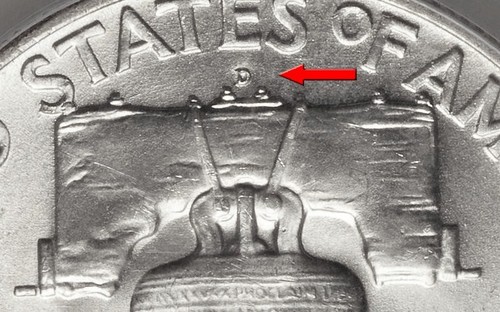
The mint mark, when present, sits on the reverse above the bell's wooden yoke, between the top of the bell and the lettering. Philadelphia coins carry no mint mark; D is Denver and S is San Francisco. Size and metal are also diagnostic: at about 30.6 mm and 12.5 g in 90% silver, the coin is noticeably larger and heavier than a quarter and has a bright silver ring.
Collectors also grade Franklin halves by the strength of the bell's lower horizontal lines. A well-struck coin with fully separated lines across the bottom of the Liberty Bell is described as "Full Bell Lines" (FBL), a designation that can add significant premium.
Value & Collectibility
Every Franklin Half Dollar contains about 0.3617 troy ounce of pure silver, so even a heavily worn example is worth a multiple of face value as bullion. Common-date circulated coins generally trade close to their silver melt value, which moves with the silver market.
Uncirculated coins, and especially those with sharp "Full Bell Lines," command higher premiums, and certain dates and mint marks are scarcer in top grades. Proof examples (struck at Philadelphia from 1950 onward) also carry collector premiums. As with any coin, condition, eye appeal, and third-party certification drive value more than the date alone. Consult a current price guide or dealer for up-to-date figures rather than relying on a fixed number.
Frequently asked questions
Is the Franklin Half Dollar made of silver?
Yes. Every Franklin half (1948–1963) is struck in 90% silver and 10% copper, containing roughly 0.36 troy ounce of pure silver, so all of them carry intrinsic bullion value above their fifty-cent face value.
Why does the coin show Benjamin Franklin instead of a president?
Franklin was never president, but Mint Director Nellie Tayloe Ross championed placing him on the half dollar to honor his contributions to the nation. It remains the only regular-issue U.S. coin to depict him.
Why was the series so short, ending in 1963?
After President John F. Kennedy was assassinated in November 1963, Congress replaced the Franklin design with a Kennedy portrait. The Kennedy Half Dollar began in 1964, making 1963 the last year for Franklin halves.
What does the small eagle on the reverse signify?
U.S. law required the half dollar to bear an eagle. Because the Liberty Bell dominates the reverse, a small eagle was added to the right of the bell to meet that legal requirement.
What are 'Full Bell Lines'?
It is a strike designation for coins on which the horizontal lines across the bottom of the Liberty Bell are complete and fully separated. Full Bell Lines examples are scarcer and typically bring a premium over ordinary strikes.
Franklin Half Dollar guides
In-depth guides for identifying, valuing, and collecting Franklin Half Dollar.
Franklin Half Dollar identified by the community
Real coins identified with Coin Identifier.
Other coins you may enjoy
Walking Liberty Half Dollar
1916–1947
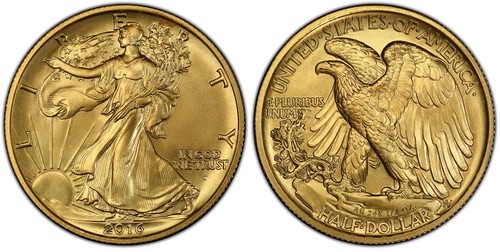
Walking Liberty Half Dollar Centennial Gold
2016
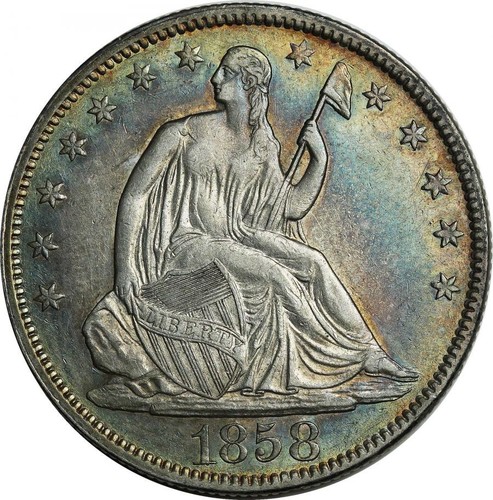
Seated Liberty Half Dollar
1839–1891
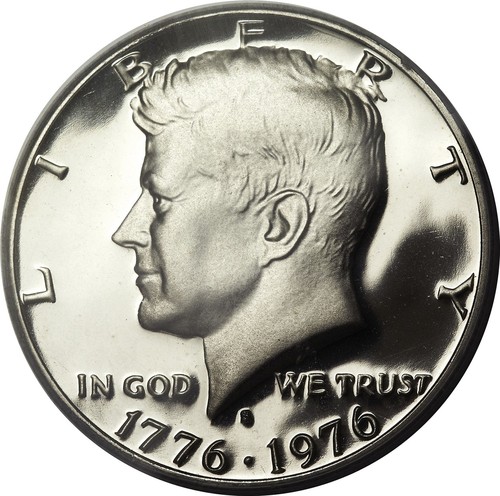
Kennedy Half Dollar Bicentennial
1976
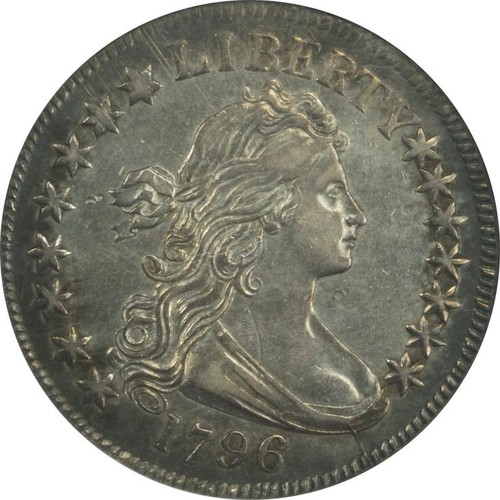
Draped Bust Half Dollar
1796–1807
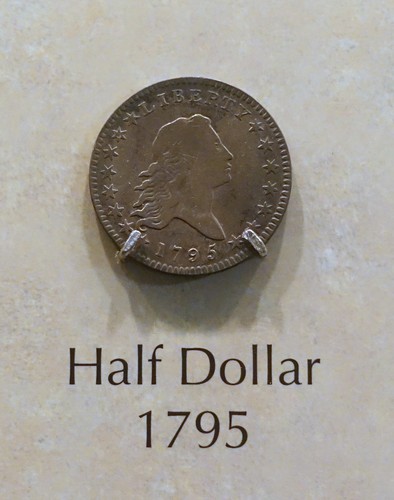
Flowing Hair Half Dollar
1794–1795
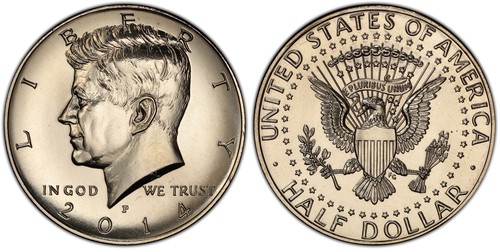
Kennedy Half Dollar 50th Anniversary High Relief
2014
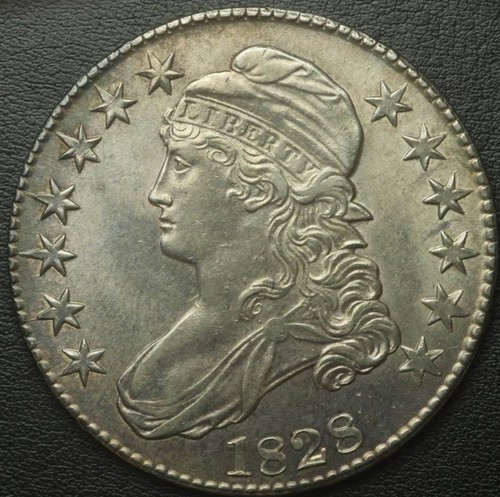
Capped Bust Half Dollar
1807–1839