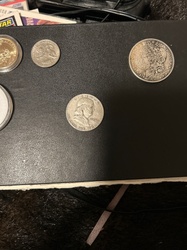
How to Identify the Franklin Half Dollar
Confirm a Franklin Half by its Franklin profile, Liberty Bell reverse with a small eagle, silver composition, and mint mark above the bell.
Read the full Franklin Half Dollar encyclopedia entry →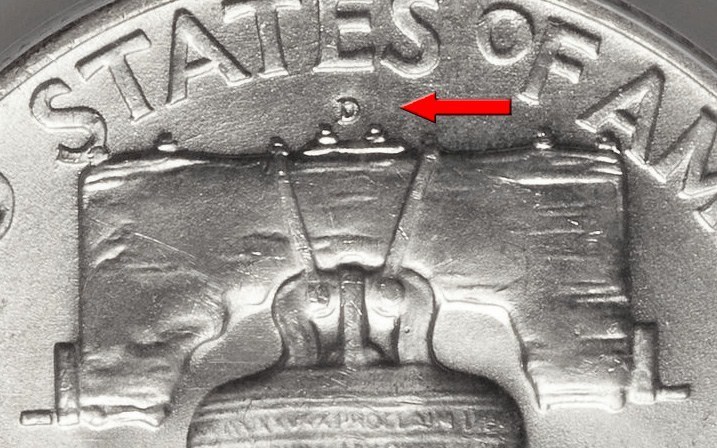
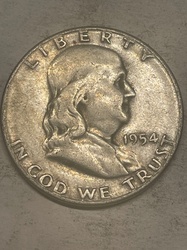
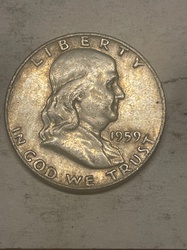
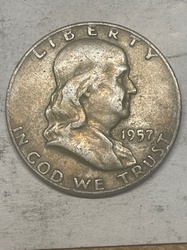
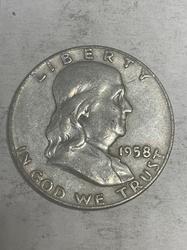
Start with the two design faces, because they are unmistakable. The obverse carries a right-facing bust of Benjamin Franklin with LIBERTY arcing above and the four-digit date below. The reverse centers on the Liberty Bell, with a small eagle to the right of the bell, E PLURIBUS UNUM to the left, and HALF DOLLAR beneath. If you see a large heraldic eagle or a walking Liberty figure, you have a different half-dollar series.
Check size and metal next. A genuine Franklin half is about 30.6 mm across and weighs roughly 12.5 grams in 90% silver — clearly larger and heavier than a quarter, with a reeded edge and a bright silver tone. A quick weight check on a small scale is a useful screen; significantly light or off-diameter pieces warrant caution.
Find the mint mark on the reverse, above the bell's wooden yoke and just below the lettering. No mint mark means Philadelphia, D means Denver, and S means San Francisco. The date on the obverse should fall within 1948–1963; any Franklin-design half dated 1964 or later does not exist as a regular issue and should be treated as suspect.
For grading and value, inspect the lower horizontal lines of the Liberty Bell. Fully struck, separated lines earn the "Full Bell Lines" designation, which raises desirability. Because premiums can be meaningful, higher-value dates and Full Bell Lines coins are worth authenticating.
Be alert to a few pitfalls: altered dates or added mint marks meant to imitate scarcer issues, cleaned or polished surfaces that hurt value, and counterfeits in bullion-grade silver. When a coin's date, mint mark, or condition suggests real premium, professional certification from a recognized grading service is the safest confirmation.
Frequently asked questions
Where is the mint mark on a Franklin Half Dollar?
On the reverse, above the Liberty Bell's wooden yoke and just below the surrounding lettering. Coins with no mint mark were struck in Philadelphia; D is Denver and S is San Francisco.
How can I tell a Franklin half from a Walking Liberty or Kennedy half?
Look at the designs: the Franklin half shows Franklin's profile and a Liberty Bell reverse, the Walking Liberty shows a striding Liberty with a heraldic eagle, and the Kennedy half shows JFK's portrait. Dates also help — Franklin halves run 1948–1963.
Is a quick weight-and-diameter check reliable for spotting fakes?
It is a good first screen. A genuine coin is about 30.6 mm and 12.5 g in 90% silver. Pieces that are noticeably light, thin, or the wrong diameter deserve scrutiny, but a matching weight alone does not guarantee authenticity — certify high-value coins.
Do Full Bell Lines matter for identification?
They do not change the type, but they affect grade and value. Strongly struck coins with complete, separated horizontal lines at the bottom of the bell are labeled Full Bell Lines and command a premium.
Franklin Half Dollar identified by the community
Recent Franklin Half Dollar coins identified with Coin Identifier.