Seated Liberty Half Dollar
U.S. 90% silver fifty-cent piece struck 1839–1891, with a seated figure of Liberty by Christian Gobrecht and a heraldic eagle reverse.
- Country
- United States
- Denomination
- 50 cents
- Metal
- Silver
Got a coin like this?
Identify any coin from a photo, free.
Overview
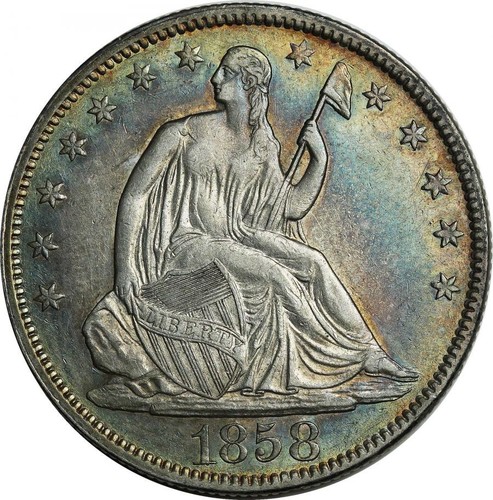
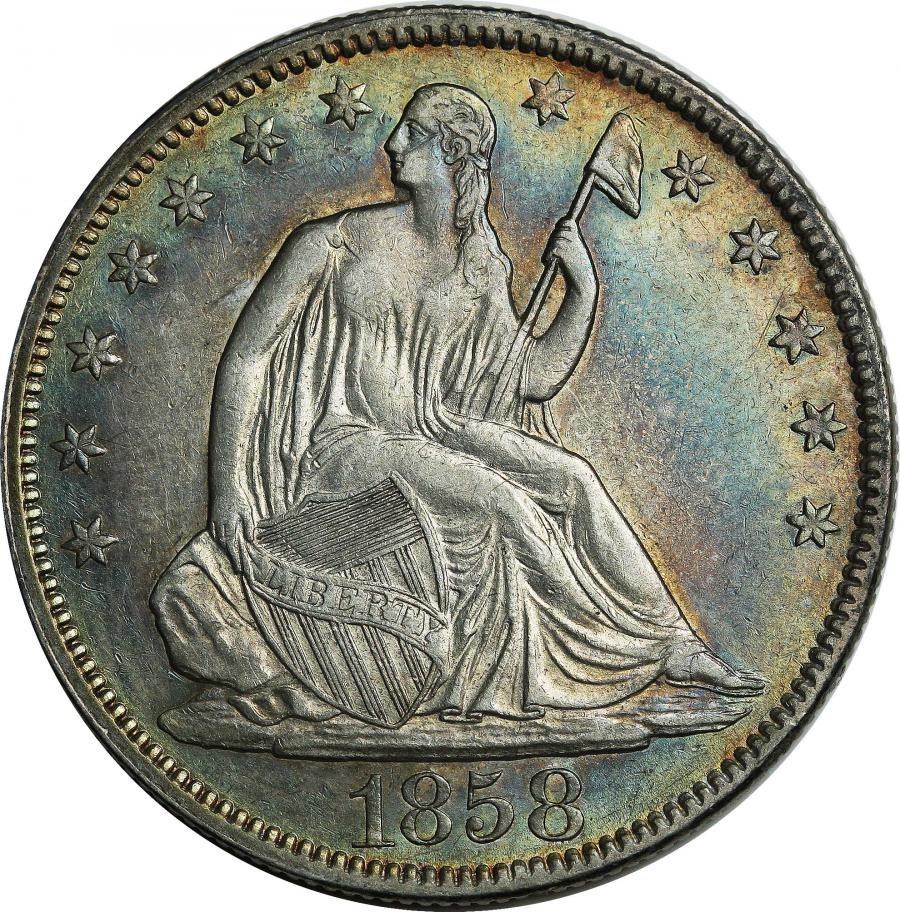
The Seated Liberty Half Dollar is a United States fifty-cent coin produced from 1839 through 1891. Its obverse shows Liberty seated on a rock, holding a Union shield and a pole topped by a liberty cap, encircled by thirteen stars. The reverse carries a naturalistic eagle with a shield on its breast, grasping an olive branch and a bundle of arrows. The example shown here is dated 1858 and displays the rich, multicolor toning that silver coins of this age often acquire.
The coin is large and made of silver — 90% silver with 10% copper, roughly 30.6 mm across, with a reeded edge. As a heavily used circulating denomination struck across half a century, most surviving pieces show honest wear, and toned examples like this one are common among coins that spent time in albums or long-term storage.
History & Background
The Seated Liberty design was created by Chief Engraver Christian Gobrecht and derived from Thomas Sully's allegorical figure of Liberty. Introduced on the silver dollar in the late 1830s, the seated motif was rolled out across the silver denominations, reaching the half dollar in 1839. The design remained in service until 1891, when it was replaced by Charles Barber's Liberty head coinage.
Over its long run the half dollar saw several small modifications. Arrows were placed beside the date in 1853–1855 to signal a reduction in weight, and the motto IN GOD WE TRUST was added above the eagle beginning in 1866. A coin dated 1858, like the one shown, falls in the earlier "no motto" period and carries no arrows at the date. The series was struck at Philadelphia (no mint mark) and at branch mints including New Orleans and San Francisco.
How to Identify
The obverse shows the full figure of Liberty seated on a rock, her right hand steadying a shield inscribed LIBERTY and her left holding a capped pole. Thirteen stars arc around the field with the date below. The eagle-free, figural obverse and the surrounding stars are the quickest way to place the type.
The reverse depicts a heraldic eagle with a shield on its chest, clutching an olive branch and three arrows, with UNITED STATES OF AMERICA around the top and HALF DOL. at the bottom. On an 1858 coin there is no motto ribbon above the eagle — that scroll appears only from 1866 onward — which helps date the piece at a glance.
Physically the coin is 90% silver, about 30.6 mm in diameter, with a reeded edge. Its large size and silver tone, combined with the seated figure and denomination spelled HALF DOL., separate a genuine Seated Liberty half dollar from the smaller seated dimes, quarters, and half dimes that share the same obverse motif.
Value & Collectibility
Value depends heavily on date, mint mark, and condition. Common-date Seated Liberty half dollars in worn grades trade for a premium over their silver content, while sharply struck, higher-grade or attractively toned examples bring stronger prices. Original color and problem-free surfaces add to desirability among collectors of the series.
Certain dates, mint marks, and design subtypes — such as the arrows-and-rays and arrows issues, and various low-mintage branch-mint coins — command significant premiums. Because condition and variety drive value across a fifty-year series, and because cleaned or altered pieces are common, coins of potential value should be authenticated and graded by a reputable third-party service. Treat any figures here as general context rather than firm prices.
Frequently asked questions
Who designed the Seated Liberty Half Dollar?
The seated figure of Liberty was engraved by Christian Gobrecht, Chief Engraver of the U.S. Mint, based on a design concept by Thomas Sully. The same motif appears on other silver coins of the era.
Is a Seated Liberty Half Dollar made of silver?
Yes. It is 90% silver and 10% copper and is a large coin, so even worn examples carry meaningful intrinsic silver value.
Why doesn't my 1858 half dollar say IN GOD WE TRUST?
That motto was not added to the half dollar until 1866. An 1858 coin is from the earlier no-motto period, so the space above the eagle is plain.
What are the arrows and rays some of these coins have?
Arrows beside the date (1853–1855) marked a reduction in the coin's weight, and 1853 also added rays around the reverse eagle. An 1858 coin has neither arrows nor rays.
Where is the mint mark on a Seated Liberty Half Dollar?
On the reverse, below the eagle. Branch-mint coins show O (New Orleans), S (San Francisco), or CC (Carson City) there; no mint mark indicates Philadelphia.
Seated Liberty Half Dollar guides
In-depth guides for identifying, valuing, and collecting Seated Liberty Half Dollar.