
How to Identify the Seated Liberty Half Dollar
A collector's walkthrough for confirming a Seated Liberty half dollar: the seated figure, the eagle reverse, size and metal, mint marks, and dating clues.
Read the full Seated Liberty Half Dollar encyclopedia entry →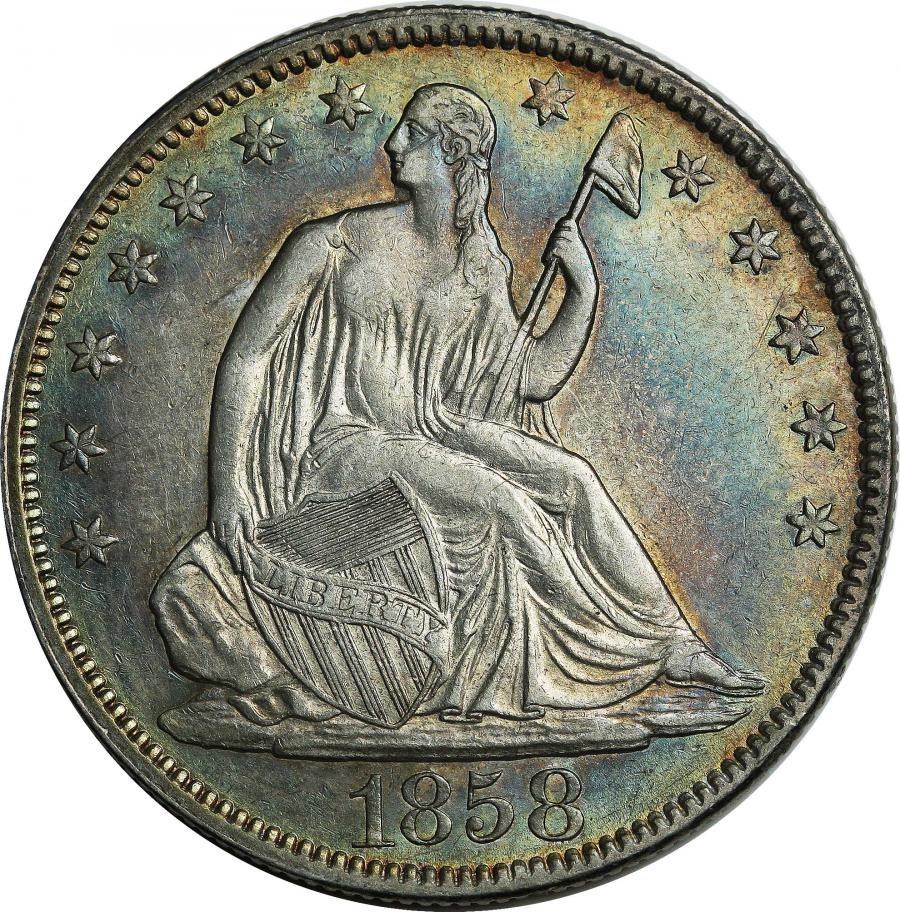
Start with the obverse. A Seated Liberty half dollar shows the full figure of Liberty seated on a rock, holding a shield marked LIBERTY in one hand and a pole topped by a liberty cap in the other. Thirteen stars ring the field and the date sits at the bottom. This seated figure with surrounding stars immediately identifies the design family; the challenge is confirming the denomination rather than the type.
Confirm size and metal to pin down the denomination. The half dollar is the large member of the seated silver series — about 30.6 mm across and struck in 90% silver with a reeded edge. The seated dime, quarter, and half dime carry the same obverse motif but are noticeably smaller. If the coin is large, silver-toned, and reads HALF DOL. on the reverse, you have the half dollar rather than one of its smaller cousins.
Read the reverse for both confirmation and dating. You should see a heraldic eagle with a shield on its breast, holding an olive branch and arrows, with UNITED STATES OF AMERICA above and HALF DOL. below. Whether a motto ribbon (IN GOD WE TRUST) sits above the eagle is a fast dating clue: it appears only from 1866 onward, so an 1858 coin has none. Arrows beside the date and rays around the eagle mark the 1853–1855 weight-change issues; their absence is consistent with an 1858 date.
Find the mint mark on the reverse, below the eagle. You may see O, S, CC, or nothing at all for Philadelphia. Because date, mint mark, and subtype together drive value across this long series, read the mint mark carefully under magnification. Given that toning can be genuine or artificially induced and that cleaned surfaces are common on coins this old, any piece you believe is scarce, or that shows a tooled or mismatched mint mark, should be sent to a reputable grading service such as PCGS or NGC before you rely on the attribution.
Frequently asked questions
How do I tell a Seated Liberty half dollar from a seated quarter or dime?
Size and the reverse legend. The half dollar is the largest at about 30.6 mm and reads HALF DOL. on the reverse, while the quarter (QUAR. DOL.) and dime (ONE DIME) are smaller and use different denomination wording.
Is the colorful toning on my coin a problem?
Natural toning on old silver is normal and can even add appeal. However, toning can also be induced artificially to hide problems, so let a grading service judge originality on anything you think is valuable.
My coin has no mint mark — what does that mean?
No mint mark indicates the coin was struck at the Philadelphia Mint. Branch-mint coins carry O, S, or CC on the reverse below the eagle.
Should I clean the coin before identifying it?
No. Cleaning damages the surface and lowers collector value. Identify and grade the coin as-is, and leave authentication of anything potentially rare to a professional service.