Flowing Hair Half Dollar
The first U.S. half dollar, struck 1794–1795 in silver, with a flowing-hair Liberty facing right and a small eagle within a wreath on the reverse.
- Country
- United States
- Denomination
- 50 cents
- Metal
- Silver
Got a coin like this?
Identify any coin from a photo, free.
Overview
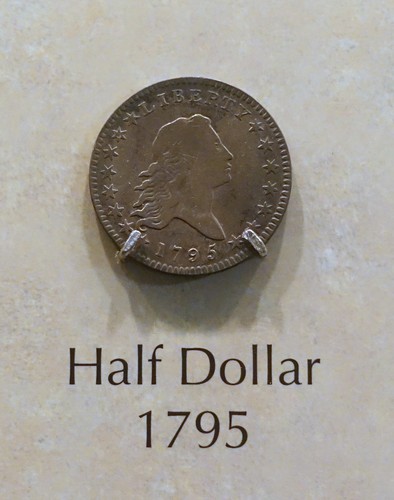
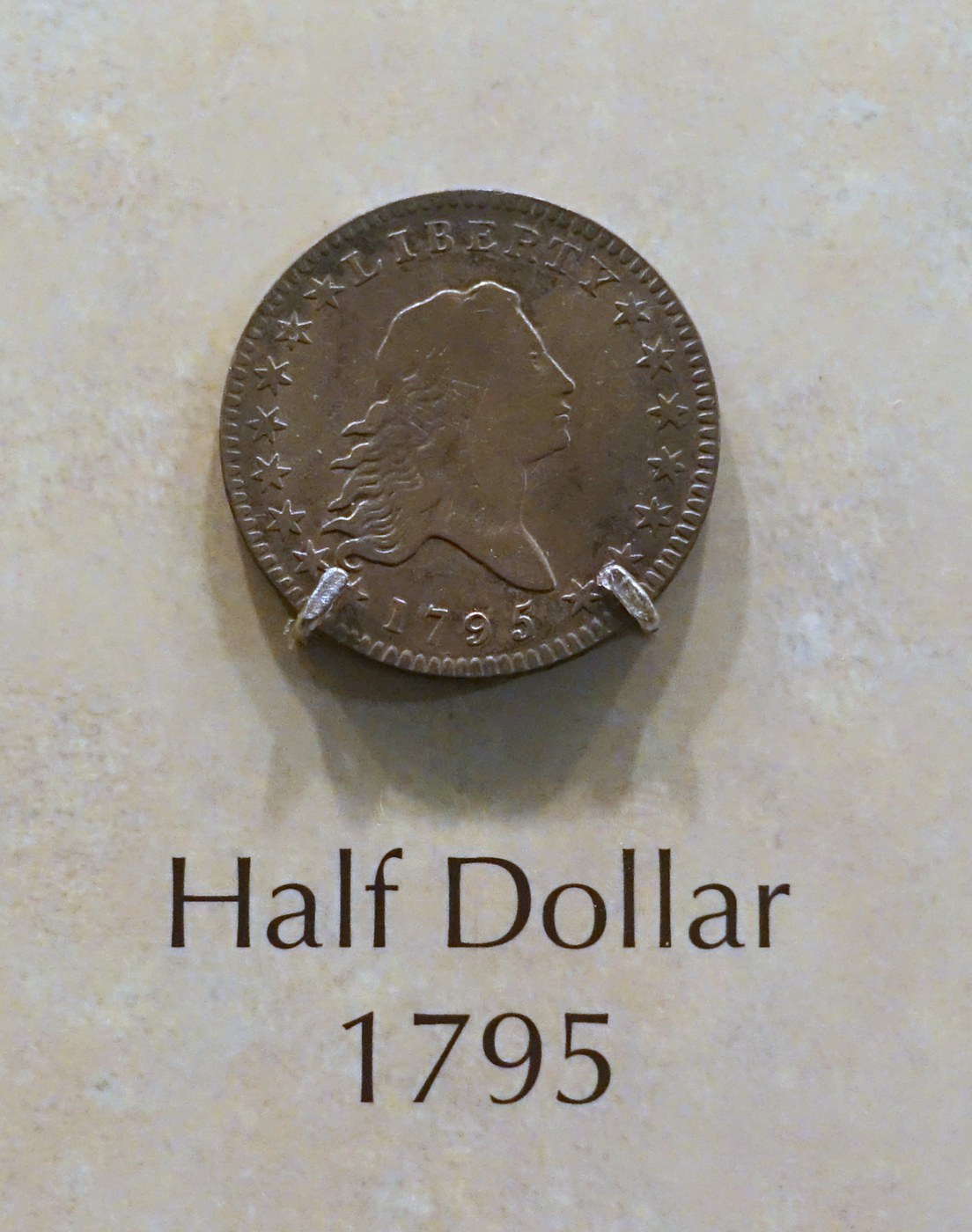
The Flowing Hair Half Dollar is the first fifty-cent coin issued by the United States, produced at the Philadelphia Mint in 1794 and 1795. It belongs to the earliest generation of federal silver coinage, struck alongside the Flowing Hair half dime and dollar of the same short-lived design. The example shown here is dated 1795.
The coin is silver — an alloy of roughly 90% silver and 10% copper — and was struck by hand on early screw presses, so surfaces are often irregular with adjustment marks, uneven strikes, and off-center centering. The obverse portrays Liberty with long, loose flowing hair facing right, surrounded by stars; the reverse shows a small, spread-winged eagle perched within an open wreath. As a two-year type, surviving pieces are scarce and highly collectible.
History & Background
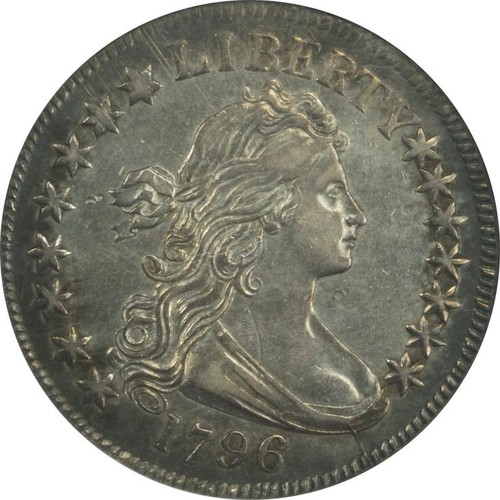
The Coinage Act of 1792 established the United States Mint and authorized a national silver coinage, including the half dollar of fifty cents. The Flowing Hair design, generally credited to the Mint's first Chief Engraver Robert Scot, was adopted for the earliest silver issues. Half dollars first appeared in 1794 in very limited numbers, followed by a larger 1795 production.
The design was short-lived. In 1796 the Flowing Hair Liberty was replaced by the Draped Bust portrait, and the small eagle reverse later gave way to a heraldic eagle. Because the type spans only two years and early Mint output was small by later standards, Flowing Hair half dollars survive in limited quantities. Many known pieces show the crude manufacturing of the era, and specialists study them by die marriage — the specific pairing of obverse and reverse dies used to strike a given coin.
How to Identify
The obverse shows Liberty facing right with long, unbound flowing hair, the word LIBERTY above and the date below, with stars flanking the portrait. On 1795 coins the stars are typically arranged along the sides of the head. The reverse depicts a small eagle with outstretched wings standing within an open wreath, encircled by the legend UNITED STATES OF AMERICA. Notably, the coin carries no numeric mark of value — the fifty-cent denomination is not spelled out on the coin itself.
The piece is silver, roughly 32–33 mm in diameter and about 13.4 g, larger and heavier than the dime, half dime, or quarter of the era. Early half dollars have a lettered edge reading FIFTY CENTS OR HALF A DOLLAR, rather than the reeded edge of later silver coins. There is no mint mark: all were struck at Philadelphia.
Because these coins were made by hand, expect wide variation — planchet adjustment marks (fine parallel file lines), weak areas of strike, and centering that drifts off the dies. These traits are normal for the type and are part of how genuine early pieces are distinguished from modern reproductions.
Value & Collectibility
Flowing Hair half dollars are scarce, historically important early coins, and even heavily worn examples carry substantial premiums well above their silver content. Value is driven by date, die variety, condition, and eye appeal, with 1794 issues generally rarer and more sought after than 1795. High-grade or rare-variety pieces can reach very significant sums at auction.
Because values are high and the type is famous, counterfeits and altered coins exist. Genuine examples should be authenticated and graded by a reputable third-party service (such as PCGS or NGC) before purchase or sale. Treat any figures as broad context only — actual prices vary widely with grade and variety, and this type sits firmly in specialist territory.
Frequently asked questions
What years was the Flowing Hair Half Dollar made?
Only 1794 and 1795, at the Philadelphia Mint. It was the first U.S. half dollar and was replaced by the Draped Bust design in 1796.
Is the Flowing Hair Half Dollar made of silver?
Yes. It was struck in a silver alloy of about 90% silver and 10% copper, weighing roughly 13.4 grams.
Does it have a mint mark?
No. All Flowing Hair half dollars were struck at the Philadelphia Mint, which used no mint mark in this period.
Why doesn't the coin say '50 cents' or 'Half Dollar' on the face?
Early half dollars carry no numeric value on the obverse or reverse. Instead, the denomination is spelled out on the lettered edge: FIFTY CENTS OR HALF A DOLLAR.
Are the file-like lines on the surface damage?
Not necessarily. Fine parallel lines are often adjustment marks, made at the Mint to bring an overweight planchet to standard before striking. They are common on early coins and are part of the type's character.
Flowing Hair Half Dollar guides
In-depth guides for identifying, valuing, and collecting Flowing Hair Half Dollar.