
How to Identify the Flowing Hair Half Dollar
A collector's walkthrough for confirming a 1794–1795 Flowing Hair half dollar: the flowing-hair portrait, small eagle reverse, size, lettered edge, and authentication cautions.
Read the full Flowing Hair Half Dollar encyclopedia entry →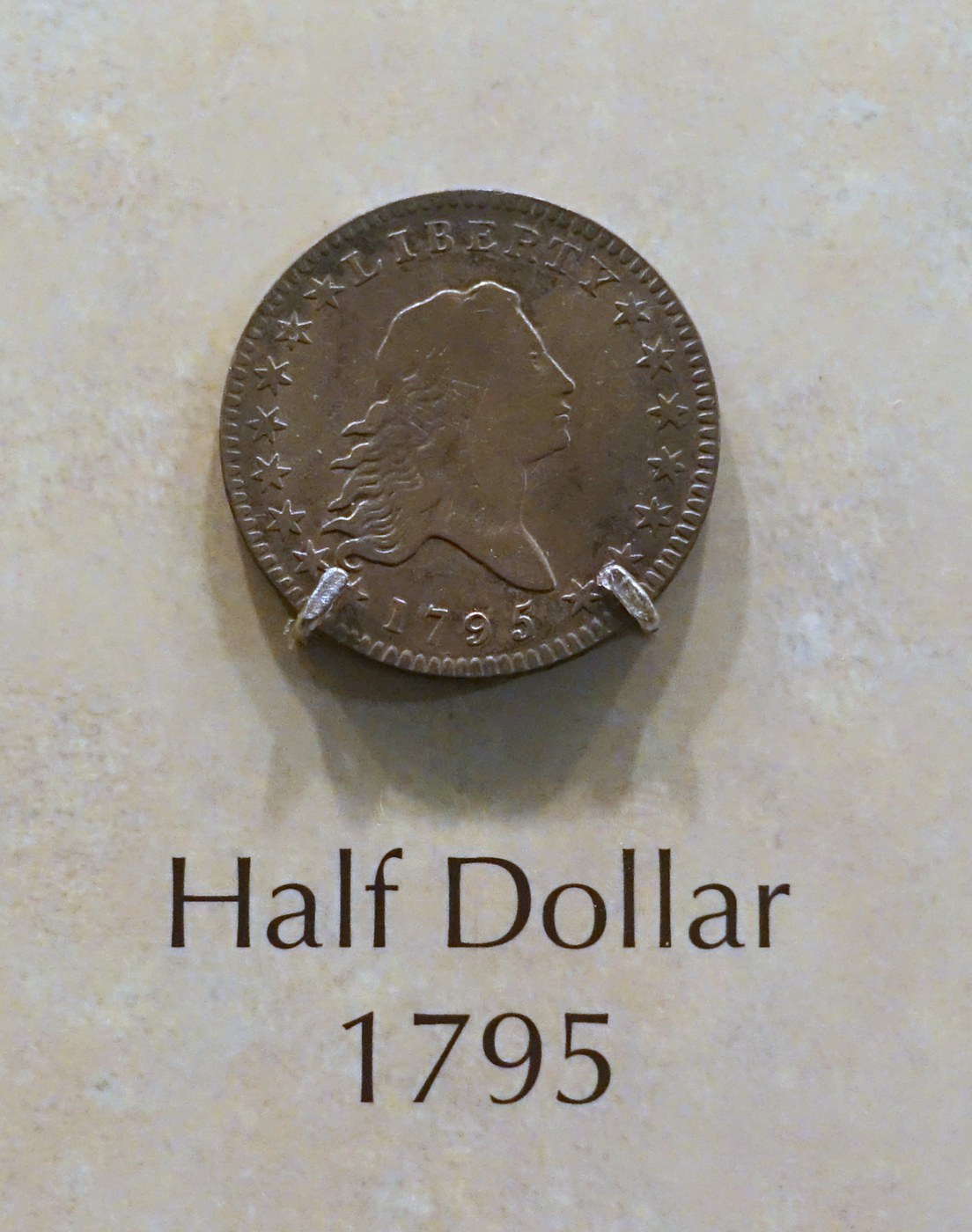
Begin with the obverse portrait. A Flowing Hair half dollar shows Liberty facing right with long, loose hair streaming behind her — not tied, capped, or draped. LIBERTY appears above the head and the date (1794 or 1795) below, with stars flanking the portrait. If the head wears a cap or a ribbon-tied drapery, you are looking at a later type, not a Flowing Hair coin.
Turn to the reverse. The genuine type shows a small, thin eagle with wings spread, standing inside an open wreath, ringed by UNITED STATES OF AMERICA. There is no shield on the eagle's breast and no scroll or banner — that heraldic style belongs to later half dollars. Critically, the coin displays no number or words for the denomination on either face.
Confirm size and metal. This is a large silver coin, about 32–33 mm across and roughly 13.4 g — clearly bigger and heavier than an early quarter or dime. Check the edge: an authentic piece has a lettered edge reading FIFTY CENTS OR HALF A DOLLAR, not the reeded grooves of later silver. A smooth plain edge or a reeded edge is a red flag on this type.
Expect handmade irregularity. Because these were struck on early screw presses, normal genuine coins can show adjustment marks (fine parallel file lines), soft or uneven striking, and off-center centering. These are not automatically signs of a fake. Because values are high and the coins famous, alterations and counterfeits are a real concern — verify the date, examine the edge lettering, and have any candidate authenticated and graded by a reputable service (such as PCGS or NGC) before treating it as genuine.
Frequently asked questions
How do I tell a Flowing Hair half dollar from a Draped Bust half dollar?
Look at the hair. Flowing Hair Liberty (1794–1795) has long, loose, untied hair; the Draped Bust type (from 1796) shows Liberty with a ribbon and drapery across the bust. The date will also fall in the two-year Flowing Hair window.
What should the edge look like?
The edge is lettered, reading FIFTY CENTS OR HALF A DOLLAR. There are no reeded grooves. Always inspect the edge, since it helps confirm both the type and authenticity.
There's no mint mark — is that a problem?
No. All Flowing Hair half dollars came from the Philadelphia Mint, which used no mint mark. The absence of one is expected and correct for the type.
The strike is weak and off-center — is my coin fake?
Not necessarily. Early hand-struck coins commonly show weak areas, adjustment marks, and drifting centering. These traits are normal, but because of the coin's value, have any genuine candidate authenticated by a professional grading service.