Seated Liberty Dime
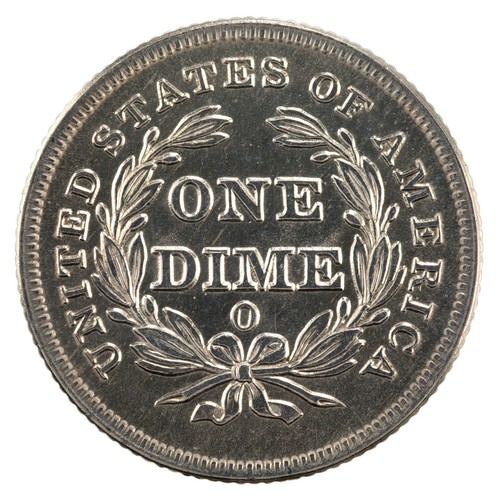
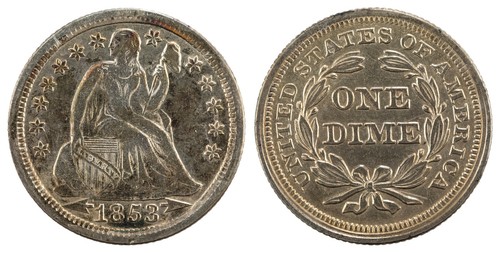
A U.S. silver ten-cent coin showing Liberty seated with a pole and shield; the early No Stars type has a plain obverse and a laurel-wreath ONE DIME reverse.
- Country
- United States
- Denomination
- 10 Cents
- Metal
- Silver
Got a coin like this?
Identify any coin from a photo, free.
Overview
The Seated Liberty Dime is a small United States silver coin worth ten cents, produced from 1837 through 1891. It shows Liberty seated on a rock, holding a liberty pole topped by a cap in one hand and steadying a striped shield inscribed LIBERTY with the other. The reverse names the denomination, ONE DIME, inside a wreath. The coin photographed here is dated 1838 and belongs to the earliest variety, which has a completely open field around Liberty with no stars.
This No Stars type was the very first version of the Seated Liberty dime and was made for only a short time before stars were added around the obverse rim. Its plain, uncluttered design and short production window make it one of the more distinctive and sought-after subtypes of the long-running series.
As a 90 percent silver coin from the 1830s, the Seated Liberty Dime is collected both as an early federal type coin and for its modest silver content, though on a piece this old and scarce the collector value nearly always exceeds the metal value.
History & Background
The Seated Liberty design was introduced in 1837, based on the seated figure of Liberty that engraver Christian Gobrecht had prepared for the silver dollar. It replaced the earlier Capped Bust dime and would go on to appear across the entire silver series, from the half dime up to the dollar, for more than half a century.
The first dimes of 1837 and a portion of those dated 1838 carried no stars on the obverse, leaving the field around Liberty plain. Very early in the run the Mint added thirteen stars around the border, and the No Stars type was discontinued. Because it spans only 1837 and part of 1838, this opening variety was made in far smaller numbers than the later star-bearing dimes and is treated as its own collectible type.
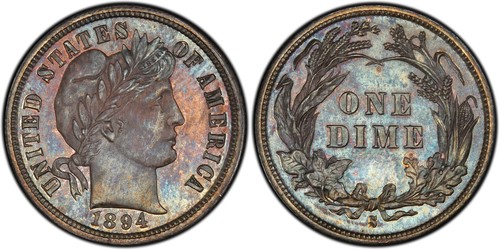
After the stars were introduced, the Seated Liberty dime continued with further small changes, such as added drapery, arrows beside the date, and a legend replacing the wreath reverse, until it was retired in 1891 and succeeded by the Barber dime. The 1838 No Stars coin therefore represents the brief first chapter of a design that lasted decades.
How to Identify
Start with the obverse. Liberty is seated on a rock, facing left, holding a pole with a liberty cap on top and resting her other hand on a shield marked LIBERTY, with the date below her. On this early type the space around her is empty, with no stars along the rim, which immediately marks it as the No Stars variety of 1837–1838. The pictured coin is dated 1838.
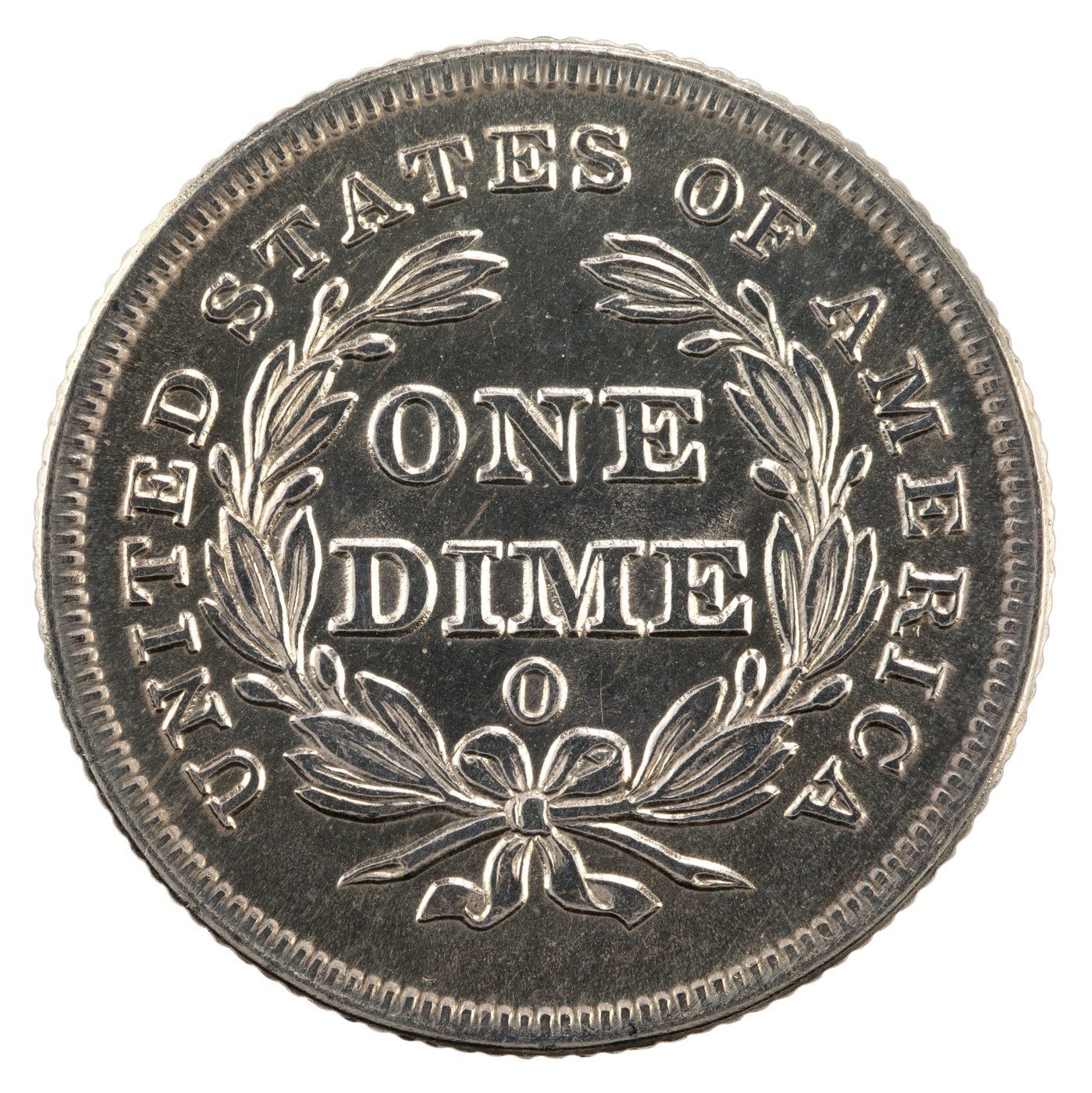
The reverse reads ONE DIME within a wreath of laurel, with UNITED STATES OF AMERICA around the outer edge. The coin is 90 percent silver, roughly 17.9 mm in diameter, weighs a little over 2.4 grams, and has a reeded (grooved) edge. It is noticeably smaller than a Seated Liberty quarter or half dollar.
A mint mark, when present, sits on the reverse beneath the wreath; New Orleans coins carry an O there, while Philadelphia strikes have no mint mark. The combination of the seated figure, the plain star-free field, and the ONE DIME wreath reverse is what confirms this specific early type rather than a later stars-added dime.
Value & Collectibility
Value depends heavily on the date, mint, and condition. The short-lived No Stars type of 1837–1838 is scarcer than the common later Seated dimes and generally carries a meaningful premium even in well-worn grades, with sharper, less-worn examples worth substantially more. Exact figures move with the collector market, so treat any single quoted price as a snapshot rather than a fixed value.
Condition is decisive: full detail in Liberty's gown and shield, clear wreath and lettering, and original surfaces free of cleaning, scratches, or corrosion all raise desirability. Because the coin is only about 2.5 grams of silver, its bullion value is small, and almost all of the worth of an early 1838 piece comes from its age, scarcity, and eye appeal.
Since early Seated dimes are sometimes cleaned, damaged, or have altered dates and mint marks, coins believed to be scarce or high grade are best bought with certification from an established third-party grading service.
Frequently asked questions
Why does this dime have no stars around Liberty?
It is the earliest No Stars type, made only in 1837 and part of 1838. The Mint left the field plain at first, then added thirteen stars around the obverse, so a star-free field marks the first variety.
Is the Seated Liberty Dime made of silver?
Yes. It is struck in 90 percent silver and about 10 percent copper, weighing a little over 2.4 grams, though on an early scarce coin the collector value far exceeds the small silver content.
What does ONE DIME mean on the reverse?
It is the denomination, ten cents. Early U.S. coins spelled out the value as ONE DIME inside the reverse wreath rather than using a numeral.
Where is the mint mark on an 1838 dime?
If present, it is on the reverse below the wreath. A coin with no mint mark was struck in Philadelphia; an O below the wreath indicates the New Orleans Mint.
How big is a Seated Liberty Dime?
It is a small coin, about 17.9 mm across and just over 2.4 grams, with a reeded edge, making it noticeably smaller than a quarter or half dollar of the same era.
Seated Liberty Dime guides
In-depth guides for identifying, valuing, and collecting Seated Liberty Dime.