Seated Liberty Dime with Arrows
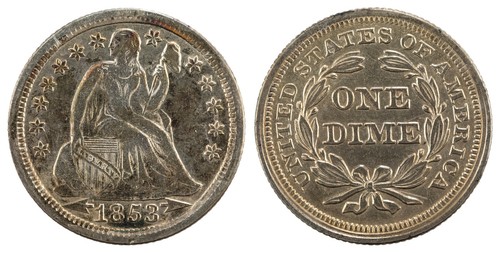
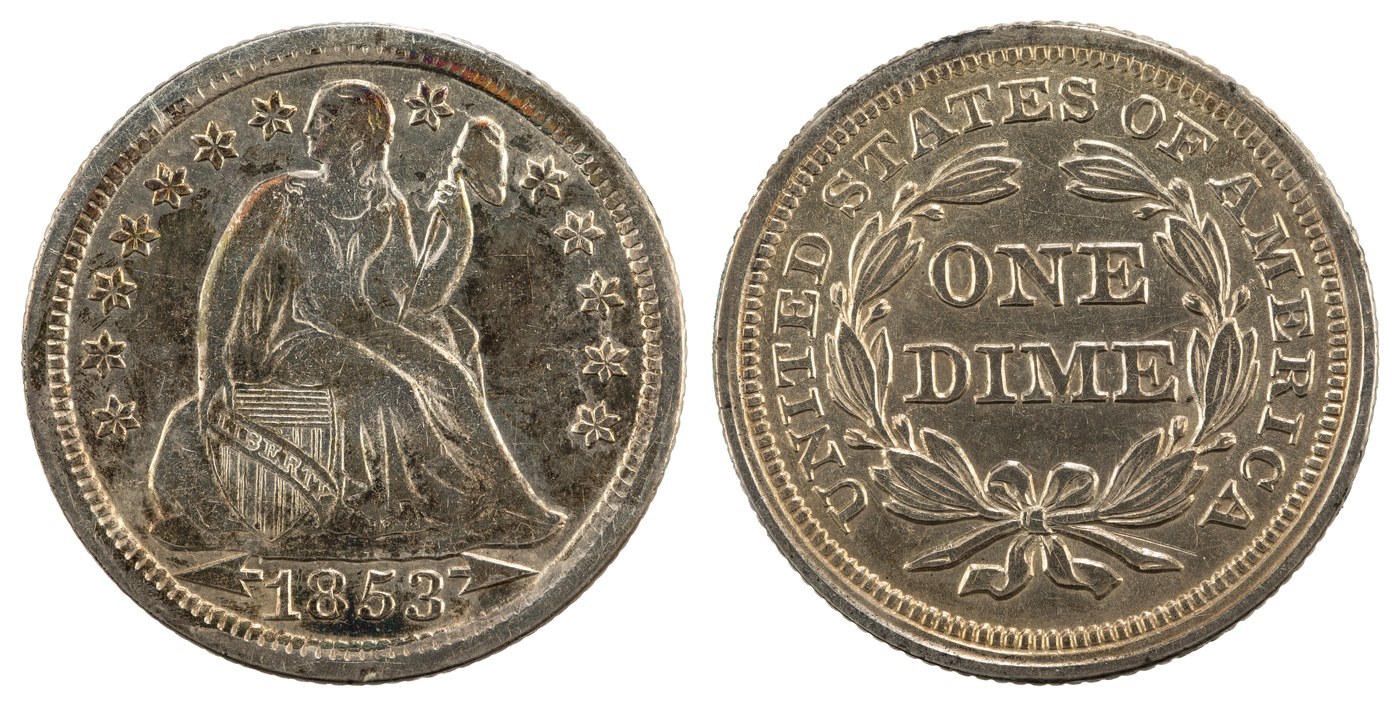
A silver Seated Liberty dime with small arrows flanking the date, marking the 1853 weight reduction; struck 1853–1855, with the pictured coin dated 1853.
- Country
- United States
- Denomination
- 10 Cents
- Metal
- Silver
Got a coin like this?
Identify any coin from a photo, free.
Overview
The Seated Liberty Dime with Arrows is a ten-cent silver coin struck from 1853 to 1855, easily recognized by the two small arrowheads placed on either side of the date. The obverse shows Liberty seated on a rock, holding a Union shield in one hand and a pole topped by a liberty cap in the other, ringed by thirteen stars with the arrows-flanked date below. The reverse presents the words ONE DIME inside a wreath, encircled by UNITED STATES OF AMERICA. The example shown here is dated 1853.
The arrows are not decorative: they were added to signal that the coin's silver weight had been reduced under an 1853 law. This makes the type a compact, three-year subset within the much longer Seated Liberty dime series, and a popular way for collectors to own a coin tied to a specific moment in U.S. monetary history.
Because it is a 90% silver coin, the type carries a modest base value from its metal, but date, mint, and condition are what set most examples apart. The 1853 Philadelphia issue shown here is the most common date of the group.
History & Background
Seated Liberty dimes were introduced in 1837 with a design derived from the portrait work of Christian Gobrecht. By the early 1850s a sharp rise in the price of silver meant the metal in a dime was worth close to, or more than, ten cents, encouraging coins to be melted or hoarded and creating a shortage of small change.
Congress responded with the Coinage Act of February 21, 1853, which lowered the weight of the silver dime, quarter, half dollar, and other fractional silver. To mark the lighter standard for the public and the Mint, arrowheads were added beside the date on the dime beginning in 1853. The arrows remained in place through 1855, after which they were dropped even though the reduced weight continued.
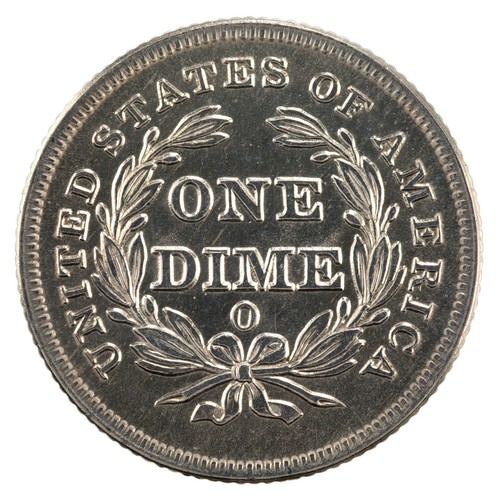
During these years the type was struck at the Philadelphia Mint and at the New Orleans Mint, whose coins carry an O mint mark on the reverse. The 1853 arrows dime was produced in very large numbers at Philadelphia, making it the workhorse date of the short series and the one most often encountered today.
How to Identify
Confirm the obverse first: Liberty is seated on a rock, holding an upright shield inscribed LIBERTY and a pole with a liberty cap at its top, surrounded by thirteen stars. The date sits at the bottom, and the defining feature of this type is a small arrowhead pointing outward on each side of that date. The pictured coin reads 1853.
The reverse reads ONE DIME within a wreath, with UNITED STATES OF AMERICA around the rim. There is no eagle and no motto on this design. On New Orleans coins a small O mint mark appears on the reverse, below or within the wreath; Philadelphia coins such as a plain 1853 have no mint mark.
The coin is 90% silver, about 17.9 mm in diameter with a reeded edge, and lighter than pre-1853 dimes because of the weight reduction the arrows announce. If a Seated Liberty dime lacks arrows beside the date, it is a different sub-type of the same series, not the Arrows dime described here.
Value & Collectibility
Value depends heavily on which coin you have. The 1853 Philadelphia arrows dime was struck in huge quantities and is the affordable, common date of the type; well-worn examples trade for modest sums driven largely by silver content, while sharp, original coins bring more. The New Orleans issues of these years are scarcer and carry higher premiums, and pieces with full detail or Mint State surfaces can be worth many times a common circulated example.
As a 90% silver coin, every genuine example has a base value tied to its metal, so even heavily worn pieces are worth more than face value. Above that floor, grade, eye appeal, and the absence of cleaning, corrosion, or damage make the biggest difference.
Because silver prices and collector demand shift over time, treat any figure as a range rather than a fixed price, and check a current price guide or recent auction results for the specific date and mint before buying or selling.
Frequently asked questions
What do the arrows next to the date mean?
They mark a reduction in the coin's silver weight under the Coinage Act of 1853. The arrowheads were added to the date from 1853 through 1855 to signal the new, lighter standard.
Is the Seated Liberty Dime with Arrows made of silver?
Yes. It is struck in 90% silver with 10% copper, so it always carries a base value from its metal content on top of any collector premium.
Does my 1853 dime have a mint mark?
A plain 1853 arrows dime was struck at Philadelphia and has no mint mark. Coins from New Orleans show a small O on the reverse near the wreath.
Why doesn't the reverse show an eagle?
The Seated Liberty dime uses a wreath reverse reading ONE DIME, not an eagle. An eagle reverse on a small silver ten-cent coin would point to a different, later dime series.
Is the 1853 Arrows dime rare?
The 1853 Philadelphia issue is common because it was made in very large numbers. New Orleans coins and high-grade examples are scarcer and more valuable.
Seated Liberty Dime with Arrows guides
In-depth guides for identifying, valuing, and collecting Seated Liberty Dime with Arrows.