Mercury Dime Centennial Gold
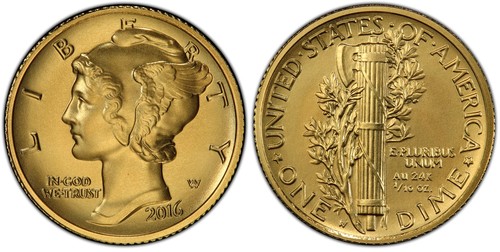
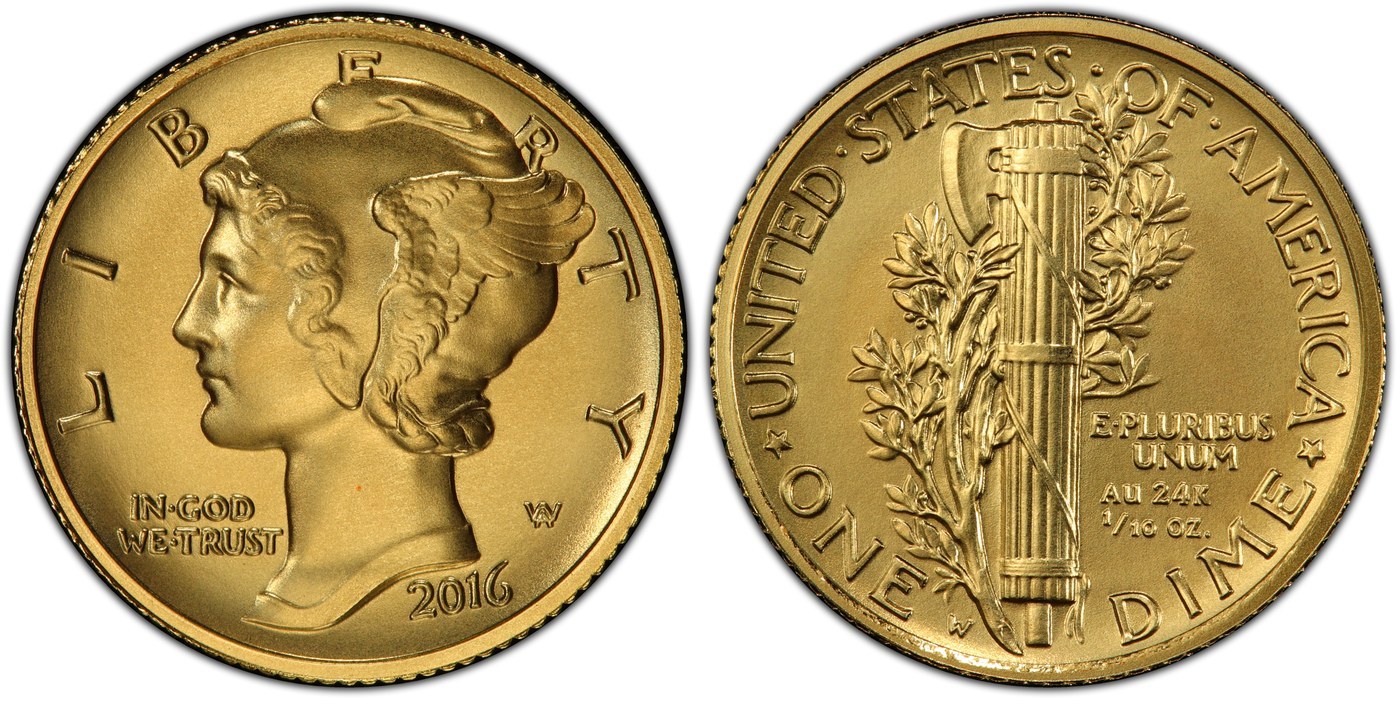
A 2016-W gold collector coin marking the centennial of the 1916 Mercury dime, struck in 1/10 oz of 24-karat gold at West Point.
- Country
- United States
- Denomination
- 10 cents
- Metal
- Gold
Got a coin like this?
Identify any coin from a photo, free.
Overview
The Mercury Dime Centennial Gold Coin is a modern United States collector coin the U.S. Mint issued in 2016 to mark 100 years since the original "Mercury" (Winged Liberty Head) dime debuted in 1916. It reproduces Adolph A. Weinman's classic dime design but is struck in gold rather than the silver of the circulating original.
Each coin contains one-tenth of a troy ounce of .9999 fine (24-karat) gold, a fact spelled out directly on the reverse with the markings "1/10 OZ." and "AU 24K." It was sold as a numismatic keepsake, not for circulation, and carries the "W" mint mark of the West Point Mint.
History & Background
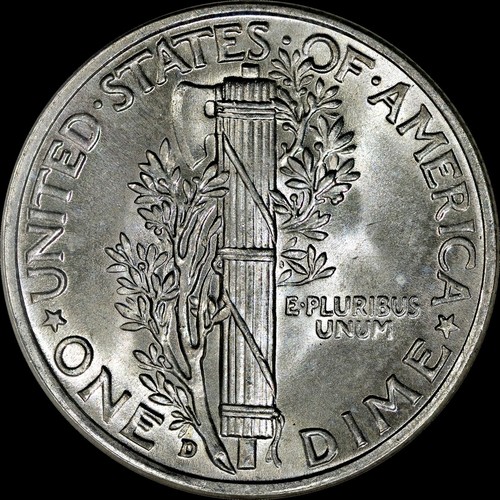
The original dime this coin honors was designed by sculptor Adolph A. Weinman and struck in 90% silver from 1916 through 1945. Its obverse shows Liberty wearing a winged cap meant to symbolize freedom of thought; the wings were widely mistaken for those of the Roman god Mercury, giving the coin its enduring nickname.
In 2016 the U.S. Mint produced gold centennial versions of three beloved Weinman-era designs — the Mercury dime, the Standing Liberty quarter, and the Walking Liberty half dollar — to celebrate their 1916 centennials. The gold Mercury dime was released first, in spring 2016. It was offered directly to collectors with a stated production limit (announced at 125,000 coins) and sold out, so it was never a circulating coin and never traded at its 10-cent face value.
How to Identify
The obverse carries Weinman's left-facing Winged Liberty Head with "LIBERTY" around the upper rim, "IN GOD WE TRUST" to the lower left, and the date "2016." The reverse shows a fasces (a bound bundle of rods) with an olive branch, encircled by "UNITED STATES OF AMERICA" and "E PLURIBUS UNUM," with "ONE DIME" below.
The features that mark it as the gold centennial issue — not an original silver dime — are the reverse metal-content inscriptions "1/10 OZ." and "AU 24K," the "W" mint mark, and the coin's small size and heavy feel for its diameter. It measures about 16.5 mm across and weighs roughly 3.11 grams (one-tenth troy ounce), noticeably smaller than the 17.9 mm silver dime. The edge is reeded and the finish is a bright, specimen-quality uncirculated strike.
Value & Collectibility
Because the coin contains about a tenth of an ounce of gold, its baseline worth tracks the gold market and shifts with bullion prices; it always trades far above its symbolic 10-cent face value. On top of that melt value it carries a collector premium tied to its centennial status and limited release.
Examples typically change hands for their gold content plus a modest-to-moderate numismatic premium, with sealed original-packaging coins and high-grade certified pieces (for example those graded SP-70 by NGC or PCGS) bringing the strongest prices. Because values move with gold, check current spot prices and recent certified sales rather than relying on a fixed figure.
Frequently asked questions
Is the 2016 gold Mercury dime real gold?
Yes. It contains one-tenth of a troy ounce of .9999 fine (24-karat) gold, as marked on the reverse with "1/10 OZ." and "AU 24K."
Was this coin meant to be spent as ten cents?
No. It is a collector coin the U.S. Mint sold directly to the public in 2016. Its gold content is worth far more than its 10-cent face denomination.
How is it different from an original Mercury dime?
The original 1916–1945 dimes are 90% silver, about 17.9 mm wide, and have no fineness markings. The gold centennial coin is smaller (about 16.5 mm), dated 2016, carries a "W" mint mark, and is inscribed "1/10 OZ." and "AU 24K."
Why is it called a Mercury dime?
The design is actually a Winged Liberty Head. The winged cap was often mistaken for the helmet of the Roman god Mercury, and the nickname stuck.
Mercury Dime Centennial Gold guides
In-depth guides for identifying, valuing, and collecting Mercury Dime Centennial Gold.