Capped Bust Dime
An early U.S. silver ten-cent piece showing Liberty in a cloth cap over a shield-breasted eagle, struck at Philadelphia from 1809 to 1837.
- Country
- United States
- Denomination
- 10 Cents
- Metal
- Silver
Got a coin like this?
Identify any coin from a photo, free.
Overview
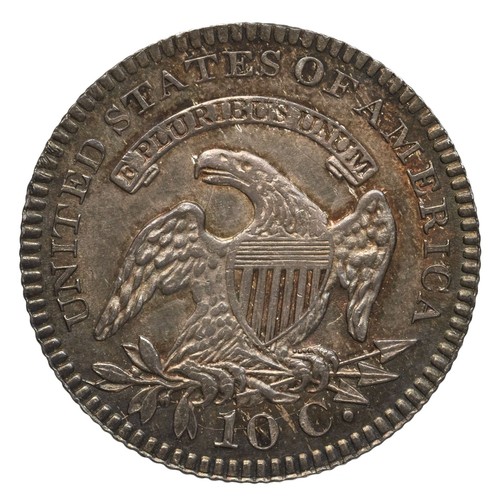
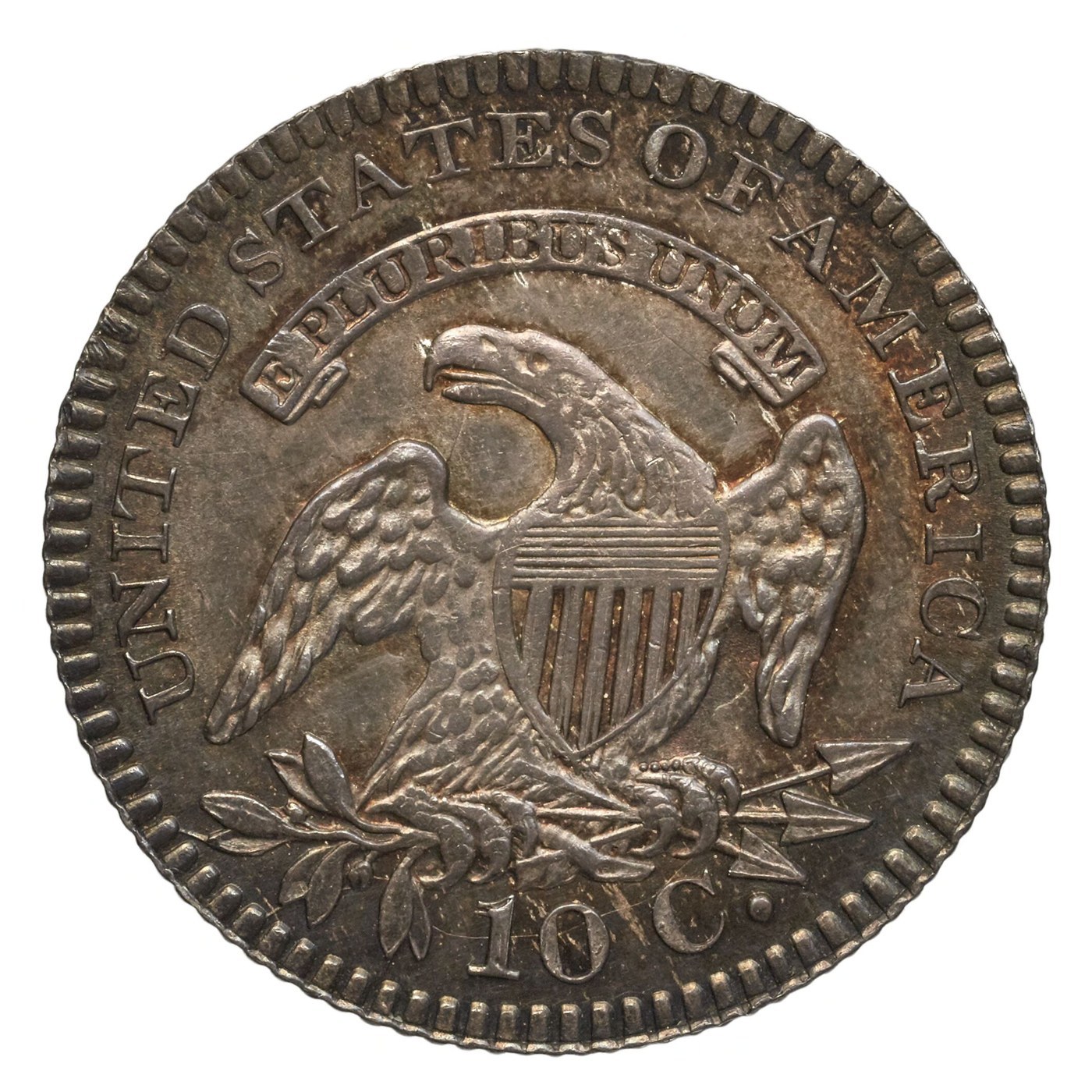
The Capped Bust Dime is an early United States silver ten-cent coin featuring Liberty facing left in a soft cloth cap, her loose curls falling to the shoulder and the cap band inscribed LIBERTY, surrounded by stars. The reverse shows a bald eagle with a shield across its breast, holding an olive branch and arrows, framed by UNITED STATES OF AMERICA and the denomination. The example shown here is dated 1834.
Struck at the Philadelphia Mint from 1809 through 1837, the series belongs to the first generation of small silver coinage the young nation produced for everyday commerce. The design is often called the 'Turban Head' because of the cap's turban-like appearance, though Liberty is in fact wearing a mob cap.
As a genuine 90-percent-silver coin roughly two centuries old, the Capped Bust Dime is collected both for its early-federal history and its classical portrait. Value is driven by date, die variety, and condition rather than by its small silver content.
History & Background
The Capped Bust design was created by Mint engraver John Reich and first appeared on the dime in 1809, replacing the earlier Draped Bust type. Reich's Liberty, in her cloth cap, brought a new, more matronly look to the small silver denominations and was used across the half dime, dime, quarter, and half dollar of the era.
Early Capped Bust dimes, struck through 1828, were made on an open-collar press that produced coins of slightly varying diameter, the so-called 'large size' variety. In 1828 the Mint adopted the close collar, which yielded a standardized, smaller diameter with a raised rim; dimes from 1828 to 1837, including the 1834 shown here, are the 'small size' type. All were struck at Philadelphia and carry no mint mark.
The series ended in 1837 when the Capped Bust design gave way to Christian Gobrecht's Seated Liberty dime. Because these coins circulated heavily and were made in an age of hand-engraved dies, collectors study them by die marriage, and many varieties are catalogued in specialized references.
How to Identify
Confirm the obverse first: Liberty faces left in a cloth cap with the band lettered LIBERTY, her curls loose over the shoulder, ringed by stars with the date below. The reverse must show a bald eagle with a striped shield on its breast, an olive branch and arrows in its talons, a scroll reading E PLURIBUS UNUM above, and UNITED STATES OF AMERICA with the denomination around the rim. The pictured coin is dated 1834.
The coin is 89.24-percent silver, small, and light—about 18.8 mm across on the small-size (1828–1837) coins and near 2.7 grams—with a reeded edge. Earlier large-size coins (1809–1828) run slightly larger in diameter. The denomination is expressed as '10 C.' on the reverse rather than 'ONE DIME' or 'TEN CENTS'.
There is no mint mark on any Capped Bust dime, as all were produced in Philadelphia. Genuine examples show honest gray silver toning and crisp, hand-cut lettering; be wary of coins that look too sharp for their wear or that show casting seams.
Value & Collectibility
Capped Bust dimes are early silver type coins, so even well-worn common dates carry a meaningful premium over their tiny silver value—typically starting in the low tens of dollars in Good to Very Good condition, with prices climbing steadily through the higher circulated grades. An 1834 is one of the more available dates within the small-size run, so condition and eye appeal matter more than rarity.
Scarcer dates, sharp Mint State survivors with original luster, and certain sought-after die varieties command substantial premiums, sometimes reaching into the hundreds or thousands of dollars. Cleaning, rim damage, holes, and heavy wear all reduce value significantly, as they do on any early silver coin.
Because the series is widely counterfeited and altered, and because die varieties can matter a great deal to price, any higher-value example is best purchased certified by a recognized grading service. Consult a current price guide or recent auction records for specific figures, since the market moves over time.
Frequently asked questions
Is the Capped Bust Dime real silver?
Yes. It was struck in an alloy of about 89 percent silver and 11 percent copper. Its silver content is small, however, so most of its value comes from age, date, and condition rather than metal.
Why is it called a 'Turban Head' dime?
The nickname comes from the cloth cap Liberty wears, which resembles a turban. She is actually wearing a mob cap, and the official design name is Capped Bust.
Does my 1834 dime have a mint mark?
No. Every Capped Bust dime was struck at the Philadelphia Mint, which used no mint mark in this era, so a blank field is normal and correct.
What is the difference between the large-size and small-size dimes?
Coins from 1809 to 1828 were struck with an open collar and vary slightly in diameter (large size). From 1828 to 1837, including 1834, the Mint used a close collar for a smaller, standardized diameter with a raised rim (small size).
How can I tell a Capped Bust Dime from a Seated Liberty Dime?
The Capped Bust dime shows a bust of Liberty in a cap. The Seated Liberty dime, which replaced it in 1837, shows a full seated figure of Liberty holding a shield and pole.
Capped Bust Dime guides
In-depth guides for identifying, valuing, and collecting Capped Bust Dime.