
How to Identify the Seated Liberty Dime
A collector's checklist for confirming a Seated Liberty Dime and its early No Stars type: reading the design, checking size and metal, and spotting look-alikes.
Read the full Seated Liberty Dime encyclopedia entry →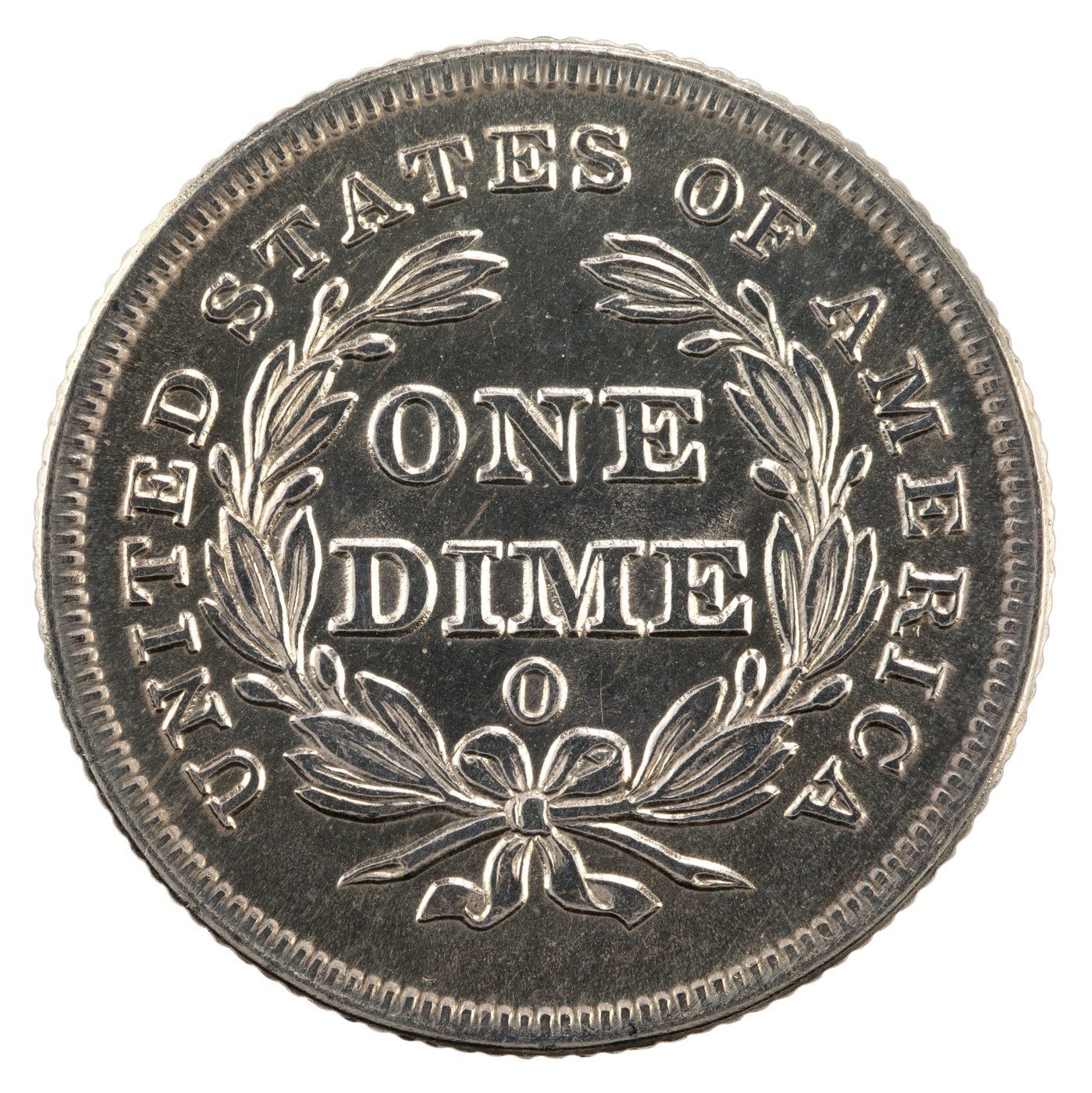
Begin with the seated figure that names the type. The obverse shows Liberty seated on a rock, facing left, holding a pole topped by a liberty cap and resting a hand on a shield lettered LIBERTY, with the date beneath her. This same seated Liberty appears on other silver denominations, so the next steps are what pin the coin to the dime.
Check the field around Liberty. If the space along the rim is completely plain with no stars, you have the earliest No Stars type, struck only in 1837 and part of 1838; the coin pictured here is dated 1838. If thirteen stars ring the border instead, it is a later stars-added Seated dime of 1838 or after. Then confirm the reverse: it should read ONE DIME inside a wreath, with UNITED STATES OF AMERICA around the edge.
Verify the physical coin. A genuine Seated Liberty dime is 90 percent silver, about 17.9 mm in diameter, weighs a little over 2.4 grams, and has a reeded edge. Size and the ONE DIME reverse are the quickest way to separate it from the larger Seated quarter (ONE QUARTER, about 24 mm) and half dollar, and from the tiny Seated half dime, which reads HALF DIME.
Look for a mint mark on the reverse, below the wreath. No mint mark means Philadelphia; an O there indicates New Orleans. Because an 1838 dime with no stars corresponds to a specific scarce issue, the mint mark and the star-free field together matter for correctly attributing the coin, so examine that area carefully rather than assuming.
Finally, weigh authentication risks. Early Seated dimes are sometimes cleaned, artificially toned, or have added or altered mint marks and dates to imitate scarcer issues. Original, evenly toned silver and crisp, unretooled detail are good signs. For any coin you believe to be an early No Stars piece or otherwise scarce, obtain grading and authentication from a recognized service before buying or selling.
Frequently asked questions
How do I know if my dime is the rare No Stars type?
Look at the field around the seated Liberty. If there are no stars along the rim, it is the early No Stars type of 1837–1838. Thirteen stars around the border indicate the later, more common stars-added variety.
How can I tell a Seated dime from a Seated quarter or half dollar?
Check the size and reverse denomination. The dime is small, about 17.9 mm, and reads ONE DIME; the quarter is larger and reads ONE QUARTER, and the half dollar is larger still and reads HALF DOL.
Where should I look for a mint mark?
On the reverse, below the wreath. No mint mark means the Philadelphia Mint; an O below the wreath means New Orleans. Mint marks were not placed on the obverse of this series.
What should make me cautious about authenticity?
Harsh cleaning, unnatural bright or uniform toning, and signs of an altered date or added mint mark are warning signs. Scarce early dates should be verified by a reputable third-party grading service.