
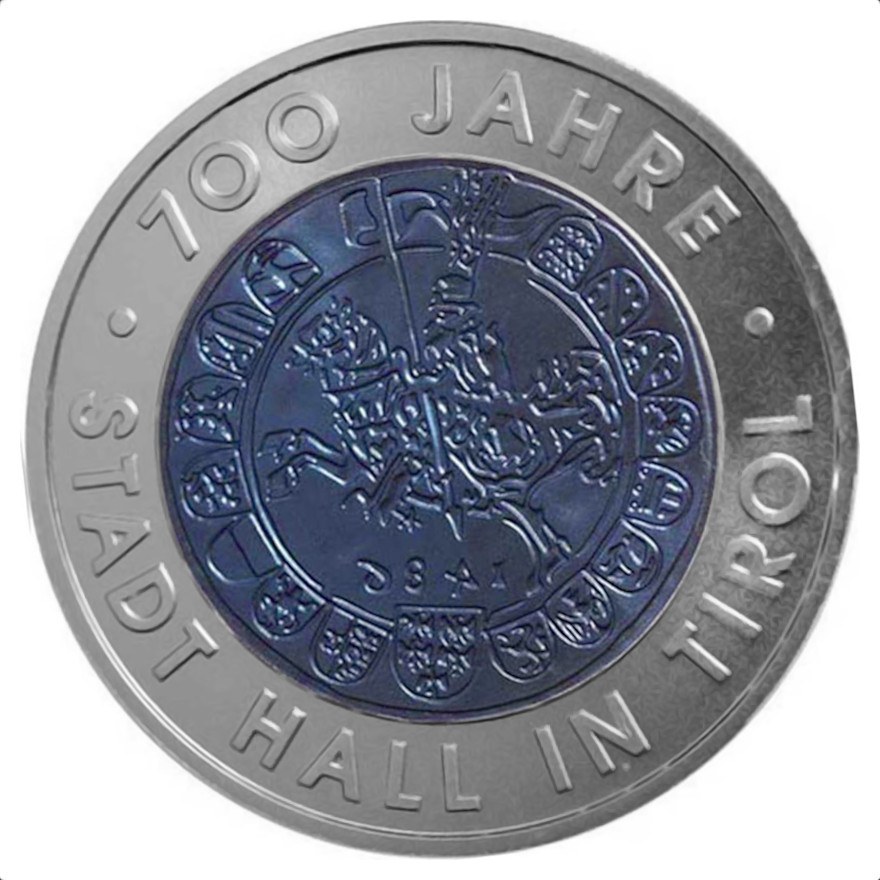
Austria 25 Euro Silver-Niobium Commemorative
Bi-metallic 25 Euro of the Austrian Mint with a silver outer ring and a colored niobium core; the 2003 first issue honored the town of Hall in Tirol.
- Country
- Austria
- Denomination
- 25 Euro
- Metal
- Bi-metallic
Got a coin like this?
Identify any coin from a photo, free.
Overview
The Austria 25 Euro Silver-Niobium is a modern commemorative coin struck by the Austrian Mint (Münze Österreich). It is bi-metallic: a fine-silver outer ring surrounds an inner core of niobium, a rare refractory metal that the Mint anodizes to produce a distinctive band of color. This color contrast between the pale silver ring and the tinted core is the series' signature feature.
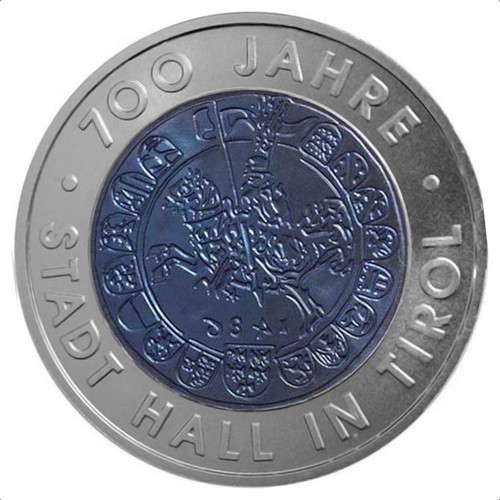
The example shown is the 2003 issue, the first coin ever produced with a niobium core. Its obverse carries a double-headed eagle bearing a shield together with an inscription referencing the town of Hall in Tirol, whose historic mint the coin honors. The reverse is not fully visible in this view but completes the commemorative design typical of the series.
Though denominated at 25 Euro, these are collector coins sold at a premium rather than pieces meant for everyday spending. Each annual issue pairs the same silver-plus-niobium construction with a new theme and a new core color.
History & Background
The Austrian Mint launched the silver-niobium 25 Euro coin in 2003, making it the world's first circulating-format coin to incorporate a niobium core. The debut coin was tied to Hall in Tirol, a town in western Austria that had been one of Europe's most important minting centers from the late medieval period onward and where large silver Guldiner were famously produced.
Niobium is difficult to work but takes on vivid colors through anodizing without any added pigment, which gave the Mint a way to create instantly recognizable, hard-to-counterfeit collector coins. The technique proved popular, and the Mint has issued a new 25 Euro silver-niobium coin nearly every year since, each with a fresh subject — often science, technology, astronomy, or Austrian heritage — and a different core color.
Because the series continues to grow, the coins are collected both individually and as a set. The 2003 first issue holds special standing as the piece that introduced the format and connected the new technology to Austria's long minting history at Hall in Tirol.
How to Identify
Construction: the defining trait is the two-metal build — a silver outer ring encircling a niobium center in a contrasting color. On the 2003 coin the core is a blue-toned niobium. If you see a silver ring around a colored (blue, green, violet, etc.) center, you are almost certainly looking at this Austrian series.
Obverse (this coin): a double-headed eagle with a shield, accompanied by lettering that names Hall in Tirol and marks the town's anniversary. The eagle motif and the German-language legend identify both the issuing country and the subject.
Denomination and specs: the coin is marked 25 EURO and REPUBLIK ÖSTERREICH somewhere in the design. Diameter is about 34 mm with a total weight in the mid-teens of grams; the silver is fine (.900). No exact reeding or edge inscription should be assumed from this view — confirm against catalog data for the specific year.
Series context: each annual issue shares the ring-and-core format but changes theme, core color, and date. Read the legend and date to pin down which coin you have; the 2003 example is distinguished by the Hall in Tirol / double-eagle design.
Value & Collectibility
As modern collector coins, silver-niobium 25 Euro pieces trade at a premium over their 25 Euro face value and over bullion, driven mainly by collector demand rather than metal content — the silver and small niobium core are modest in weight. Typical retail sits from the low tens of euros up to a few hundred, depending on the year, condition, and packaging.
The 2003 first issue commonly commands a higher premium than later dates because it launched the series and had a comparatively limited mintage; well-preserved examples with original Mint packaging and certificate bring the strongest prices. Coins that are toned, handled, or missing their case sell for less.
Values shift with the collector market, so treat any figure as a range and check recent sold listings and dealer prices for the exact year before buying or selling. Original capsule, box, and certificate meaningfully help realized prices.
Frequently asked questions
What is the Austria 25 Euro Silver-Niobium coin?
It is a bi-metallic commemorative coin from the Austrian Mint with a fine-silver outer ring and a colored niobium core. The 2003 first issue honored the town of Hall in Tirol and its minting history.
What makes the center a different color?
The core is niobium, a metal that develops vivid colors when anodized — no paint or pigment is used. Each annual issue in the series has a different core color; the 2003 coin's core is blue-toned.
Is it worth 25 Euro or more?
The 25 Euro is its face value, but as a collector coin it sells at a premium above that. The 2003 first issue in particular tends to bring more than later dates, especially with original packaging.
Why does the 2003 coin show Hall in Tirol?
Hall in Tirol was a major historic mint in Austria. The 2003 debut coin linked the brand-new niobium technology to that long minting heritage, pairing a double-headed eagle and shield with the town's name.
Can I spend one as regular money?
It is legal tender in Austria at 25 Euro, but its collector value is higher, so these are kept and traded by collectors rather than spent.
Austria 25 Euro Silver-Niobium Commemorative guides
In-depth guides for identifying, valuing, and collecting Austria 25 Euro Silver-Niobium Commemorative.
Other coins you may enjoy
Leif Erikson Commemorative 1000 Króna
2000
Swedish Gold Commemorative
Early 20th century
1 Lats (Christmas Bells)
2012
Romania International Year of Chemistry Commemorative
2011
1 Euro (10 Years EMU)
1999-2009
25 Euro (Bionik)
2012
100 Forint (Commemorative)
commemorative issue
2 Euro (150 Years PSP)
2018
3 Roubles (First All-Russian Coins)
1982
10 Euro (Royal Marriage)
2002
Swiss Shooting Thaler
1934
Sachsen-Weimar-Eisenach 5 Mark Wedding Commemorative
1903-1910