
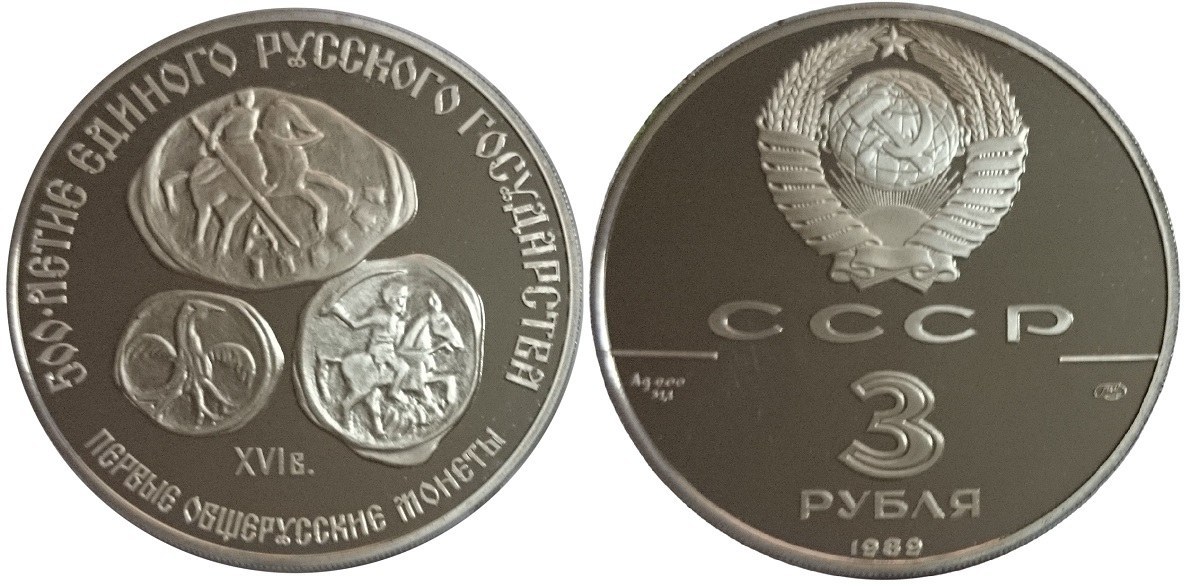
3 Roubles (First All-Russian Coins)
Soviet 1982 commemorative 3 Roubles honoring the first all-Russian coins, showing three historical 18th-century Russian coins with the state emblem reverse.
- Country
- USSR
- Denomination
- 3 Roubles
- Metal
- Copper-nickel
Got a coin like this?
Identify any coin from a photo, free.
Overview
This is a Soviet commemorative 3 Roubles dated 1982, issued to honor the first all-Russian coinage. Its obverse groups three historical Russian coins of earlier centuries, with a period marker of the eighteenth century (XVIII), while the reverse carries the standard USSR state emblem, the denomination 3 РУБЛЯ, and the country name СССР.
The design is unusual in that it depicts coins upon a coin: the older Russian money is shown as the subject, a numismatic tribute to Russia's early unified currency. This makes it a piece of interest to collectors of coins-on-coins themes as well as of Soviet commemoratives.
As a commemorative rather than an everyday circulation piece, it was produced for collectors and marked occasions in Soviet coinage. The example described here is a copper-nickel type; anniversary Soviet roubles of this era were struck in base metal for general collectors and, in some programs, in precious metal for premium editions.
History & Background
The Soviet Union issued a long series of commemorative roubles from the 1960s onward, marking anniversaries, historical figures, and cultural milestones. Higher-denomination pieces such as 3 Roubles were reserved for special commemorative and collector programs rather than daily commerce, where 1, 2, 3 and 5 kopeck and small rouble coins circulated.
This 1982-dated 3 Roubles looks back much further than the Soviet period itself, to the early consolidation of Russian coinage. By depicting historical Russian coins of earlier centuries and marking the eighteenth century, it celebrates the heritage of a unified Russian money that predated the USSR by generations.
The reverse follows the standard Soviet format of the era, dominated by the state emblem of the USSR: the hammer and sickle over a globe, framed by wheat-ear wreaths and rising sun rays. That emblem, the СССР legend, and the 1982 date place the coin firmly within late-Soviet commemorative coinage.
How to Identify
The obverse is the diagnostic side: it shows three historical Russian coins from earlier periods arranged together, accompanied by Cyrillic text referring to Russia's first coins and a Roman-numeral period marker, XVIII, for the eighteenth century. Seeing coins depicted as the design subject, rather than a portrait or building, is the fastest way to recognize this type.
The reverse carries the USSR state emblem, the hammer and sickle superimposed on a globe within a wreath of wheat ears and sunburst, with the legend СССР above and the denomination 3 РУБЛЯ, plus the date 1982. The value in words (РУБЛЯ, the grammatical form used with the number three) confirms the three-rouble denomination.
Key identifiers are the three depicted historical coins with the XVIII marker on the obverse, and the Soviet state emblem with СССР, 3 РУБЛЯ, and 1982 on the reverse. Note that some Soviet 3 Rouble commemoratives of this period were struck in precious metal for collector editions, so metal, weight, and diameter should be checked against the specific issue rather than assumed.
Value & Collectibility
As a Soviet commemorative, this 3 Roubles derives value from collector demand, condition, and which metal version an example represents. Base-metal (copper-nickel) commemorative roubles of the era are generally affordable, trading from a few dollars for worn pieces up to higher amounts for pristine uncirculated or proof-quality strikes.
Condition and originality drive price. Proof and proof-like coins with mirror fields and frosted devices, and coins preserved in original mint packaging or holders, command clear premiums over handled or cleaned examples. Precious-metal collector editions of Soviet 3 Rouble commemoratives, where issued, carry substantially higher value tied to their metal content and low mintages.
Because exact prices depend on the specific metal, grade, packaging, and market demand, treat these as general ranges rather than fixed quotes. Confirm the exact composition of any given piece before valuing it, since base-metal and precious-metal versions of Soviet commemoratives can look similar but differ greatly in worth.
Frequently asked questions
What does the 1982 Soviet 3 Roubles commemorate?
It honors Russia's first all-Russian coins, celebrating the heritage of early unified Russian coinage. The obverse depicts three historical Russian coins and marks the eighteenth century with the Roman numerals XVIII.
Why are there coins pictured on the coin?
The design is a numismatic tribute: it shows older Russian coins as its subject to commemorate early Russian money. This coins-on-a-coin theme is what makes the type distinctive.
What is on the reverse?
The reverse shows the USSR state emblem, a hammer and sickle over a globe within a wheat-ear wreath, with the legend СССР, the denomination 3 РУБЛЯ, and the date 1982.
Is it made of silver or gold?
The example described here is copper-nickel base metal. Some Soviet 3 Rouble commemoratives were also struck in precious metal for collector editions, so check the specific issue's composition, weight, and diameter before assuming.
Is this coin valuable?
Base-metal versions are modestly priced and depend on condition, with proof and uncirculated pieces worth more. Any precious-metal collector edition would be worth considerably more. Value varies with metal, grade, and demand.
3 Roubles (First All-Russian Coins) guides
In-depth guides for identifying, valuing, and collecting 3 Roubles (First All-Russian Coins).
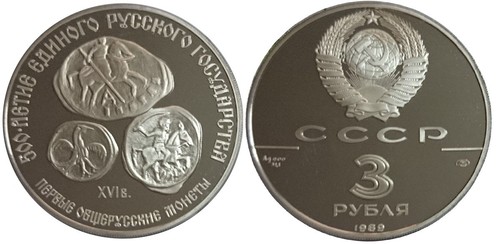
3 Roubles (First All-Russian Coins) identified by the community
Real coins identified with Coin Identifier.
Other coins you may enjoy
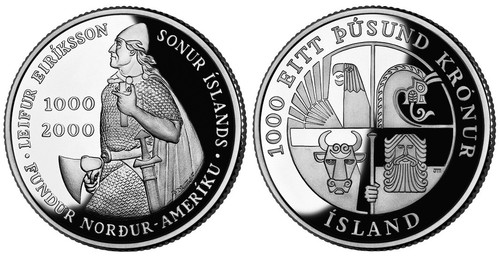
Leif Erikson Commemorative 1000 Króna
2000
Swedish Gold Commemorative
Early 20th century
1 Lats (Christmas Bells)
2012
Romania International Year of Chemistry Commemorative
2011
1 Euro (10 Years EMU)
1999-2009
25 Euro (Bionik)
2012
100 Forint (Commemorative)
commemorative issue
2 Euro (150 Years PSP)
2018
10 Euro (Royal Marriage)
2002
Swiss Shooting Thaler
1934
Sachsen-Weimar-Eisenach 5 Mark Wedding Commemorative
1903-1910
Germany 2 Euro Elbphilharmonie Commemorative
2017