
How to Identify the Austria 25 Euro Silver-Niobium Commemorative
Spot it by the silver ring around a colored niobium core, the 25 EURO mark, and — on the 2003 coin — a double-headed eagle with the Hall in Tirol legend.
Read the full Austria 25 Euro Silver-Niobium Commemorative encyclopedia entry →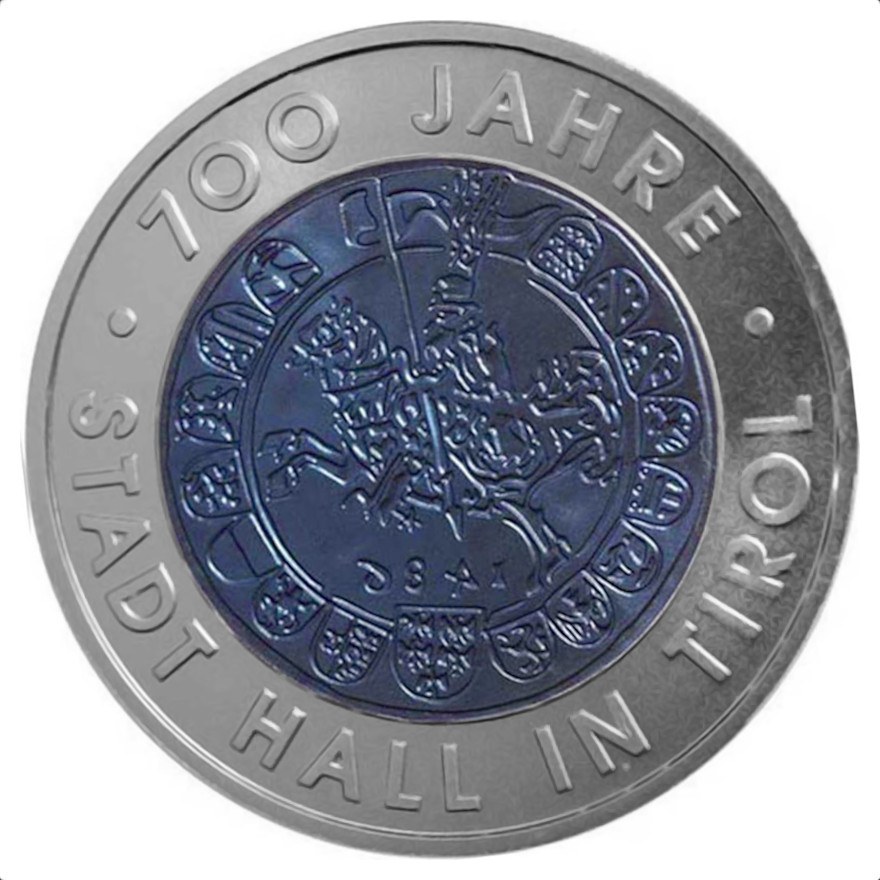
Start with the two-tone construction. The single most reliable clue is a pale silver outer ring surrounding a differently colored inner disc. That inner disc is niobium, anodized to a solid color (blue on the 2003 coin, other colors in later years). A silver-ringed coin with a blue, green, violet, or amber center is the hallmark of this Austrian series and rules out ordinary bi-metallic coins that use plain yellow and white metals.
Read the obverse of this issue. The 2003 coin shows a double-headed eagle holding a shield, with a legend naming Hall in Tirol and marking the town's anniversary. Look also for 25 EURO and REPUBLIK ÖSTERREICH in the design to confirm the denomination and country. The reverse (not shown in this view) carries the year's commemorative scene; check catalog images for the matching design.
Confirm size and metal. The coin is roughly 34 mm across — larger than most circulating coins — and made of fine silver (.900) with a niobium core. It should feel like a substantial collector piece. Note that the silver ring can tone over time; that is normal and not a sign of a fake by itself.
Pin down the year from the legend and date. Because a new silver-niobium 25 Euro has appeared almost every year since 2003, the format alone does not tell you which coin you have. Use the date and the theme to identify it: the Hall in Tirol / double-eagle design belongs specifically to the 2003 first issue.
Authenticate with care. Niobium's anodized color is very hard to fake convincingly, but verify weight, diameter, and design details against Mint specifications, and prefer coins in their original Austrian Mint capsule with box and certificate. Be wary of pieces with painted-looking centers, wrong dimensions, or mismatched legends, and consult a dealer for high-value examples.
Frequently asked questions
How do I tell this from a normal bi-metallic coin?
Ordinary bi-metallic coins use two plain metals (usually a yellow center and a white ring). This series has a fine-silver ring around a niobium core that is anodized to a strong, solid color such as blue — a look no everyday coin has.
How do I know it is the 2003 issue and not a later year?
Check the date and design. The 2003 coin shows a double-headed eagle with a shield and a Hall in Tirol legend, and its core is blue. Later years keep the silver-plus-niobium format but change the theme, date, and core color.
Is the colored center painted?
No. The color comes from anodizing the niobium, which alters how the metal reflects light. A center that looks like applied paint, or that chips, is a warning sign of a fake.
What confirms authenticity?
Match the weight, ~34 mm diameter, .900 silver ring, and design to Austrian Mint specifications, and look for the original capsule, box, and certificate. Have valuable examples checked by a reputable dealer.