
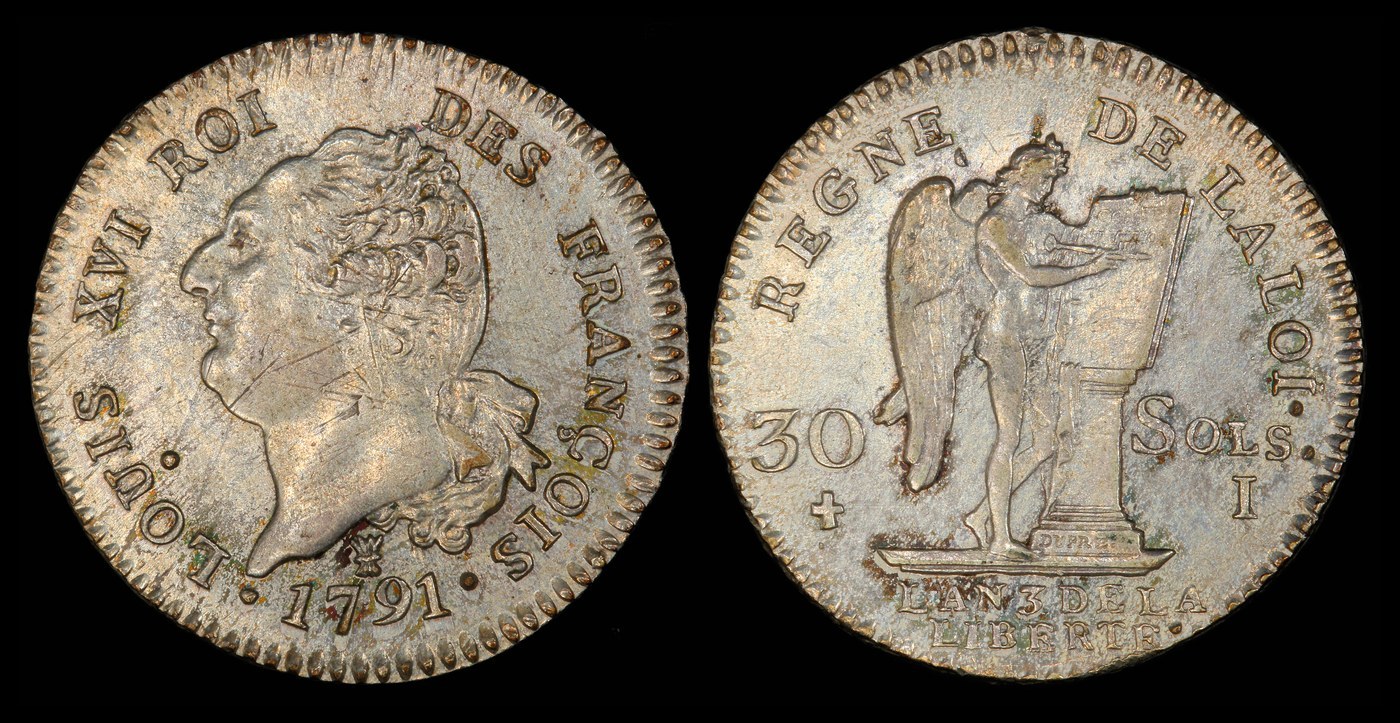
30 Sols (Half Ecu)
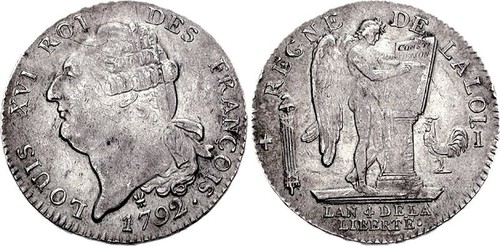
A French Revolutionary silver 30 sols of 1791: profile of Louis XVI as 'Roi des Francais' obverse, standing Liberty reverse dated 'L'An 4 de la Liberte'.
- Country
- France
- Denomination
- 30 Sols
- Metal
- Silver
Got a coin like this?
Identify any coin from a photo, free.
Overview
The 30 sols is a French silver coin of the early Revolutionary period, struck under the constitutional monarchy of Louis XVI. This example dates to 1791 and carries the king's profile on the obverse with the legend 'LOUIS XVI ROI DES FRANCAIS'—King of the French—paired with a standing figure of Liberty holding a flag and shield on the reverse.
Worth thirty sols (sous), the coin sits among the middle silver denominations of the day and is sometimes described as a half ecu. Its reverse legend, 'L'AN 4 DE LA LIBERTE' (the fourth year of Liberty), dates the design to the Revolutionary calendar of liberty rather than to a regnal year, marking it as a transitional issue between old royal coinage and the fully Republican money that followed.
History & Background
This 30 sols belongs to the brief window after 1789 when France was governed as a constitutional monarchy. The old royal title 'Roi de France et de Navarre' gave way to 'Roi des Francais'—King of the French—signalling that the king now reigned by the will of the nation rather than by divine right. That change of legend is the coin's defining historical marker.
The reverse abandons the crowned royal arms of earlier French silver in favour of a Liberty figure and the revolutionary dating 'L'An 4 de la Liberte,' counting years from the dawn of the Revolution. Coins like this circulated during the intense years of 1791 and 1792, before the monarchy was abolished and France became a Republic in September 1792.
Because it bridges royal and republican imagery on a single piece, the constitutional-era 30 sols is prized as a tangible relic of a very short-lived political experiment. Surviving examples reflect the upheaval of their time and the rapid transformation of French coinage that soon followed.
How to Identify
Read the obverse legend first. A genuine constitutional 30 sols names Louis XVI as 'ROI DES FRANCAIS' (King of the French), not 'ROI DE FRANCE.' The king appears in profile. This wording is the single strongest clue that a coin belongs to the 1791-1792 constitutional issue rather than to earlier royal coinage.
On the reverse, look for the standing figure of Liberty holding a flag and a shield, together with the legend 'L'AN 4 DE LA LIBERTE' and the date 1791. The coin is silver and mid-sized—larger than the small silver denominations of the period but below the full ecu.
Confirm the denomination and date together rather than relying on the portrait alone, since Louis XVI appears on several silver coins. The combination of the 'Roi des Francais' obverse and the Liberty-and-liberty-year reverse is what pins the piece to the 30 sols constitutional series.
Value & Collectibility
As a silver coin from the French Revolution more than two centuries old, the 1791 30 sols carries collector value well above its face. Its appeal comes from the dramatic history it represents—the short constitutional monarchy—rather than from precious-metal content alone.
Condition is the main driver of price. Heavily worn or damaged pieces are modest, while sharply struck coins with clear legends and original surfaces command a strong premium. Mint of striking, die variety and eye appeal also matter to specialists of Revolutionary coinage.
Because values swing widely with grade and variety, judge any specific coin against recent auction and dealer results for that exact date and condition. Cleaning, holing, bending or tooling reduce value significantly, so original, undamaged silver is always preferred.
Frequently asked questions
Why does the coin say 'Roi des Francais' instead of 'Roi de France'?
The Revolution recast Louis XVI as a constitutional monarch reigning by the nation's will. 'Roi des Francais'—King of the French—replaced the older 'Roi de France,' and that legend marks this as a constitutional-era issue.
What does 'L'An 4 de la Liberte' mean?
It means 'the fourth year of Liberty,' a Revolutionary way of dating that counts years from the start of the Revolution rather than by the king's reign. It appears on the coin alongside the year 1791.
Is the 30 sols made of real silver?
Yes. The constitutional 30 sols was struck in silver. As a mid-size denomination it contains a moderate amount of metal, though its collector value comes chiefly from its history and condition.
Why is it sometimes called a half ecu?
The ecu was the large French silver crown; smaller silver pieces such as the 30 sols are informally grouped beneath it, and 'half ecu' is used loosely for this middle denomination. Confirm the coin by its legends and date rather than by the nickname.
30 Sols (Half Ecu) guides
In-depth guides for identifying, valuing, and collecting 30 Sols (Half Ecu).
Other coins you may enjoy
French 30 Sols
1791–1793 (French Revolution)
French Constitutional Ecu
1792
Constitutional Ecu
1792
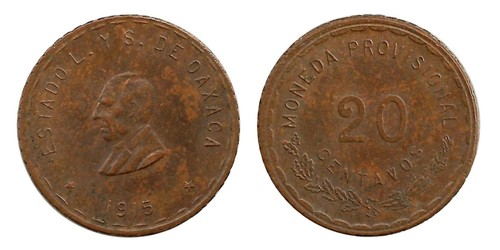
Oaxaca 20 Centavos
1915 (observed); Mexican Revolution provisional issue
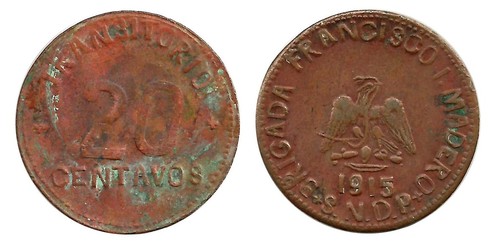
Puebla 20 Centavos
1915
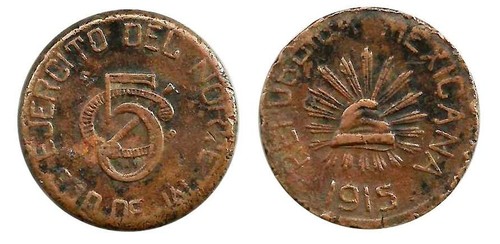
Jalisco 5 Centavos
1915
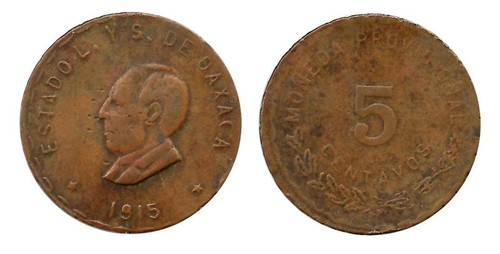
Oaxaca 5 Centavos
1915
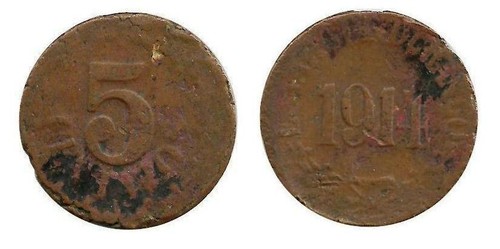
Durango 5 Centavos
1914
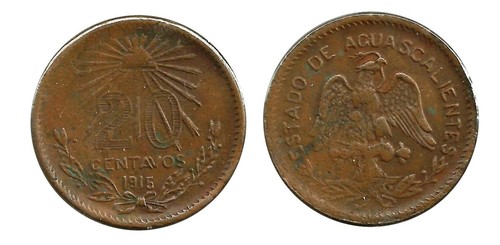
Aguascalientes 20 Centavos
1915
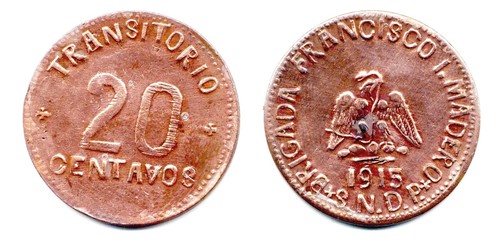
Chiconcuautla 20 Centavos
1915