
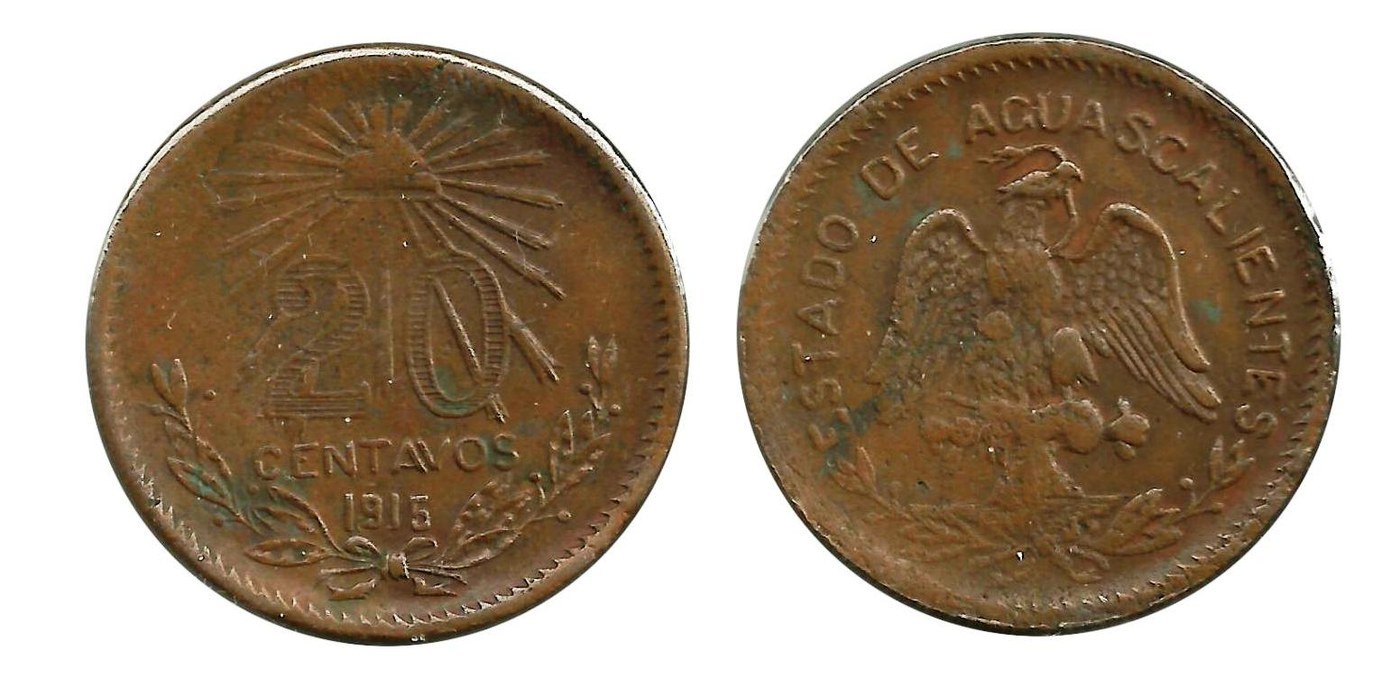
Aguascalientes 20 Centavos
A copper 20 centavos struck in Aguascalientes during the Mexican Revolution in 1915, showing the denomination on one side and a large numeral 20 with the national eagle on the other.
- Country
- Mexico
- Denomination
- 20 Centavos
- Metal
- Copper
Got a coin like this?
Identify any coin from a photo, free.
Overview
The Aguascalientes 20 centavos is a copper coin issued in the central Mexican state of Aguascalientes during the Mexican Revolution, dated 1915. It belongs to the broad family of revolutionary or "necessity" coinages that appeared across Mexico in the mid-1910s, when the collapse of normal currency circulation forced local authorities and military factions to strike their own small change. The piece observed here is a base-copper coin: one side presents the denomination and its surrounding design elements, and the other pairs a large numeral 20 with the Mexican national eagle.
Unlike the finely engineered issues of the Mexico City mint, revolutionary state coins such as this were typically produced under improvised conditions, so their style is plainer and their strike often less uniform. The result is a coin whose interest comes chiefly from its history — a tangible relic of a country in the middle of civil war — rather than from precious-metal value.
For collectors, the Aguascalientes 20 centavos sits within the widely studied series of Mexican Revolution coinage, where issues are catalogued by the state or locality that produced them. It is prized as a direct artifact of 1915, one of the most turbulent years of the conflict.
History & Background
During the Mexican Revolution, fighting between rival factions disrupted commerce and drained ordinary coined money from circulation. In response, several Mexican states and revolutionary armies produced their own emergency coinage between roughly 1913 and 1917. These local issues, struck in copper, silver, and sometimes crude cast metal, filled the gap left by the scarcity of federal currency and are collected today as the "revolutionary" coins of Mexico.
Aguascalientes, a small state in central Mexico, holds particular significance in the revolution: it hosted the 1914 Convention of Aguascalientes, a major gathering of revolutionary factions. Coinage bearing the Aguascalientes attribution and the date 1915 belongs to this period of shifting control and economic emergency, when local production of coins such as this 20 centavos met an urgent practical need for small change.
Because these coins were made outside the centralized mint system and under wartime pressure, production was limited and conditions varied. Surviving pieces reflect that origin, and the series as a whole is studied by specialists who attribute each issue to its state or locality and date within the revolutionary years.
How to Identify
Identify the type by its combination of features. It is a round copper coin dated 1915. One side carries the denomination together with its design elements, while the opposite side shows a large numeral 20 — marking twenty centavos — alongside the Mexican national eagle. The eagle is Mexico's coat of arms, drawn from the Aztec founding legend of an eagle perched on a nopal cactus, and it anchors the coin firmly to Mexico.
The metal is copper, so expect brown to reddish tones where original surface survives, and honest circulation wear on the high points. As a revolutionary local issue rather than a national-mint product, the coin tends to look plainer and may show a less uniform strike than contemporary federal coinage.
Attribution to Aguascalientes and to the year 1915 places the coin within the revolutionary series. Confirm the exact issue, and any local or die-variety details, against published references for Mexican Revolution coinage, since many states and factions produced comparable low-denomination copper pieces in the same era.
Value & Collectibility
The Aguascalientes 20 centavos is collected primarily as a historical artifact of the Mexican Revolution rather than for bullion, since it is a base-copper coin. Value depends heavily on condition, eye appeal, the strength of the strike, and secure attribution to the Aguascalientes issue and 1915 date. Well-worn or damaged examples are more modest, while sharp, problem-free pieces that clearly show the numeral 20 and eagle command higher premiums.
Revolutionary coinages vary considerably in scarcity from one state and denomination to the next, so a coin's desirability rests on where and how it was issued as much as on its grade. Clean surfaces, legible design, and confident attribution all add to appeal.
Because revolutionary issues were produced locally and are actively collected, both contemporary imitations and modern fakes exist, and altered or misattributed pieces circulate. Values are best confirmed against recent sales of comparable, expertly attributed examples, and significant purchases benefit from specialist authentication.
Frequently asked questions
What is the Aguascalientes 20 centavos?
It is a copper 20 centavos coin issued in the Mexican state of Aguascalientes during the Mexican Revolution, dated 1915. It is a revolutionary or "necessity" issue, struck locally to supply small change when normal currency was scarce.
Why was this coin made?
The Mexican Revolution disrupted commerce and drained federal coins from circulation, so states and revolutionary factions struck their own emergency coinage between about 1913 and 1917. This Aguascalientes piece is one such local issue.
Is it silver or copper?
It is copper. The 20 centavos here is a base-metal coin, so its appeal is historical rather than tied to precious-metal content.
What is the eagle on the coin?
It is the Mexican national eagle, the country's coat of arms, drawn from the Aztec legend of an eagle on a cactus. On this coin it appears together with the large numeral 20 marking the denomination.
What makes it a "revolutionary" coin?
Revolutionary coins are the local and factional issues struck across Mexico during the 1910s civil war, catalogued by the state or locality that produced them. This coin's Aguascalientes attribution and 1915 date place it in that series.
Aguascalientes 20 Centavos guides
In-depth guides for identifying, valuing, and collecting Aguascalientes 20 Centavos.
Other coins you may enjoy
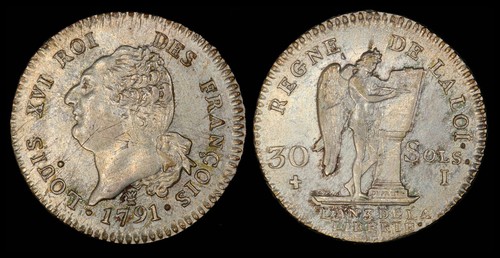
French 30 Sols
1791–1793 (French Revolution)
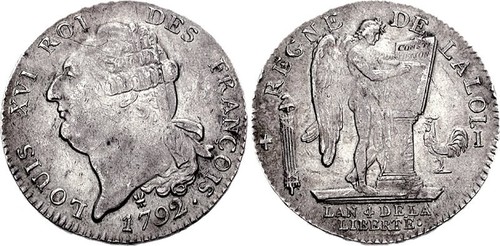
French Constitutional Ecu
1792
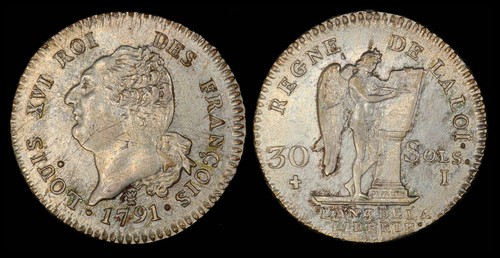
30 Sols (Half Ecu)
1791
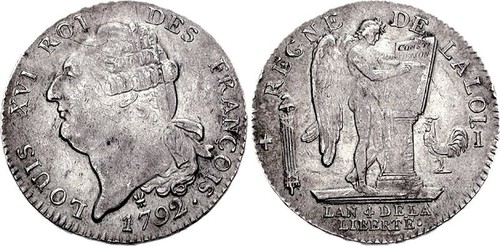
Constitutional Ecu
1792
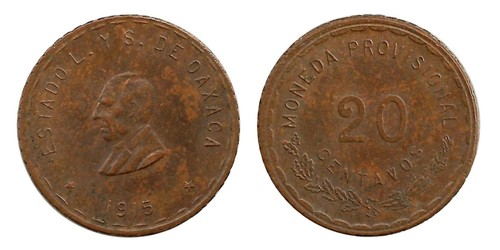
Oaxaca 20 Centavos
1915 (observed); Mexican Revolution provisional issue
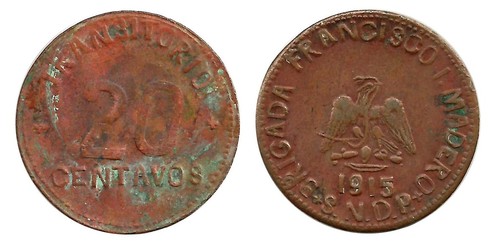
Puebla 20 Centavos
1915
Jalisco 5 Centavos
1915
Oaxaca 5 Centavos
1915
Durango 5 Centavos
1914
Chiconcuautla 20 Centavos
1915