
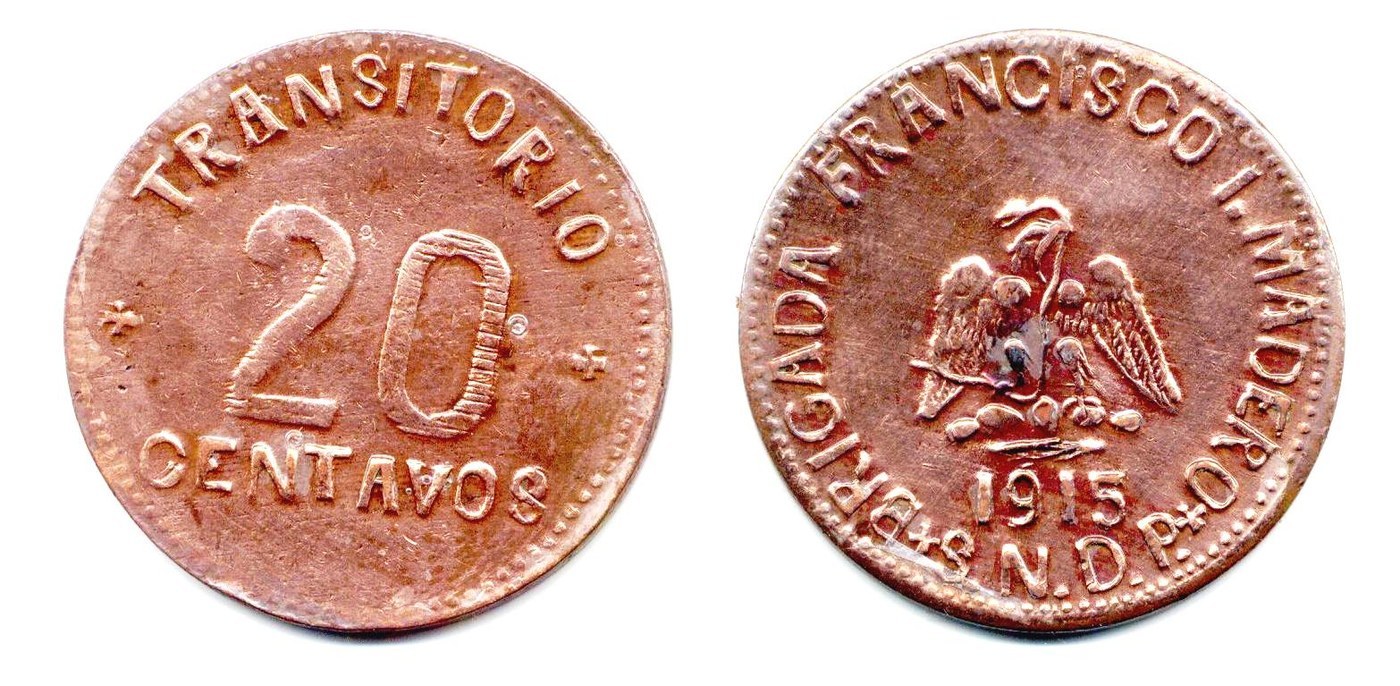
Chiconcuautla 20 Centavos
A 1915 copper 20 centavos struck as a local Revolutionary-era issue at Chiconcuautla, with a numeral 20 on one side and the Mexican national eagle on the other.
- Country
- Mexico
- Denomination
- 20 Centavos
- Metal
- Copper
Got a coin like this?
Identify any coin from a photo, free.
Overview
The Chiconcuautla 20 centavos is a copper coin issued during the Mexican Revolution and dated 1915. It belongs to the large body of provisional and locally struck money that appeared in Mexico when the national coinage system broke down amid civil war. One side is dominated by the numeral 20, marking the twenty-centavo value in a plain, transitional design; the other side carries the Mexican national eagle, with the eagle's head rendered in visible detail.
As a copper piece rather than a silver or gold issue, this coin was intended to serve as working small change in a specific region rather than as a store of value. Its relatively simple design and hand-produced character are typical of revolutionary local coinage, which was made quickly and with limited equipment to meet immediate needs.
Collectors treat Chiconcuautla and similar local issues as historical artifacts of a turbulent period, valued for their association with the Revolution and for the range of die and striking variations that these emergency coinages produced.
History & Background
Between roughly 1913 and 1917 the Mexican Revolution disrupted commerce and the flow of official coinage, and numerous states, towns, and military factions produced their own emergency money. These pieces, generically called revolutionary or provisional issues, ranged from crude cast coppers to more carefully struck silver. The 1915 date on this coin places it at the height of that period of monetary improvisation.
Chiconcuautla is a locality in the state of Puebla, in central Mexico, and lends its name to this issue. Like other local coinages of the era, the Chiconcuautla pieces were made to keep small-value transactions moving where centrally minted coins were scarce. The retention of the Mexican national eagle asserts continuity with Mexico's established coinage iconography even on money struck far from the national mint.
Because these coins were produced locally and in modest quantities, they were not made to the uniform standards of federal issues. The result is a coinage that varies in detail from piece to piece and that today documents, in metal, how ordinary economic life was sustained during the Revolution.
How to Identify
Identify this type by the pairing of a bold numeral 20 on one side, in a plain transitional style, with the Mexican national eagle on the other, where the eagle's head is a clear focal detail. The coin is copper, so expect brown to reddish-brown tones and the somewhat irregular surfaces typical of a locally produced revolutionary issue. The date 1915 ties it to the Revolution.
The fabric of the coin is a key clue: local issues like this often show less precise centering, lettering, and rims than federally minted Mexican coins of the period. The numeral 20 identifies the twenty-centavo denomination, while the eagle confirms the Mexican origin and the deliberate use of national iconography on a regional coin.
Attribution to Chiconcuautla specifically rests on matching the coin's design, style, and any accompanying legends to published references for that locality's issues, since many Mexican towns produced superficially similar copper centavo coins in 1915. Confirm the exact variety against a specialized catalog of Mexican revolutionary coinage.
Value & Collectibility
Value for Chiconcuautla and comparable local revolutionary coppers depends heavily on condition, strength of strike, and correct attribution rather than on metal content. As base-copper emergency money, these are collected as historical pieces, and prices generally sit in the affordable-to-moderate range for the series, with well-preserved or scarcer varieties commanding more.
Because local issues were produced in small quantities and vary from piece to piece, an example with clear design, an even surface, and honest wear is more desirable than a heavily corroded or damaged coin. Provenance and confident attribution to Chiconcuautla add to appeal, since the region's issues are less common than mainstream federal coinage of the era.
Given the number of look-alike local coppers and the possibility of later copies, both grade and authenticity strongly influence price. Check any specific coin against recent sales of comparable attributed examples and, for higher-value pieces, seek specialist confirmation before relying on a valuation.
Frequently asked questions
What is the Chiconcuautla 20 centavos?
It is a copper 20 centavos coin dated 1915, made as a local emergency issue during the Mexican Revolution and associated with Chiconcuautla in the state of Puebla. It carries a numeral 20 on one side and the Mexican national eagle on the other.
Why did a town issue its own coins?
During the Mexican Revolution, official coinage often could not reach many areas, so states, towns, and factions produced their own provisional money to keep small transactions going. The Chiconcuautla 20 centavos is one such local issue.
Is this coin silver or copper?
It is copper. As a base-metal small-change piece, its interest is historical, tied to the Revolution and to the local-issue coinage of 1915, rather than to precious-metal content.
What is the bird on the coin?
It is the Mexican national eagle, Mexico's coat of arms. Its use on a locally struck coin signals a deliberate link to national coinage tradition even though the piece was produced regionally.
Is a Chiconcuautla 20 centavos valuable?
Most examples are affordable-to-moderate, with value set by condition, strike quality, and confirmed attribution rather than metal. Scarcer varieties and well-preserved, authentic pieces bring higher prices; verify against recent comparable sales.
Chiconcuautla 20 Centavos guides
In-depth guides for identifying, valuing, and collecting Chiconcuautla 20 Centavos.
Other coins you may enjoy
French 30 Sols
1791–1793 (French Revolution)
French Constitutional Ecu
1792
30 Sols (Half Ecu)
1791
Constitutional Ecu
1792
Oaxaca 20 Centavos
1915 (observed); Mexican Revolution provisional issue
Puebla 20 Centavos
1915
Jalisco 5 Centavos
1915
Oaxaca 5 Centavos
1915
Durango 5 Centavos
1914
Aguascalientes 20 Centavos
1915