
Oaxaca 5 Centavos
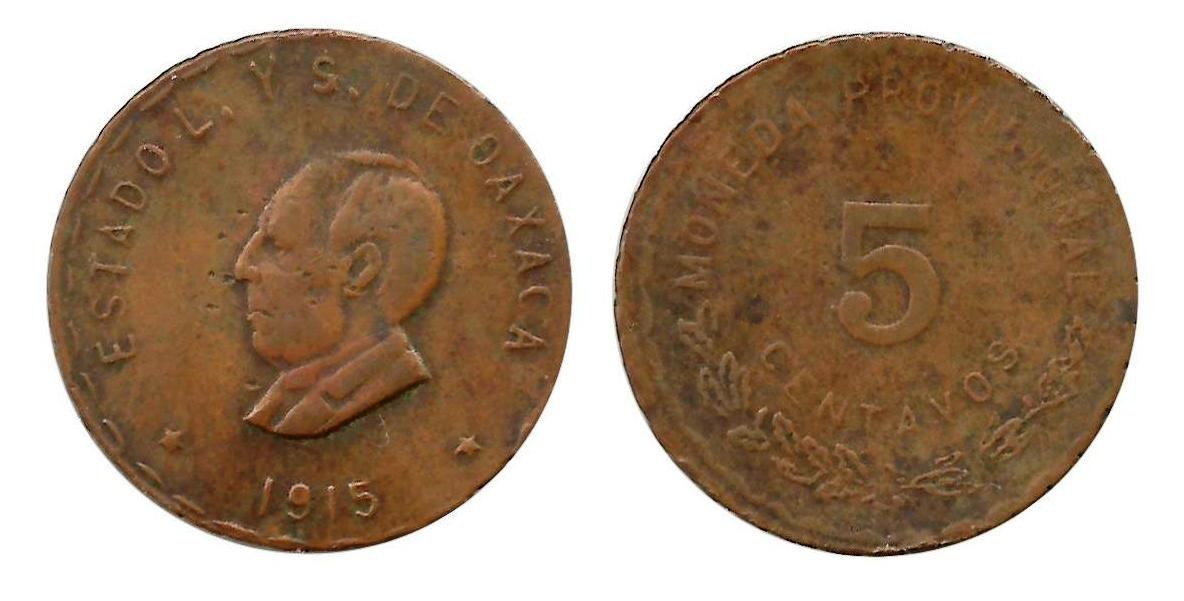
A copper 5-centavos struck by the sovereign State of Oaxaca during the Mexican Revolution, with a profile bust on the obverse and the numeral 5 in a wreath on the reverse.
- Country
- Mexico
- Denomination
- 5 Centavos
- Metal
- Copper
Got a coin like this?
Identify any coin from a photo, free.
Overview
The Oaxaca 5 Centavos is a small copper coin issued by the southern Mexican state of Oaxaca during the upheaval of the Mexican Revolution. It belongs to a family of provisional, or emergency, coins that individual Mexican states and factions produced when the national coinage system broke down and ordinary currency became scarce. The example pictured is dated 1915.
The obverse shows a left-facing profile bust set above a base or pedestal, the portrait most often associated with Benito Juarez — Oaxaca's most celebrated native son and a former president of Mexico — whose likeness appears on the state's copper minor coins. The reverse displays a large numeral 5 for the denomination, framed by a wreath.
As a low-value copper piece made under wartime conditions, the Oaxaca 5 Centavos was intended for everyday small change within the region. Today it is collected as a tangible relic of Oaxaca's brief assertion of sovereignty and of the broader revolutionary coinage of the 1910s.
History & Background
During the Mexican Revolution the country fractured into competing factions, and the flow of federally minted coins into many regions was interrupted. To keep commerce moving, states, municipalities, and revolutionary armies struck their own emergency money in whatever metals were available — copper, brass, silver, and occasionally gold. These are known collectively as Mexican Revolutionary or provisional coins.
Oaxaca produced one of the most extensive of these state coinages. Amid the political conflict of the period, Oaxaca declared itself a free and sovereign state, and its provisional government authorized a range of denominations in 1915, including copper minor coins such as the 1, 2, 3, 5, 10, and 20 centavos. The copper pieces carry a bust identified with Benito Juarez, honoring the region's ties to the celebrated Oaxacan statesman.
Because these coins were made quickly and under difficult conditions, they exist in differing styles and levels of finish, from cruder early strikings to more carefully engraved versions. The Oaxaca series as a whole is a well-known and heavily studied part of Mexican revolutionary numismatics.
How to Identify
Identify the type first by its two sides. The obverse bears a profile bust facing left, resting on a base or pedestal, corresponding to the Juarez portrait used on Oaxaca's copper coins. The reverse is dominated by a large numeral 5, the denomination, enclosed within a wreath. The date 1915 appears on the coin.
Legends and inscriptions tie the piece to Oaxaca and its provisional status — look for wording naming the state of Oaxaca and identifying it as a free and sovereign, or transitional, issue, together with the CENTAVOS denomination. The combination of the profile bust, the wreathed numeral, and the Oaxaca legend distinguishes this state issue from federally minted Mexican centavos of the era.
Physically it is a small copper coin. Surfaces and strike quality vary considerably because of the emergency conditions under which the series was made, so weight, diameter, and detail can differ from one specimen to another. The essential diagnostics remain the Oaxaca attribution, the bust-over-base obverse, the numeral-5-in-wreath reverse, and the 1915 date.
Value & Collectibility
The Oaxaca 5 Centavos is a collectible historical piece rather than a bullion coin, since it is struck in copper. Its value comes from its status as revolutionary emergency money and from collector demand for the Oaxaca provisional series, with condition and eye appeal playing a large role.
Because the series was produced in varying styles and finishes, some varieties are considerably scarcer than others, and specialists pay close attention to which variety a given coin represents. Well-worn common examples are modest, while sharply detailed pieces, scarcer varieties, and problem-free surfaces command higher premiums.
Actual prices depend on variety, grade, and current collector demand, and are best confirmed against recent sales of comparable Oaxaca copper coins. As with any sought-after revolutionary series, coins offered as scarce varieties benefit from expert attribution.
Frequently asked questions
What is the Oaxaca 5 Centavos?
It is a copper 5-centavos coin issued by the state of Oaxaca as provisional, or emergency, money during the Mexican Revolution. The pictured example is dated 1915 and shows a profile bust on the obverse and the numeral 5 in a wreath on the reverse.
Whose portrait is on the coin?
The left-facing profile bust on the obverse is the portrait associated with Benito Juarez, Oaxaca's most famous native son and a former president of Mexico, whose likeness appears on the state's copper minor coins.
Why did Oaxaca make its own coins?
During the Revolution the national coinage system broke down and ordinary money grew scarce, so Oaxaca — which declared itself a free and sovereign state — struck its own provisional coinage in 1915 to supply small change for local commerce.
Is the Oaxaca 5 Centavos made of silver?
No. This denomination is a copper minor coin. The Oaxaca provisional series also included higher-value pieces in other metals, but the 5 centavos shown here is copper and has collector, not bullion, value.
Are there different varieties?
Yes. Because the coins were made quickly under wartime conditions, the Oaxaca series exists in differing styles and levels of finish, from cruder strikings to more carefully engraved versions, and some varieties are scarcer than others.
Oaxaca 5 Centavos guides
In-depth guides for identifying, valuing, and collecting Oaxaca 5 Centavos.
Other coins you may enjoy
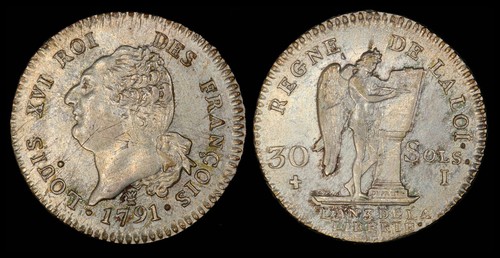
French 30 Sols
1791–1793 (French Revolution)
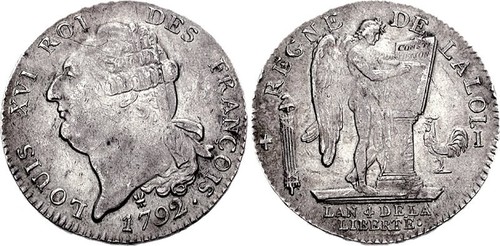
French Constitutional Ecu
1792
30 Sols (Half Ecu)
1791
Constitutional Ecu
1792
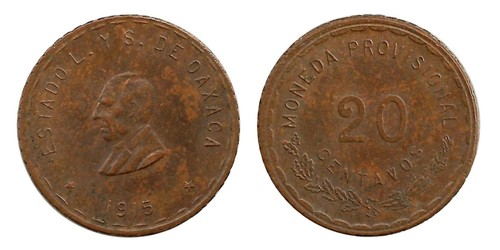
Oaxaca 20 Centavos
1915 (observed); Mexican Revolution provisional issue
Puebla 20 Centavos
1915
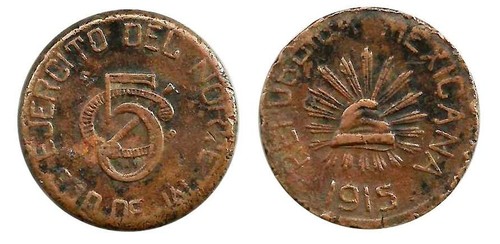
Jalisco 5 Centavos
1915
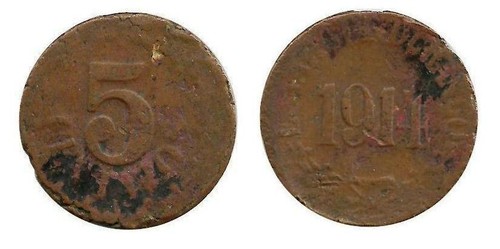
Durango 5 Centavos
1914
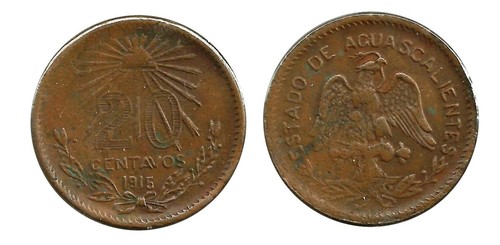
Aguascalientes 20 Centavos
1915
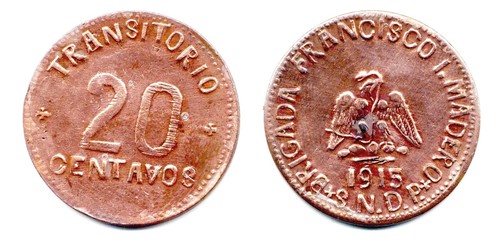
Chiconcuautla 20 Centavos
1915