Oaxaca 20 Centavos
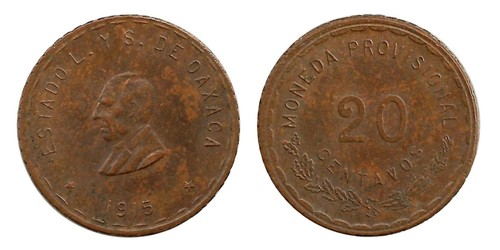
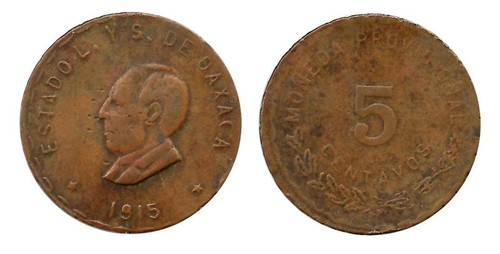
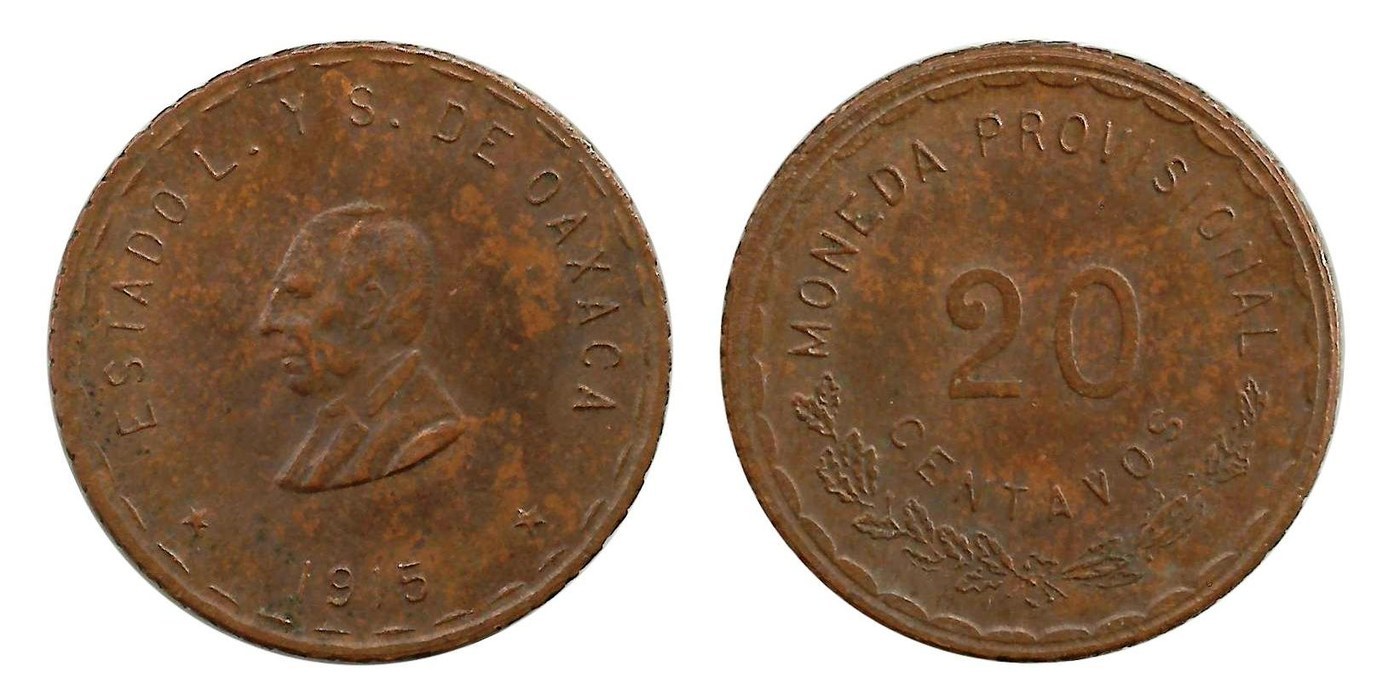
A copper 20 centavos struck by revolutionary-era Oaxaca in 1915, showing a profiled bust on a round base and a large numeral 20 with the Mexican eagle.
- Country
- Mexico
- Denomination
- 20 Centavos
- Metal
- Copper
Got a coin like this?
Identify any coin from a photo, free.
Overview
The Oaxaca 20 centavos is a provisional coin issued by the southern Mexican state of Oaxaca during the Mexican Revolution. The example here is a copper piece dated 1915. One side carries a profile bust set on a distinctive round base, while the other shows a large numeral 20 for the denomination together with the Mexican national eagle.
Coins like this were produced by a regional authority rather than the central national mint, part of the wave of state and factional money that circulated when normal coinage supply broke down during the revolution. The 20 centavos was a minor denomination in the decimal system, in which one hundred centavos made a peso.
Collectors treat Oaxaca revolutionary coinage as a distinctive and historically charged series. This copper 20 centavos is a base-metal minor issue, so its interest is tied to its wartime origin and design rather than to bullion content.
History & Background
During the Mexican Revolution the country fragmented into competing factions and regions, and the flow of coinage from the central mint was disrupted. In response, the Provisional Government of the State of Oaxaca produced its own money, and pieces dated 1915 belong to this emergency, state-level issue rather than to regular federal coinage.
The profile bust on the obverse follows the pattern of Oaxaca's revolutionary coinage, which is closely associated with Benito Juarez, the Oaxaca-born Mexican statesman long honored on the state's money. The reverse pairs the value with the Mexican national eagle, the country's coat of arms rooted in the Aztec legend of an eagle on a nopal cactus at the founding of Tenochtitlan.
Oaxaca's provisional series spanned many denominations and was made in both cast and struck forms, which is why surviving pieces vary widely in surface and sharpness. As locally produced emergency money, these coins were made under difficult conditions, and their character reflects the improvised nature of revolutionary-era regional minting.
How to Identify
Look for a round copper coin with a profile bust set on a rounded base on one side and a large numeral 20 accompanied by the Mexican national eagle on the other. The date, here 1915, and legends naming the issuing authority and the state of Oaxaca help confirm the attribution.
The coin is copper, showing brown to reddish tones where original surface remains, and belongs to the minor end of the denomination range at twenty centavos. Because the series includes both cast and struck pieces, examine the surface and edges: cast examples can show grainier fields and softer detail than struck ones.
Identification rests on the combination of the round-based bust, the numeral 20 with the spread-winged eagle, the 1915 date, and the Oaxaca provisional legends together. Confirm the exact variety, method of manufacture, and any die differences against published references for the Oaxaca revolutionary series.
Value & Collectibility
As a copper minor coin from a revolutionary provisional series, the Oaxaca 20 centavos draws collector interest for its history, but individual values depend heavily on variety, method of manufacture, and condition. Struck pieces, sharper detail, and problem-free surfaces generally command more than grainy or heavily worn examples.
Because the Oaxaca series was made in both cast and struck forms and across numerous varieties, correct attribution matters: some varieties are notably scarcer than others, and cast versus struck distinctions can affect desirability. Value is not tied to metal content, since these are base-copper pieces.
For a realistic sense of worth, match the specific variety and grade against recent sales of comparable Oaxaca revolutionary coins, and treat surfaces, wear, and originality as the main drivers. Provisional revolutionary coinage is also a frequent target of reproduction, so authentication can be important before assigning value.
Frequently asked questions
What is the Oaxaca 20 centavos?
It is a 20 centavos coin issued by the Provisional Government of the State of Oaxaca in Mexico during the revolution. The example here is copper and dated 1915, a regional emergency issue rather than a regular federal coin.
Who is on the obverse?
The obverse shows a profile bust on a rounded base, in the style of Oaxaca's revolutionary coinage, which is associated with Benito Juarez, the Oaxaca-born Mexican statesman honored on the state's money. Confirm details against a reference for the exact variety.
Why did a single state issue its own coins?
During the Mexican Revolution the supply of coinage from the central mint was disrupted, so states and factions, including Oaxaca, produced their own provisional money to meet local needs. These issues circulated as emergency currency.
Is it silver or copper?
This 20 centavos is copper, a base-metal minor coin. Its collector value comes from its revolutionary history and design rather than from precious-metal content.
Are these coins ever faked?
Yes. Revolutionary provisional coinage, including Oaxaca issues, is a common target for reproductions and casts. Because the genuine series itself includes cast and struck varieties, authentication by a specialist is worthwhile before relying on a valuation.
Oaxaca 20 Centavos guides
In-depth guides for identifying, valuing, and collecting Oaxaca 20 Centavos.