
How to Identify the Oaxaca 20 Centavos
A collector's checklist for the 1915 Oaxaca provisional 20 centavos: the round-based bust, numeral-and-eagle reverse, copper fabric, cast vs. struck, and fakes.
Read the full Oaxaca 20 Centavos encyclopedia entry →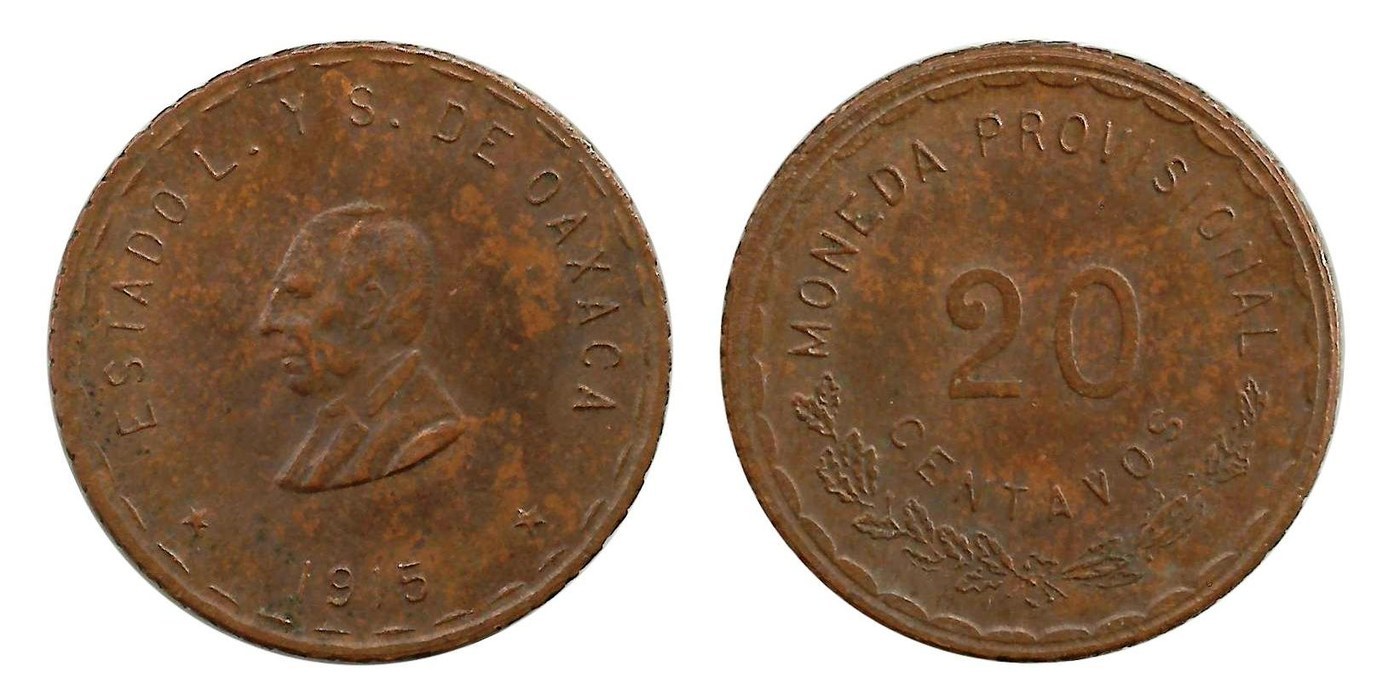
Begin with the two defining sides. One face carries a profile bust set on a distinctive rounded base, a hallmark of Oaxaca's revolutionary coinage. The other shows a large numeral 20 for the denomination alongside the Mexican national eagle. Together on a copper coin, these point to the Oaxaca provisional 20 centavos rather than a regular federal issue.
Read the legends and date. Look for wording that names the state of Oaxaca and the provisional government, and locate the year 1915. These inscriptions separate the coin from ordinary Estados Unidos Mexicanos small change and tie it to the specific revolutionary series. The national eagle confirms Mexican origin, but it is the Oaxaca legends and the round-based bust that pin down the issuer.
Check the physical make-up. This is a copper coin, brown to reddish where original surface survives, in the minor twenty-centavo range. Weigh and measure it and compare against published figures for the Oaxaca 20 centavos, since provisional coins can vary. Crucially, decide whether the piece looks struck or cast: the genuine Oaxaca series exists in both, and cast pieces tend to show grainier fields, softer detail, and sometimes casting seams that are normal for those varieties but must not be confused with modern fakes.
Attribute the variety carefully. The Oaxaca revolutionary series is large, spanning many denominations and die varieties, and small differences in the bust, the eagle, the lettering, and the numeral distinguish one variety from another. Match these details to a specialized reference for the series rather than assuming all 1915 20 centavos are identical, because scarcity and desirability differ by variety.
Be cautious about authenticity and look-alikes. Provisional revolutionary money is widely reproduced, so treat unusually clean, uniformly grainy, or blurry-lettered pieces with suspicion, and watch for re-cut dates or added detail. Because the real coins include cast examples, telling a period cast from a modern counterfeit takes experience. When origin, variety, or value is in doubt, seek an opinion from a specialist in Mexican revolutionary coinage.
Frequently asked questions
What quickly confirms this as an Oaxaca 20 centavos?
Check both sides plus the legends: a profile bust on a rounded base on one face, a large numeral 20 with the Mexican eagle on the other, and inscriptions naming Oaxaca with the 1915 date. That combination on a copper coin identifies the Oaxaca provisional 20 centavos.
How do I tell it from regular Mexican federal coinage?
Regular federal small change lacks the Oaxaca provisional legends and the round-based bust. The national eagle alone is not enough, since it appears on many Mexican coins; rely on the Oaxaca wording and the distinctive bust to confirm the state issue.
Is a cast surface a sign of a fake?
Not necessarily. The genuine Oaxaca series was made in both cast and struck forms, so a period cast can be authentic. The challenge is separating a period cast from a modern counterfeit, which is why matching weight, style, and detail to a reference, or consulting a specialist, is important.
Does the variety matter for identification?
Yes. The Oaxaca revolutionary series has many varieties with small differences in the bust, eagle, and lettering, and some are far scarcer than others. Attributing the exact variety against a specialized reference affects both correct identification and value.