
How to Identify the Aguascalientes 20 Centavos
A collector's checklist for the 1915 Aguascalientes 20 centavos: the numeral-20 and eagle side, copper composition, revolutionary attribution, and authentication cautions.
Read the full Aguascalientes 20 Centavos encyclopedia entry →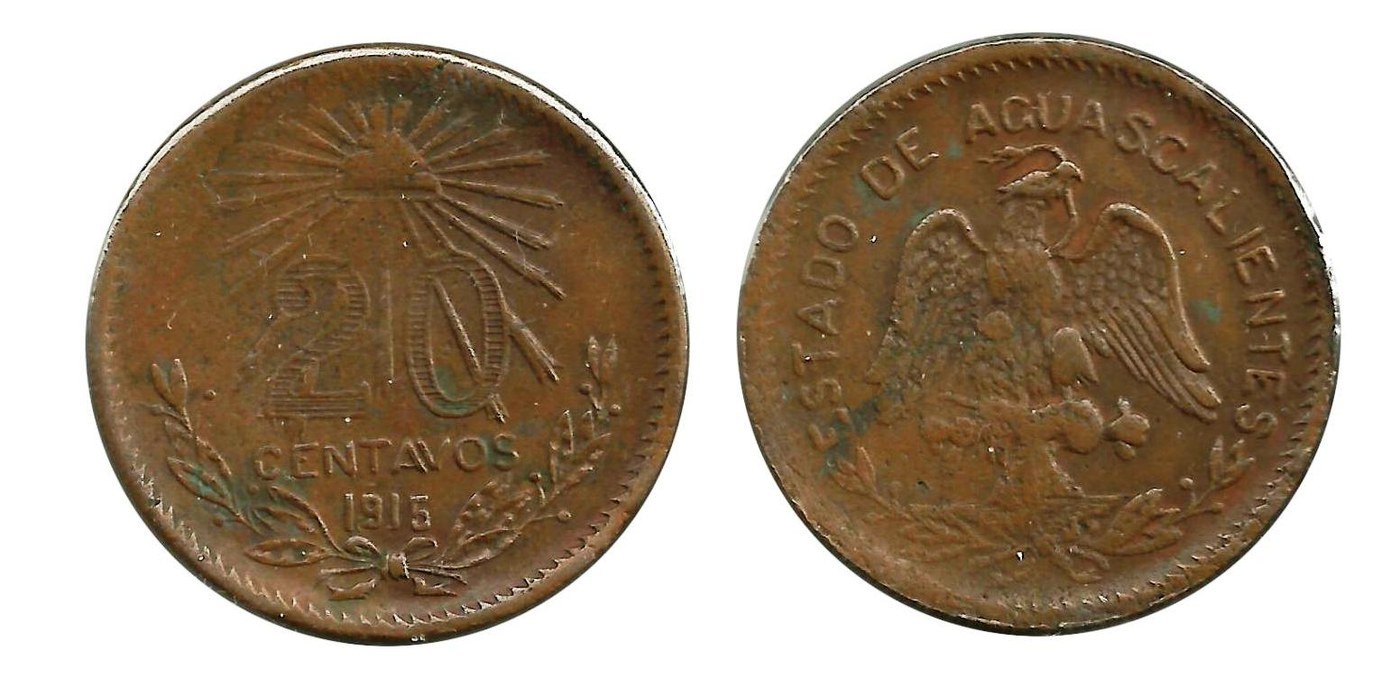
Begin with the two sides together, since neither alone confirms the type. Look for a copper coin bearing the denomination and its design elements on one face and a bold numeral 20, marking twenty centavos, paired with the Mexican national eagle on the other. The eagle ties the coin to Mexico, while the value 20 fixes the denomination. Both features present on a copper coin dated 1915 point toward this revolutionary issue.
Read the date and consider the attribution. The 1915 date places the coin squarely in the revolutionary years, when Aguascalientes and other states produced emergency coinage. Because the attribution to Aguascalientes is what separates this piece from similar 20 centavos struck elsewhere in the same period, match the specific design details, lettering, and eagle style against a reference for Mexican Revolution coinage rather than relying on the denomination alone.
Check the physical traits. This is a copper coin, brown to reddish where original surface remains, of small-change size. As a locally produced revolutionary issue, it is often plainer and less uniformly struck than national-mint coinage, so expect a more workmanlike appearance. Weigh and measure the coin and compare against published figures for the issue; a piece markedly off in size or weight deserves closer scrutiny.
Be alert to look-alikes and misattribution. Many Mexican states and factions struck low-denomination copper coins with a numeral and the national eagle during the revolution, so it is easy to confuse one state's issue with another's. Small differences in the eagle, the numeral, and the surrounding design are what distinguish them, and confident attribution should rest on a direct comparison with catalogued examples.
Approach authentication carefully. Because revolutionary coins are collected and were produced under irregular conditions, both period imitations and modern fakes exist. Watch for casting seams, grainy or bubbled surfaces, and soft, blurry detail that lacks a struck crispness, as well as tooled or re-cut dates. For any coin of significance, seek an opinion from a specialist in Mexican Revolution coinage before relying on the attribution or paying a premium.
Frequently asked questions
What is the fastest way to recognize this coin?
Check both sides of a copper coin dated 1915: the denomination with its design on one, and a large numeral 20 with the Mexican national eagle on the other. That combination, attributed to Aguascalientes, identifies the revolutionary 20 centavos.
How do I tell it from other revolutionary 20 centavos?
Many Mexican states and factions struck similar copper coins with a numeral and the eagle during the revolution. Distinguish them by comparing the specific eagle style, lettering, and design details against a catalogue of Mexican Revolution coinage, since the state attribution is what sets each apart.
Why does the coin look cruder than other Mexican coins?
It was produced locally as emergency coinage during the revolution, not at the centralized Mexico City mint. That improvised origin means a plainer design and a less uniform strike than contemporary federal coins.
How can I spot a fake or misattributed piece?
Look for casting seams, grainy or bubbled surfaces, soft lettering, and re-cut dates. Because revolutionary issues are easily misattributed and were made under irregular conditions, confirm significant coins with a specialist in Mexican Revolution coinage.