
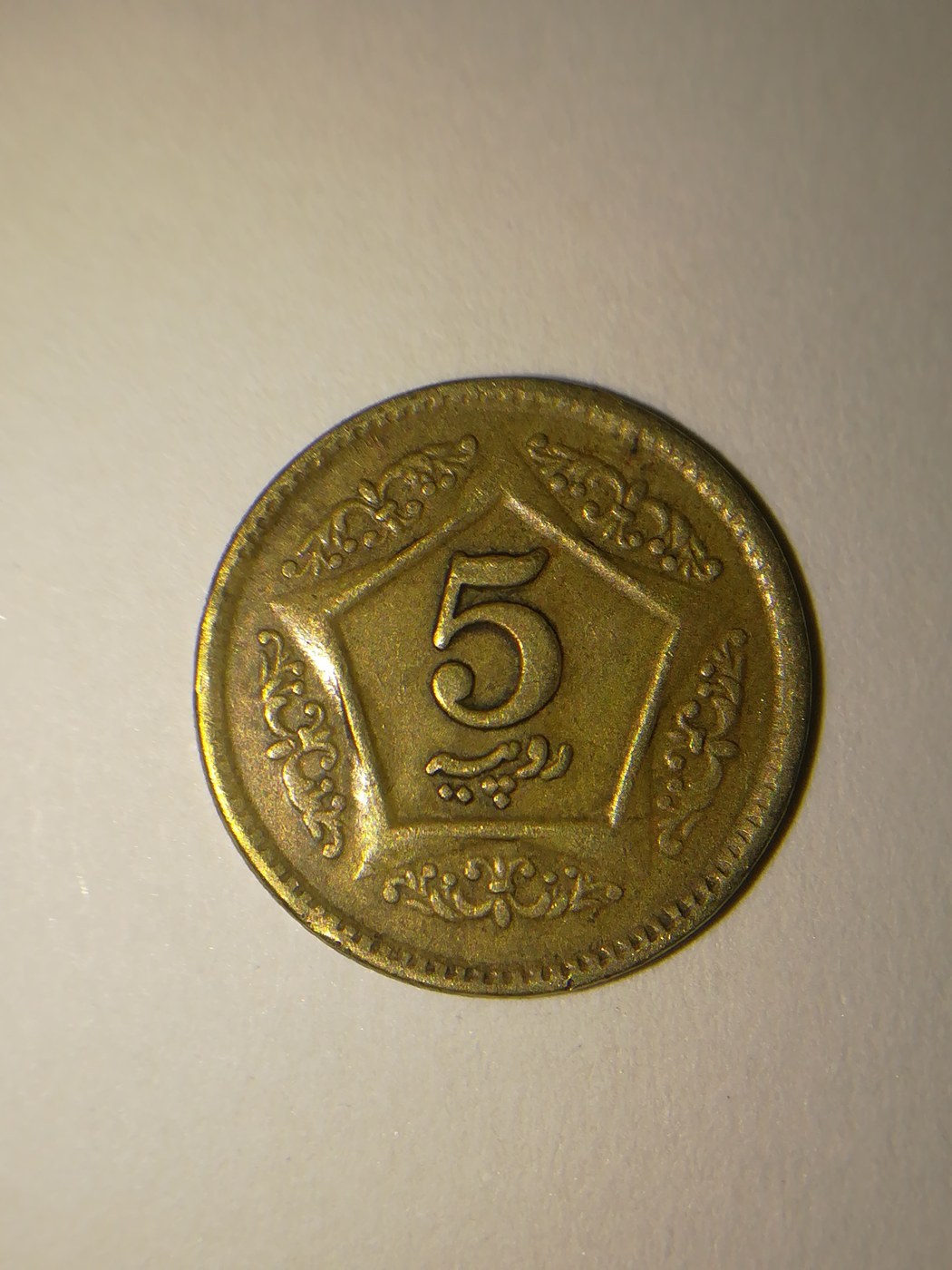
Pakistan 5 Rupees
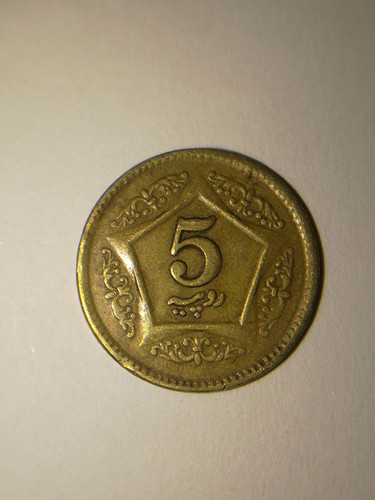
A brass Pakistani five-rupee coin with a large numeral 5 set in an ornamental frame and Islamic-style Urdu calligraphy around both faces.
- Country
- Pakistan
- Denomination
- 5 Rupees
- Metal
- Brass
Got a coin like this?
Identify any coin from a photo, free.
Overview
The Pakistan 5 Rupees seen here is a brass (yellow base-metal) coin of the Islamic Republic of Pakistan carrying the five-rupee denomination. The face shown in our photograph is dominated by a large numeral 5 set inside a shaped panel with a shield-like or hexagonal outline, framed by a border of ornamental Urdu/Arabic script. The opposite face continues the decorative theme with flowing Islamic-style calligraphy rather than a portrait, in keeping with Pakistani coinage tradition.
Because Pakistan is an Islamic republic, its coins avoid human portraiture and instead rely on calligraphy, the state emblem, the crescent-and-star, and value numerals in both Western and Urdu forms. This piece fits squarely in that tradition: the design communicates value and country through lettering and ornament rather than a monarch's or leader's bust.
The five-rupee is one of the higher everyday denominations of the Pakistani rupee (₨, subdivided historically into 100 paisa). Coins of this value and style are a familiar part of 20th-century Pakistani circulating and commemorative coinage.
History & Background
Pakistan has issued its own coinage since independence in 1947, with denominations first in annas and pice and, after decimalisation in 1961, in paisa and rupees. Over the following decades the State Bank of Pakistan introduced progressively higher coin denominations as the rupee's purchasing power changed, moving from small-value paisa coins toward one-, two- and five-rupee pieces.
Pakistani coins are struck at the Pakistan Mint in Lahore for the State Bank of Pakistan. Throughout the 20th century the country produced both regular circulating coins and a series of commemoratives marking national anniversaries, Islamic occasions and notable figures; many of these were struck in brass or nickel-brass and carry heavy use of decorative Urdu calligraphy of the kind seen on this coin.
Without the visible date and full legends it is not possible to pin this piece to a single year, but its brass composition, five-rupee value and ornamental script place it among Pakistan's later 20th-century issues rather than the earliest post-independence coinage.
How to Identify
Start with the denomination face. The clearest diagnostic is the bold numeral 5 enclosed in a shaped frame with a shield-like or hexagonal outline, surrounded by a ring of ornamental Urdu script that typically spells the value (پانچ روپے, "five rupees") and the country name. The lettering is right-to-left Arabic-script Urdu, a strong sign of a Pakistani (or broader South Asian Muslim) issue.
The metal is brass — a warm yellow, gold-toned alloy that is non-magnetic and can darken to a brown patina with handling. The other face carries decorative Islamic calligraphy and, on many Pakistani coins, the crescent-and-star or the state emblem; a Gregorian and/or Islamic (Hijri) date is usually present in the legends. Locating that date is the key to attributing the exact year and any commemorative theme.
Use the combination of value numeral, Urdu script, brass color and the absence of any human portrait to separate this from neighbouring countries' coins. Reading the Urdu legends, or comparing them against a standard catalogue of Pakistani coins, will confirm whether the piece is a regular circulating five-rupee or a dated commemorative.
Value & Collectibility
Circulating Pakistani five-rupee coins are common and, when worn, are generally worth little more than a small collector premium over face value. Their appeal lies in the attractive calligraphy and in completing a set of Pakistani denominations rather than in scarcity.
Value depends on the specific year, whether the coin is a regular issue or a commemorative, and its state of preservation. Uncirculated examples with full brass luster, scarcer dates, and commemorative types tied to a notable anniversary or theme command more than ordinary well-handled pieces.
Because prices vary with grade, date and collector demand, treat any figure as general context rather than a fixed quote. A clean, problem-free coin is inexpensive but collectible; heavily circulated examples trade close to token value.
Frequently asked questions
What country is this coin from?
It is from the Islamic Republic of Pakistan. The Urdu (Arabic-script) legends and the five-rupee value identify it as a Pakistani coin, struck at the Pakistan Mint in Lahore for the State Bank of Pakistan.
Why is there no face or portrait on it?
Pakistan is an Islamic republic and its coinage generally avoids human portraiture. Designs instead use ornamental calligraphy, the state emblem, the crescent-and-star and value numerals.
Is this coin made of gold?
No. Its warm yellow color comes from brass, a base-metal alloy of copper and zinc. It contains no precious metal, though good examples keep a bright golden luster.
What does the writing around the 5 mean?
The Urdu script typically states the denomination — پانچ روپے ("five rupees") — along with the country name, and the coin's date usually appears within the legends.
How do I find out the exact year?
Look for a date in the legends, which may be given as a Gregorian year and/or an Islamic (Hijri) year. Matching the date and inscriptions to a catalogue of Pakistani coins pins down the precise issue.
Pakistan 5 Rupees guides
In-depth guides for identifying, valuing, and collecting Pakistan 5 Rupees.
Other coins you may enjoy
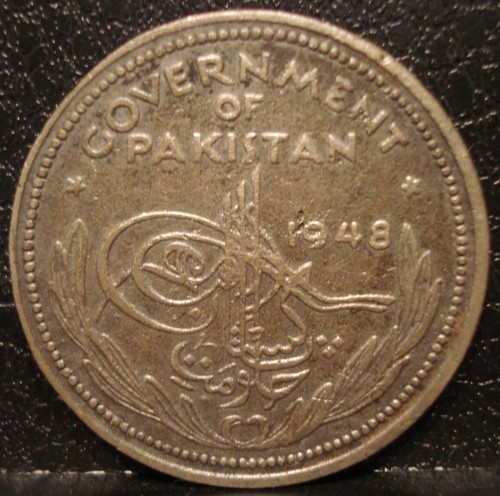
Pakistan One Rupee
1948
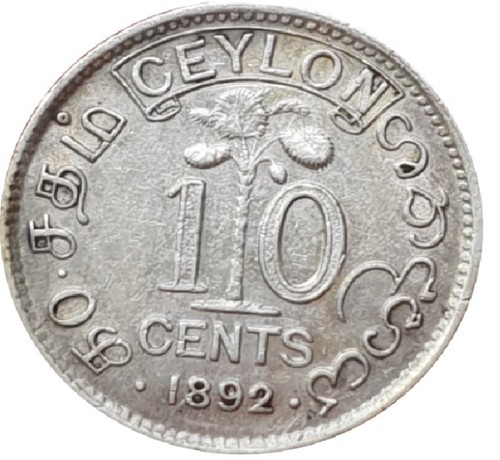
Ceylon 10 Cents (Cupronickel)
1944
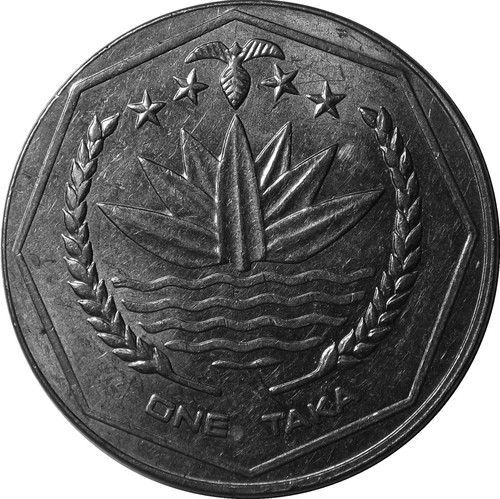
Bangladesh One Taka
Circulating type of the early 2000s; example dated 2002
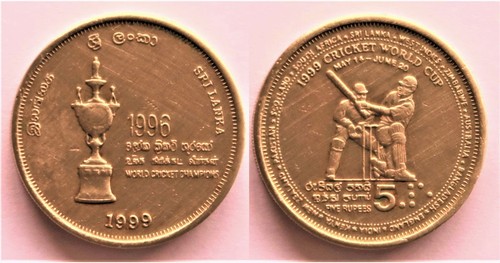
Sri Lanka 5 Rupees
Dated 1999, a commemorative Cricket World Cup issue
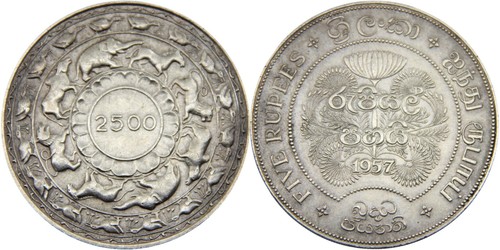
Ceylon 5 Rupees Buddhism Anniversary
Dated 1957, a single-year commemorative issue
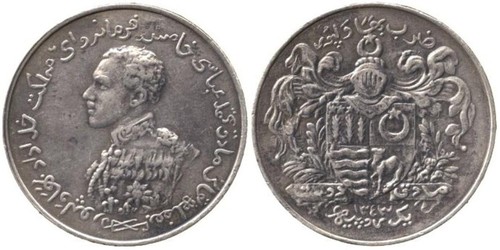
Bahawalpur Gold Coin
19th–20th century
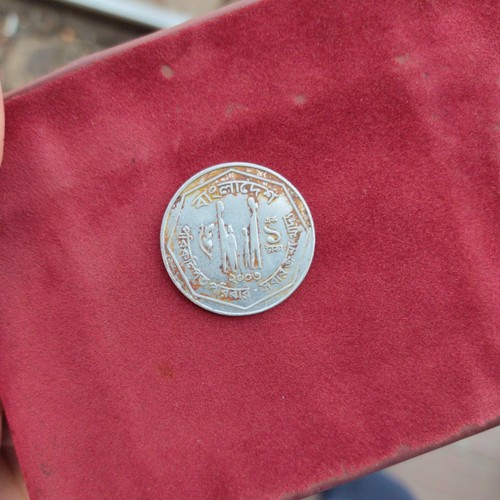
Bangladesh 5 Taka
Modern circulation issue of the People's Republic of Bangladesh; the higher-value Taka coins were introduced from the 1990s onward, with the steel-based 5 Taka belonging to the later composition.