
How to Identify the Pakistan 5 Rupees
A collector's guide to the brass Pakistani five-rupee coin: the numeral 5 panel, Urdu calligraphy, metal, size, dates and look-alikes.
Read the full Pakistan 5 Rupees encyclopedia entry →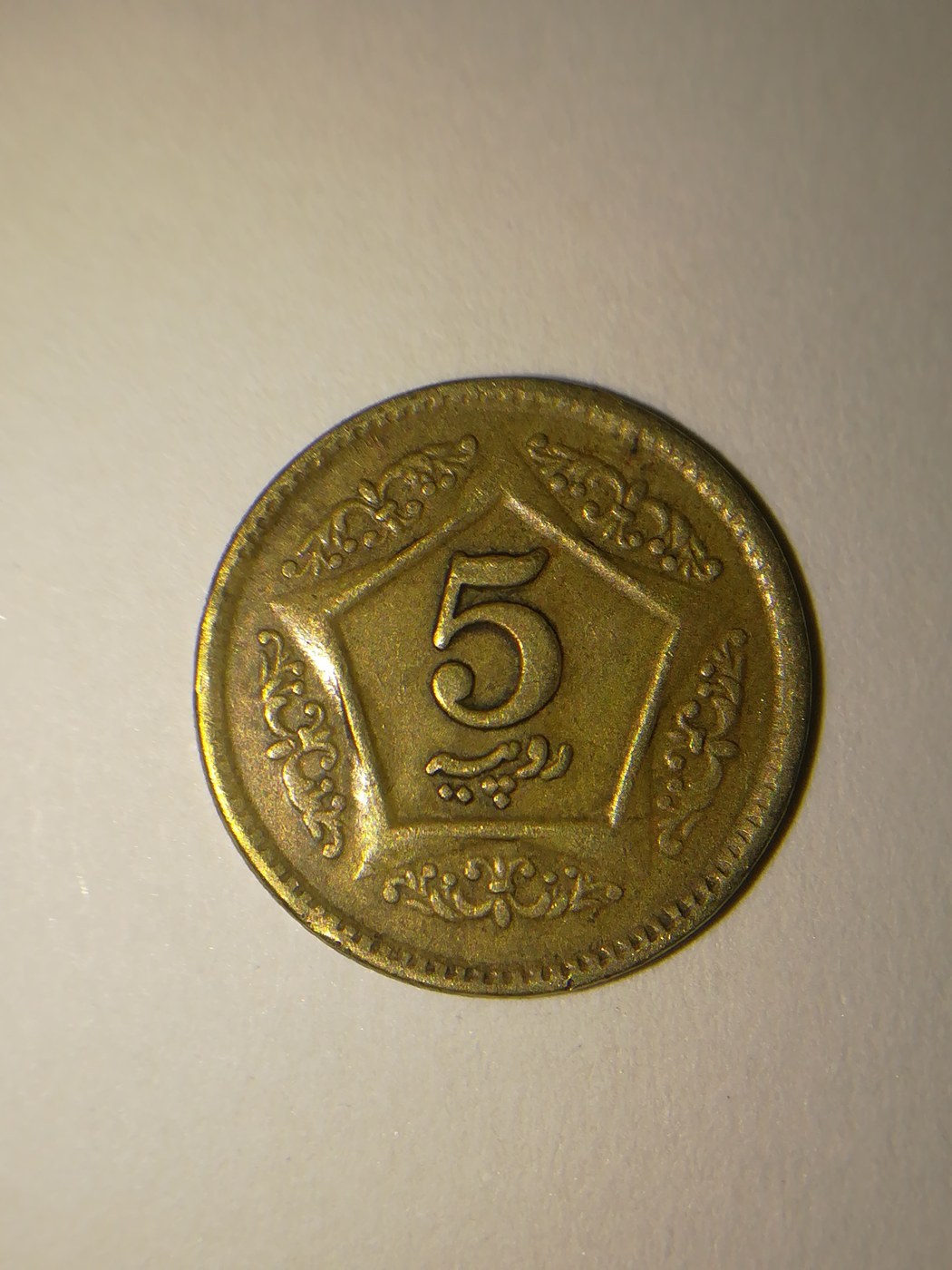
Begin with the value face, which is the quickest identifier. This coin shows a large numeral 5 set inside a shaped panel with a shield-like or hexagonal outline, ringed by ornamental Urdu script. Urdu is written in Arabic script and read right-to-left, so a coin whose lettering flows that way, with no human portrait and a bold Western-numeral value, is almost certainly a Pakistani (or related South Asian Muslim) issue. The word for the denomination, پانچ روپے ("five rupees"), typically appears in the surrounding legend.
Confirm the metal and physical feel. This is a brass coin: a warm golden-yellow alloy that is non-magnetic and tends to develop a brown patina with wear. Brass and nickel-brass five-rupee coins should be weighed and measured and compared against catalogue specifications, since color alone can be mimicked by other alloys. A magnet test helps rule out later steel-based coins, and the absence of a silvery core distinguishes it from cupro-nickel pieces.
Read the second face and the legends for attribution. The reverse carries decorative Islamic calligraphy and, on many Pakistani coins, the crescent-and-star or the state emblem. Crucially, search the inscriptions for a date — Pakistani coins may show a Gregorian year, an Islamic (Hijri) year, or both. The date, together with the exact wording, is what separates an ordinary circulating five-rupee from a dated commemorative and fixes the coin to a specific issue.
Watch for look-alikes. Several South Asian and Middle Eastern countries issue brass or nickel-brass rupee and non-rupee coins with heavy calligraphy and no portrait, so do not assume Pakistan from the yellow metal alone. Neighbouring India, and Gulf states using Arabic script, produce superficially similar coins; the specific Urdu spelling of the denomination and country name is the deciding factor. Mint marks are not a prominent feature of standard Pakistani coinage, so rely on legends and date rather than a mint letter.
Apply the usual cautions. Genuine coins are struck, with crisp lettering and sharp frame lines around the numeral; be wary of cast copies with soft detail, seams or bubbles, and of pieces artificially brightened or plated to imitate gold. When the script is hard to read, photograph both faces and compare them against a reliable reference for Pakistani coins before drawing conclusions about the year or type.
Frequently asked questions
How can I tell this is Pakistani and not from another country?
Look at the script and value. The legends are in Urdu (Arabic script, read right-to-left) and typically spell out پانچ روپے ("five rupees") with the country name. Matching that specific spelling, rather than just the yellow metal, confirms a Pakistani coin.
Where is the date on the coin?
It is usually within the legends on one of the faces and may be shown as a Gregorian year, an Islamic (Hijri) year, or both. Finding it is essential to identifying the exact issue and any commemorative theme.
The coin looks gold — is it valuable?
The golden color is brass, not gold, so the metal itself is not precious. Value comes from the specific date, whether it is a commemorative, and condition; most circulated examples carry only a small premium over face value.
How do I spot a fake or altered coin?
Genuine pieces are struck with sharp calligraphy and clean frame lines around the numeral. Watch for casting seams, bubbles, mushy detail, gold plating, or an incorrect weight and diameter, and verify against a standard catalogue of Pakistani coins when unsure.