
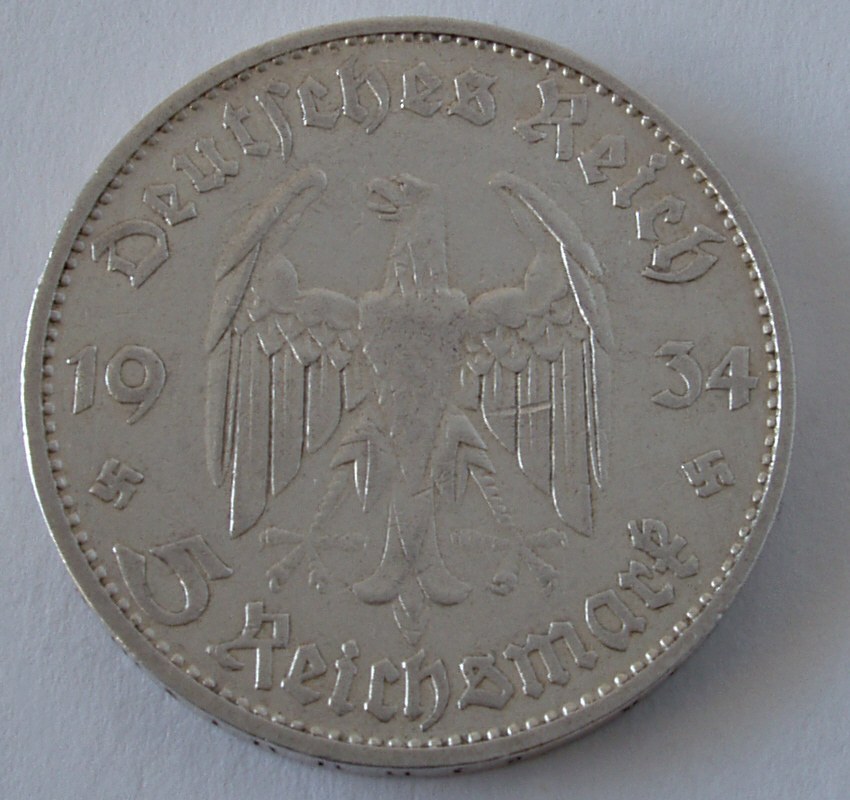
German 5 Reichsmark Garrison Church Commemorative
A 1934 German silver 5 Reichsmark commemorative with a spread-winged Reichsadler and 'Deutsches Reich' on the obverse and the Potsdam Garrison Church reverse.
- Country
- Germany
- Denomination
- 5 Reichsmark
- Metal
- Silver
Got a coin like this?
Identify any coin from a photo, free.
Overview
The German 5 Reichsmark Garrison Church Commemorative is a large silver coin issued in 1934. The face shown here is the obverse, carrying a spread-winged Reichsadler (national eagle), the inscription Deutsches Reich, the split date 19 34, the value 5 Reichsmark, and small mint-mark letters flanking the lower field.
The coin's paired reverse, which gives the type its name, depicts the Garrison Church (Garnisonkirche) at Potsdam. Struck in .900 silver at roughly crown size, it was produced as a commemorative rather than for ordinary daily circulation, and it remains one of the more widely collected German coins of the mid-1930s.
History & Background
The Garrison Church type was issued in 1934 and commemorates the Potsdam Garrison Church, a landmark Baroque church long associated with Prussian and German state ceremony. The reverse motif references the church that hosted the March 1933 state occasion known as the Day of Potsdam.
The coin belongs to the Reichsmark system that circulated in Germany between the mid-1920s and the currency reform after the Second World War. Silver 5 Reichsmark pieces of this era were struck at several German state mints, and the Garrison Church design was produced in more than one variety, including versions with and without an added commemorative date on the reverse.
Because it was minted in substantial quantities across multiple mints, the type survives in collectible numbers today, and it is frequently encountered by collectors of 20th-century German silver.
How to Identify
Obverse (shown): a Reichsadler with wings spread, the legend DEUTSCHES REICH arched above, the date split as 19 34 to either side, the denomination 5 REICHSMARK below, and small mint-mark letters in the lower field. This eagle-and-legend face is the quickest confirmation of the Reichsmark type.
Reverse (not shown on this image): the type's defining side depicts the Potsdam Garrison Church, with lettering identifying it. If you can view the reverse, the church tower is the single clearest indicator of the Garrison Church commemorative versus other 5 Reichsmark designs.
Physical clues: a crown-sized silver coin roughly 29 mm across and about 13.9 g, struck in .900 fine silver with a lettered edge. Genuine examples are non-magnetic, ring with a clear silver tone, and show crisp eagle feathering and lettering.
Value & Collectibility
Value depends on the mint mark, the specific variety, the grade, and silver content. As a .900 silver crown-sized coin, even worn examples carry a premium over face value tied to their silver, while sharp uncirculated pieces and scarcer mint-mark/variety combinations command more.
Because the Garrison Church 5 Reichsmark was produced in large numbers across several mints, common dates and mints are an affordable entry into 1930s German silver, while proofs, top-grade survivors, and the scarcer varieties trade well above the ordinary range. For a specific figure, compare recent sales of the same mint mark, variety, and grade rather than relying on a single catalog number.
Frequently asked questions
What is this 1934 German 5 Reichsmark coin?
It is a silver commemorative from the German Reichsmark era. The obverse shows a spread-winged national eagle with 'Deutsches Reich' and the 5 Reichsmark value, while the reverse depicts the Potsdam Garrison Church, which gives the type its name.
Is the coin made of silver?
Yes. The 5 Reichsmark Garrison Church piece was struck in .900 fine silver at roughly crown size, about 29 mm and near 13.9 g, so its silver content underpins much of its value.
What do the small letters near the bottom mean?
They are mint marks identifying which German state mint struck the coin. Reichsmark coinage of this period was produced at several mints, and the letter helps pin down the exact issue and its relative scarcity.
Why is it called the Garrison Church commemorative?
The reverse depicts the Potsdam Garrison Church. Although that side is not visible in this image, the church design is the feature that names and distinguishes the type.
Is this coin rare?
The type was minted in large numbers across multiple mints, so it is generally accessible to collectors. Value climbs with higher grades and with the scarcer mint-mark and variety combinations.
German 5 Reichsmark Garrison Church Commemorative guides
In-depth guides for identifying, valuing, and collecting German 5 Reichsmark Garrison Church Commemorative.
Other coins you may enjoy
Leif Erikson Commemorative 1000 Króna
2000
Swedish Gold Commemorative
Early 20th century
1 Lats (Christmas Bells)
2012
Romania International Year of Chemistry Commemorative
2011
1 Euro (10 Years EMU)
1999-2009
25 Euro (Bionik)
2012
100 Forint (Commemorative)
commemorative issue
2 Euro (150 Years PSP)
2018
3 Roubles (First All-Russian Coins)
1982
10 Euro (Royal Marriage)
2002
Swiss Shooting Thaler
1934
Sachsen-Weimar-Eisenach 5 Mark Wedding Commemorative
1903-1910