Australian Halfpenny
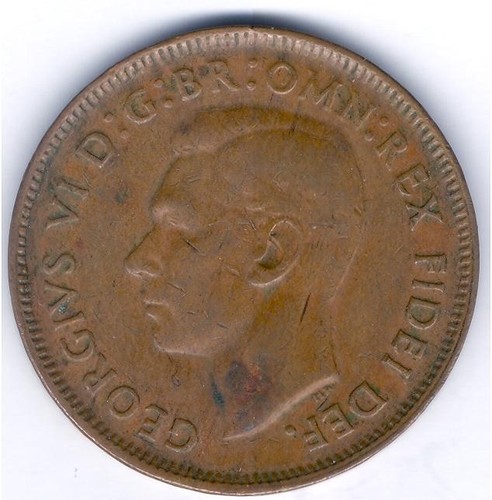
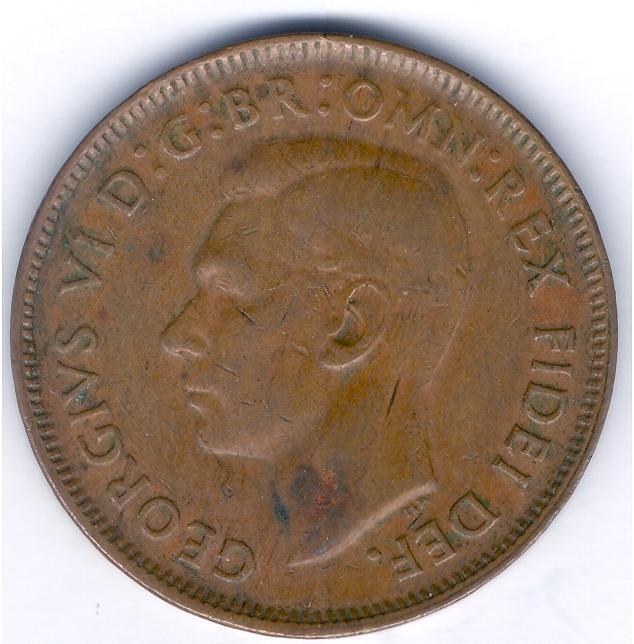
Small bronze pre-decimal Australian half penny; the George VI kangaroo type shown here was struck through the early 1950s.
- Country
- Australia
- Denomination
- Halfpenny
- Metal
- Bronze
Got a coin like this?
Identify any coin from a photo, free.
Overview
The Australian Halfpenny is a small bronze coin worth half of one penny, part of the pre-decimal currency Australia used before the dollar and cent arrived in 1966. The example shown is a King George VI type, with the king's bare head facing left on the obverse and a bounding kangaroo on the reverse, dated 1951.
The obverse carries a Latin royal legend beginning GEORGIVS VI and the abbreviated titles for "King of all the Britains, Defender of the Faith." The reverse pairs the leaping kangaroo, a distinctly Australian emblem, with the words AUSTRALIA and HALF PENNY and the year of striking.
Struck in bronze and measuring roughly 25.5 mm across, the halfpenny was the smallest of Australia's copper-coloured coins. It circulated heavily in everyday commerce, so most surviving examples show honest wear.
History & Background
Australia introduced its own bronze halfpenny and penny in 1911, a decade after Federation, replacing the British copper that had previously circulated in the colonies. Early halfpennies (1911-1936) used a simple text-and-crown reverse under Kings Edward VII and George V.
In the late 1930s the reverse was redesigned with the now-familiar kangaroo by George Kruger Gray, and this bounding-kangaroo type carried the coin through the reign of George VI (1936-1952) and into the reign of Elizabeth II. The 1951 halfpenny falls in the George VI series; by this date the royal title IND:IMP ("Emperor of India") had been dropped from Australian coinage following Indian independence in 1947.
The halfpenny remained in production until 1964 and was demonetised when Australia adopted decimal currency on 14 February 1966. Over its life the denomination was struck at Australian branch mints such as Melbourne and Perth, and in some years at overseas facilities to meet demand.
How to Identify
Read the reverse first. A kangaroo bounding to the right with AUSTRALIA, HALF PENNY, and a date identifies this coin and separates the halfpenny from the larger Australian penny, which uses a very similar kangaroo but is noticeably bigger. The date on this example is 1951.
The obverse shows a bare-headed male portrait facing left with the legend beginning GEORGIVS VI. The presence of George VI, rather than George V or Queen Elizabeth II, places the coin between roughly 1938 and 1952. On 1949-1952 issues such as this one the legend no longer includes the "Emperor of India" title used on earlier coins.
Confirm the physical standards: the halfpenny is bronze (copper-coloured, non-magnetic), about 5.6-5.7 grams, roughly 25.5 mm in diameter, with a plain edge. The penny by contrast is about 30.8 mm and heavier, so size alone reliably distinguishes the two denominations.
Value & Collectibility
Most circulated George VI halfpennies, including the 1951 date, are common and carry modest value, typically a small handful of dollars in worn to average grades. Their appeal is as inexpensive, historically interesting type coins rather than as rarities.
Condition drives most of the price: crisp, lustrous uncirculated examples with full detail command a clear premium over well-worn pieces, and certain scarcer dates and mint varieties in the wider halfpenny series (the 1923 halfpenny being the famous key) are worth far more. A common 1951 in ordinary condition sits at the low end of that spectrum.
Because grade, mint variety, and eye appeal all affect price, treat any figure as indicative only. For a specific coin, check current dealer listings for the same date and grade, or seek a written opinion before buying, selling, or insuring.
Frequently asked questions
What metal is the Australian halfpenny made of?
It is struck in bronze, an alloy of mostly copper with small amounts of tin and zinc. It is copper-coloured and not attracted to a magnet.
What is the animal on the reverse?
A kangaroo shown bounding, an emblem of Australia, alongside the words AUSTRALIA and HALF PENNY and the date. The same kangaroo motif appears larger on the Australian penny.
How can I tell a halfpenny from a penny?
By size and weight. The halfpenny is about 25.5 mm across and 5.6-5.7 g; the penny is much larger at about 30.8 mm. Both use a kangaroo reverse, so measure the coin to be sure.
Is a 1951 Australian halfpenny rare or valuable?
No, it is a common date. Worn examples are worth only a few dollars, though sharp uncirculated pieces bring a premium. The rare key of the series is the 1923 halfpenny, not 1951.
When did Australia stop using the halfpenny?
The halfpenny was struck until 1964 and ceased to be legal tender when Australia switched to decimal dollars and cents on 14 February 1966.
Australian Halfpenny guides
In-depth guides for identifying, valuing, and collecting Australian Halfpenny.