Australian Crown
Australia's only crown (five-shilling) coin, a large sterling-silver piece struck in 1937 and 1938 with a George VI portrait and a crown reverse.
- Country
- Australia
- Denomination
- Crown
- Metal
- Silver
Got a coin like this?
Identify any coin from a photo, free.
Overview
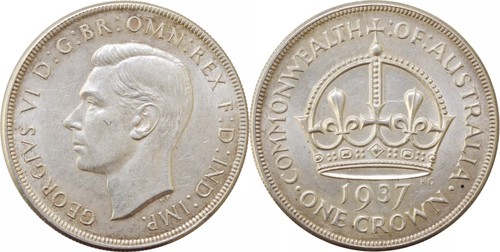
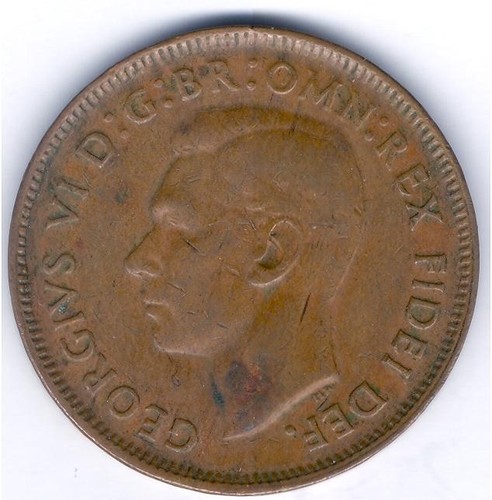
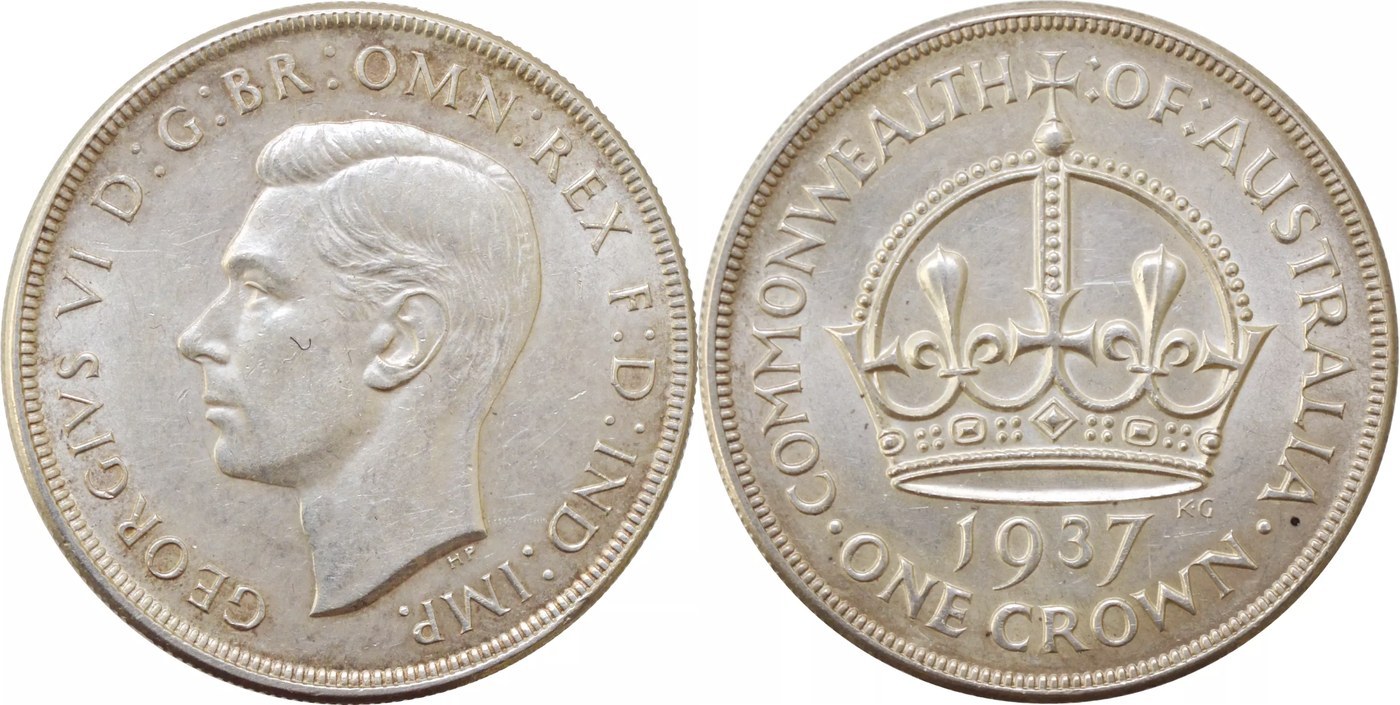
The Australian Crown is a large sterling-silver five-shilling coin and the only crown-denomination coin ever issued for circulation in Australia. The example shown here is the 1937 issue, with a bare-headed portrait of King George VI facing left and the legend GEORGVS VI D.G.BR.OMN.REX on the obverse.
The reverse gives the type its name: a single St Edward's Crown above the words COMMONWEALTH OF AUSTRALIA, with ONE CROWN and the date below. The design is bold and uncluttered, and at roughly 38.5 mm across it is one of the largest coins Australia has struck.
The coin is made of 92.5% (sterling) silver and weighs about 28.3 grams, giving it a substantial silver content. It was produced for only two years, 1937 and 1938, making the complete type short-lived and popular with collectors.
History & Background
The crown was introduced in 1937, the year of King George VI's coronation, and was intended as a prestige large-denomination silver coin for the Commonwealth of Australia. It was struck at the Melbourne Mint. The 1937 obverse portrait of George VI is the work of Thomas Humphrey Paget, while the crown reverse was designed by George Kruger Gray.
The denomination was not a commercial success. Five shillings was a large sum to carry as a single heavy coin, and the piece saw limited everyday use. A second and final issue followed in 1938, after which the crown was discontinued. No Australian crowns were struck for circulation after 1938.
Because it ran for just two years, the Australian Crown stands apart from the country's long-running shillings, florins, and pennies. The 1937 coronation-year issue was produced in the larger quantity of the two dates; the 1938 issue is distinctly scarcer.
How to Identify
Read the reverse first. A single crown above COMMONWEALTH OF AUSTRALIA, with the words ONE CROWN and a date of 1937 or 1938, positively identifies this type. No other Australian coin carries the crown denomination or this reverse.
The obverse shows a bare-headed King George VI facing left with the legend GEORGVS VI D.G.BR.OMN.REX ("George VI, by the Grace of God, King of all the Britains"). Confirm the physical standard: sterling silver (0.925 fine), about 28.3 grams, roughly 38.5 mm in diameter, with a reeded edge.
There are only two dates to distinguish, 1937 and 1938, both struck at Melbourne. The coin carries no visible mint-mark letter. The size, weight, and crown reverse together separate it clearly from the smaller silver florin (two shillings) and shilling.
Value & Collectibility
As a large sterling-silver coin, the Australian Crown always carries a floor of silver bullion value from its roughly 0.84 troy ounce of fine silver, and most examples trade well above that on numismatic demand. The two dates behave differently: the 1937 is the more available coronation-year issue, while the 1938 is scarcer and commands a higher premium.
Condition drives price sharply. Well-worn circulated crowns are affordable and widely traded, while sharp, lustrous examples and certified high grades sell for considerably more. Toning, cleaning, and edge knocks all affect desirability on a coin this size.
Values shift with the silver market and with grade, so treat any figure as indicative only. For a specific coin, get a written opinion from a reputable dealer or a third-party grading service before buying, selling, or insuring.
Frequently asked questions
Is the Australian Crown real silver?
Yes. It is struck in sterling silver (92.5% fine) and weighs about 28.3 grams, containing roughly 0.84 troy ounce of pure silver.
What years was the Australian Crown made?
Only two: 1937 and 1938. It was introduced in George VI's coronation year and discontinued after 1938, so the complete type is just two dates.
What is the Australian Crown worth as money?
The crown was a five-shilling coin, equal to a quarter of a pound in the old pre-decimal system, or five separate shilling coins.
Which date is rarer, 1937 or 1938?
The 1938 crown is the scarcer of the two and carries a higher premium. The 1937 coronation-year issue was struck in larger numbers and is more commonly available.
How much is an Australian Crown worth today?
Circulated examples trade modestly above their silver value, while high-grade and 1938-dated coins bring more. Values move with the silver price and condition, so have a specific coin appraised.
Australian Crown guides
In-depth guides for identifying, valuing, and collecting Australian Crown.