
How to Identify the Australian Halfpenny
Collector checks for the bronze Australian half penny: kangaroo reverse, George VI portrait, size versus the penny, and mint marks.
Read the full Australian Halfpenny encyclopedia entry →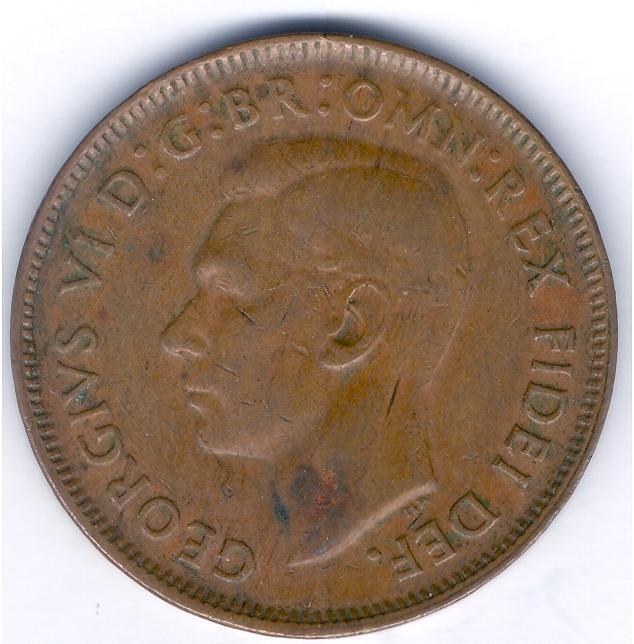
Begin with the reverse, which is the quickest identifier. Look for a kangaroo in mid-bound with the words AUSTRALIA and HALF PENNY and a date below. This confirms both the country and the denomination. If the wording reads ONE PENNY or PENNY, or the coin is clearly larger, you are holding the penny instead, which shares the same kangaroo design.
Turn to the obverse to date the coin by monarch. A bare-headed male portrait facing left with a legend beginning GEORGIVS VI indicates George VI (reigned 1936-1952). A crowned or older bearded portrait would point to George V, and a female portrait to Elizabeth II. On George VI halfpennies dated 1949 and later, the royal titles omit "IND:IMP," so an example like the 1951 shown here will not carry the Emperor-of-India abbreviation that earlier issues do.
Use measurements as a cross-check. A genuine Australian halfpenny is bronze, copper in colour, non-magnetic, about 5.6-5.7 grams, and roughly 25.5 mm in diameter with a plain (smooth) edge. A caliper and a small scale settle the halfpenny-versus-penny question immediately, since the penny is close to 30.8 mm and noticeably heavier.
Check for mint marks, which on this series are small letters or dots placed near the date or the bottom of the reverse. Australian halfpennies were struck at branch mints (such as Melbourne and Perth) and in some years at overseas mints, and the mark can distinguish a common striking from a scarcer one. Because these marks are tiny, examine the coin under magnification and compare against a standard reference or catalogue for the exact date.
Authentication is rarely a concern at this value level, but a few cautions apply. Be wary of coins that are magnetic, obviously the wrong weight or size, or that show a date-and-portrait combination that does not exist (for example, a George VI legend paired with a pre-1938 text reverse). For anything represented as a scarce date or high-grade rarity, confirm the attribution with a reputable dealer or grading service rather than relying on the design alone.
Frequently asked questions
How do I know it is a halfpenny and not a penny?
Measure it. The halfpenny is about 25.5 mm and 5.6-5.7 g; the penny is about 30.8 mm and heavier. Both read AUSTRALIA with a kangaroo, but only the smaller coin says HALF PENNY.
Where is the date and mint mark?
The date sits on the reverse near the kangaroo. Any mint mark is a small letter or dot placed near the date or the lower reverse; use magnification to spot it and compare to a catalogue.
Should the coin stick to a magnet?
No. A genuine Australian halfpenny is bronze and non-magnetic. A magnetic response indicates a steel or plated fake or an unrelated coin.
Which halfpenny dates are worth checking closely?
Common George VI dates like 1951 are inexpensive, but scarcer dates and mint varieties in the series (the 1923 halfpenny being the famous rarity) are worth far more, so verify the date and any mint mark carefully.